
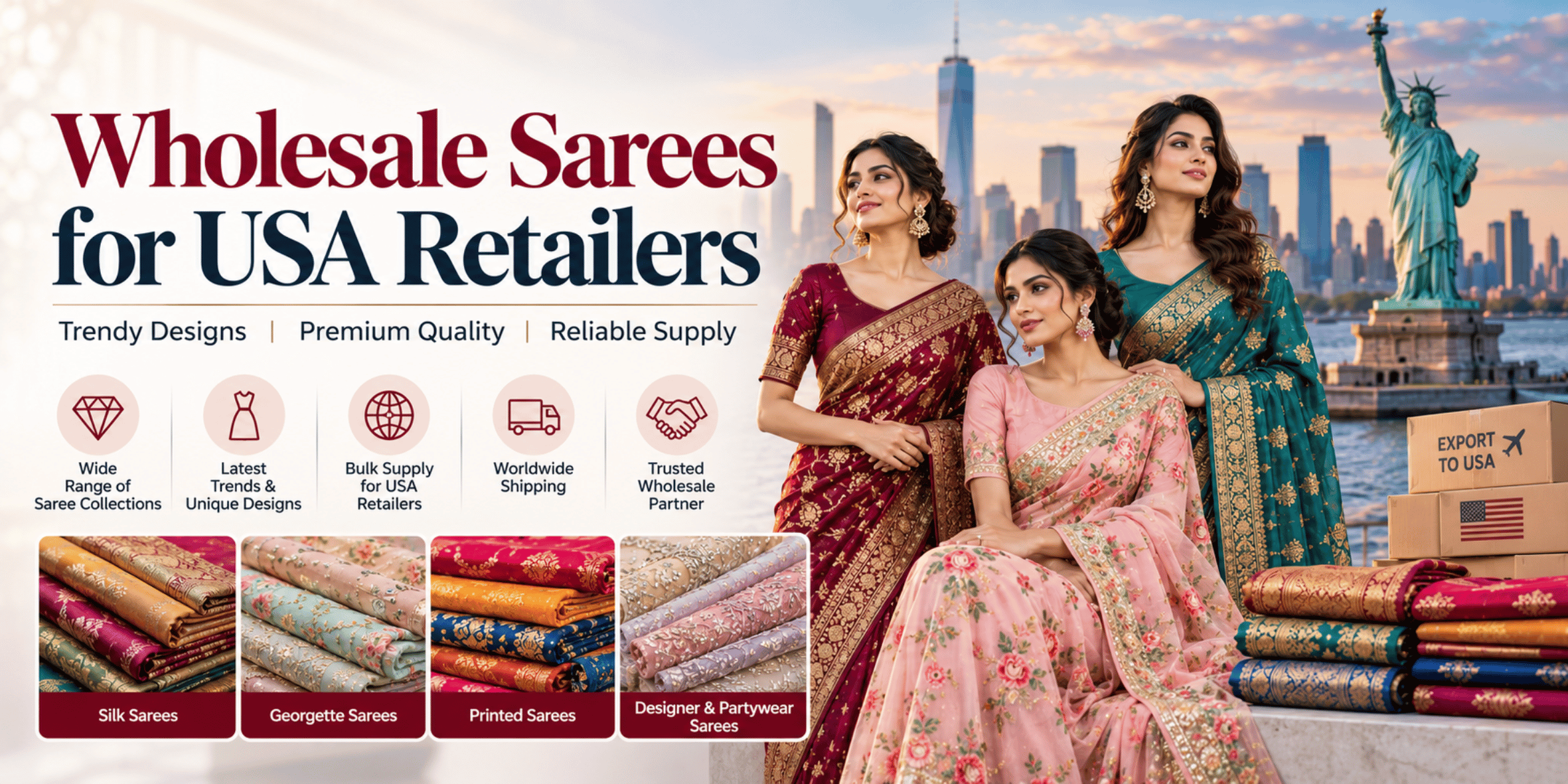
Fashionexport is a Surat-based ethnic wear sourcing partner that helps boutiques, retailers, wholesalers and importers around the world buy Indian sarees directly from manufacturers. If you run a store, an online shop or a pop-up business in America and are searching for Wholesale Sarees for USA Retailers, this two-part guide covers what you need to know before placing a bulk order. It explains which sarees sell best in the US, how to check quality, how pricing and shipping work, and how to choose a dependable partner. Visit Fashionexport to explore current saree collections, and follow Fashionexport on Instagram for new arrivals and fashion updates.
Wholesale Sarees for USA Retailers are sarees that Indian manufacturers and suppliers sell in bulk to businesses in the United States. These buyers include saree boutiques, multi-designer showrooms, Indian grocery and lifestyle stores, online sellers, wedding stylists and importers who resell to smaller shops. Instead of paying retail prices for single pieces, buyers purchase catalogs, design sets or fixed quantities at wholesale rates. That leaves room for freight, duties, store costs and a healthy resale margin.
A good supplier of Wholesale Sarees for USA Retailers does more than sell fabric. The supplier also shares clear photos and videos, explains fibre content honestly, packs goods for long-distance shipping, prepares export documents and answers questions quickly across time zones. For American buyers, the time difference with India makes responsive communication especially valuable.
Key points for quick reading:
Who buys from a wholesale supplier? A boutique owner in New Jersey may want twenty exclusive designs for bridal clients. An online seller in Texas may want lightweight, budget-friendly sarees that ship cheaply. A store in California may want a mix of festive and daily-wear pieces for a diverse customer base. Each buyer has different needs, and a flexible supplier of Wholesale Sarees for USA Retailers can serve all of them with mixed catalogs and sensible minimum order quantities.
How is a wholesaler different from a retailer? A retailer sells single pieces at a price that includes shop rent, marketing and profit. A wholesaler sells in quantity at a lower price per piece, but the buyer commits to a minimum order. A manufacturer-supplier goes one step further by controlling production, which improves consistency, makes customization possible and helps with repeat orders.
Why do US retailers source from India? India is the home of the saree. Weaving clusters across the country produce silk, cotton, linen and handloom fabrics, while Surat in Gujarat is one of the world’s largest hubs for synthetic and blended fabrics, printing, embroidery and finishing. This gives American buyers a wide price range, from premium handwoven pieces to affordable designer-look sarees that suit everyday retail budgets.
What should you expect from a trustworthy partner? Expect clear product details, real photos, reasonable minimums, transparent quotations and support after the sale. Fashionexport works with retailers and importers in more than forty countries, including the USA, UK, Canada, Australia, Malaysia, Fiji and Mauritius, so international orders are a routine part of its work.
The next sections explain why the US market is so strong for sarees, which types sell best and how to judge quality before you order.
The United States has a large and growing South Asian community, and demand for Indian clothing has remained steady for years. Cities and regions with large communities, such as the New York and New Jersey area, the San Francisco Bay Area, Dallas and Houston, Chicago, Atlanta and Washington DC, have active saree shopping scenes. Online sales extend that reach to smaller towns where no ethnic wear store exists. For retailers, this means a loyal customer base that buys sarees for many reasons throughout the year.
Weddings and engagements. Indian weddings in America often run for several days with multiple events, and each event calls for a different outfit. Guests also buy sarees, which multiplies demand beyond the bride and her family. This is one reason Wholesale Sarees for USA Retailers are in constant demand during the wedding season.
Festivals and community events. Diwali, Navratri and Garba nights, Karwa Chauth, Durga Puja, Eid, Holi, Onam, Pongal and Baisakhi all create buying peaks. Temples, cultural associations and university groups also host events where sarees are worn. Retailers who prepare stock four to eight weeks before each festival capture the strongest sales.
Work, culture days and daily wear. Lighter fabrics such as cotton, linen and soft georgette have become popular for office wear, cultural days at work and relaxed gatherings. Customers who want comfort without losing elegance often choose these sarees.
Gifting. Sarees are a traditional gift for family and friends. Gift buyers often prefer ready-to-gift sarees with a matching blouse piece, and they value attractive packaging.
New buyers. Younger customers and customers from outside the South Asian community are discovering sarees for weddings, photoshoots, themed parties and cultural celebrations. They often prefer pre-draped, lightweight or contemporary designs, and they respond well to styling guidance.
What does this mean for a retailer? Demand is year-round but uneven, with strong spikes. A smart buying plan combines evergreen styles that sell all year with seasonal stock for specific festivals. Working with a supplier of Wholesale Sarees for USA Retailers who refreshes catalogs regularly makes that plan easier, because you can add new colours and prints each season rather than sitting on old stock.
What do US customers care about most? Based on common retail feedback, shoppers focus on colour accuracy, fabric feel, comfort, price, delivery time and easy returns. Product photos must match what arrives at the door. Honest descriptions and good packaging protect your reviews and repeat sales.
Online versus store buying. Online sellers need lightweight sarees, strong photography and consistent sizing of blouse pieces. Store owners can stock heavier, more tactile pieces because customers can feel the fabric. Either way, you should test small lots before scaling, and a flexible supplier helps you do that.
How price-sensitive is the market? American buyers will pay a premium for quality and authenticity, but they compare prices online quickly. A balanced range with entry-level, mid-range and premium sarees helps you capture different budgets. When you buy Wholesale Sarees for USA Retailers at the right price and keep landed costs under control, you can price competitively and still protect your margin.
Smart retailers build a balanced range instead of buying only one style. When you speak with a supplier of Wholesale Sarees for USA Retailers, ask which of these categories are available and in what quantities.
Silk sarees. Banarasi, Kanjivaram, Patola and other silk sarees are the first choice for bridal and festive wear. They carry high perceived value and strong margins, but they are heavier and more expensive to ship. Many retailers stock a small, carefully chosen range of silk sarees alongside lighter categories.
Georgette and chiffon sarees. These flowing, lightweight fabrics are among the most popular party wear options. They drape well, travel easily and come in a huge variety of prints, sequins and embroidery. They suit both Indian and non-Indian customers who want an elegant but easy-to-wear saree.
Organza and net sarees. Crisp organza and soft net sarees with embroidery or sequin work are widely used for receptions, sangeet nights and cocktail events. They photograph beautifully and are light enough to keep shipping costs reasonable.
Cotton and linen sarees. Pure cotton, handloom cotton and linen sarees appeal to customers who want breathable, comfortable daily wear. They sell well for work, cultural days and summer events, and they usually sit at friendly price points.
Printed sarees. Digital prints, block prints and floral designs suit casual and semi-festive wear. They are a strong entry-level category for online sellers and for customers buying their first saree.
Embroidered and designer sarees. Sarees with thread work, zari, sequins or stone embellishment target the party and wedding guest segment. Designer sarees with contemporary blouse pieces attract younger buyers.
Bollywood and replica style sarees. Celebrity-inspired sarees in trending colours create social media excitement and tend to sell quickly in the right season.
Ready-to-wear and pre-draped sarees. These are becoming popular with customers who are new to draping. If your supplier offers them, they can widen your market.
How should you build a starter order? Divide your first purchase into three groups:
This structure keeps inventory balanced. It also tells you which segment your customers prefer before you increase quantities of Wholesale Sarees for USA Retailers in later orders.
Colours and tones. Red, maroon, green, royal blue and gold remain strong for weddings. Pastels, dusty pink, sage green and ivory are popular for receptions, engagements and modern festive looks. Black and navy sell well for evening events. Always keep some neutral shades that match many blouse and jewellery choices.
Blouse pieces. Customers expect a matching or contrast blouse piece. Confirm the blouse length and whether it is plain, printed or embroidered. Missing blouse details are one of the most common causes of complaints.
Size and drape considerations. Most sarees are around 5.5 metres plus a blouse piece. Confirm exact lengths, because some customers need longer sarees. Lightweight fabrics are easier for beginners to drape, which makes them popular with first-time buyers.
Fashionexport presents sarees alongside kurtis, salwar kameez, lehengas, gowns and dress materials, so US retailers can explore a wider assortment from a single sourcing partner and cross-sell to the same customers.
Quality is where wholesale buyers protect or lose their margins. A saree that looks beautiful in photos but feels rough, sheds sequins or fades after one wash leads to returns and poor reviews. Use these checks before committing to bulk quantities of Wholesale Sarees for USA Retailers from any supplier.
Confirm the fibre content. Ask whether the saree is pure silk, silk blend, georgette, chiffon, cotton, linen, viscose or polyester. Honest fibre details matter for customer trust and for US labeling rules, so ask suppliers to state the composition clearly in writing.
Feel the fabric. Touch tells you a lot. Silk should feel smooth and soft. Georgette should have a light, slightly grainy flow. Cotton should feel breathable. Linen should feel natural and slightly textured. Fabrics that feel overly stiff, plasticky or rough may be of lower grade.
Inspect the weave and finish. Look at both sides of the saree. A good saree has even weaving, clean edges and no loose threads or snags. Printed sarees should show sharp lines and even colour without smudging.
Check embroidery and embellishment. Sequins, stones, beads and zari should be firmly attached. Gently rub a small area and check for loose pieces. Heavy embellishment on a very light base fabric may cause pulling or tearing over time.
Examine colour consistency. Colours should be even across the body, border and pallu. Ask about colour fastness, especially for dark reds, maroons and blues. If possible, request a small wash test or ask how the supplier tests dyes.
Compare the pallu and border. The pallu and border are the focal point of any saree. Check that motifs are balanced and that borders run straight without puckering.
Check packaging. Sarees should be folded neatly and protected from moisture and dust. Individual poly covers or boxes help during long shipping routes.
Ask for real photos and videos. Studio images can hide details. Request natural-light photos, close-ups and short videos that show drape and movement. A reliable supplier shares these without hesitation.
Order samples first. Before placing a large order, buy a few pieces. Test them for feel, colour, washing behaviour, packaging and delivery time. Samples cost slightly more per piece but remove major risk.
Verify consistency across lots. One good sample does not guarantee that a bulk order will match. Ask how quality is controlled during production and what happens if defects are found.
Understand certification and labeling. For pure silk, ask about Silk Mark or other documentation. For all fabrics, confirm what labels or tags will be attached. US retailers must follow textile labeling rules, and the exact requirements depend on how you import and sell, so check with a qualified customs broker or advisor.
Build a checklist. Create a one-page checklist covering fibre, feel, weave, embellishment, colour, blouse piece and packing. Use it on every shipment. The best sources of Wholesale Sarees for USA Retailers welcome these checks, because informed buyers become long-term customers.
Fashionexport takes a similar approach to ethnic wear sourcing, with clear product information, quality checks before dispatch and responsive support through WhatsApp and email.
Buying directly from India gives US retailers access to the widest variety, the most competitive pricing and the deepest craft knowledge in the saree world. Here is why sourcing Wholesale Sarees for USA Retailers from India, and specifically from a hub like Surat, makes commercial sense.
Unmatched variety. From handloom cotton and Banarasi silk to georgette, chiffon, organza and net, India produces nearly every saree style in existence. Few other countries can match this breadth in a single sourcing relationship.
Competitive pricing. Direct manufacturer pricing, large-scale production and lower labour and material costs create wholesale prices that let US retailers keep healthy margins even after freight and duties.
Surat’s production ecosystem. Surat has weaving, dyeing, printing, embroidery, finishing and packing units in one region. This makes it quick to produce new designs, adjust colours and fulfil repeat orders. Many catalogs launch every month, so retailers can keep their shelves fresh.
Customization and private label. Many manufacturers can change colours, borders, prints, labels and packaging. US boutiques can build an exclusive identity rather than selling the same designs as every competitor. Even small changes, such as a unique colour range or branded packaging, can differentiate your store.
Faster trend response. When a colour or design trends on social media, Indian manufacturers can often produce similar styles quickly. This lets retailers ride trends without overstocking.
Single-source convenience. Customers who buy a saree often buy blouses, kurtis, salwar suits or lehengas for the same occasion. A supplier with multiple categories lets you cross-sell and increase basket size.
Export experience. An export-focused supplier understands packing, invoicing and courier options, and it can guide first-time importers. Fashionexport serves buyers in more than forty countries and publishes information pages on international buying, shipping rates and logistic partners.
What are the challenges? Honest buyers should consider the risks. Lead times and shipping can be longer than domestic sourcing. Duties, taxes and trade rules can change. Colours can look slightly different on screen than in person. Minimum order quantities may tie up cash. Time zones can slow communication.
How can you manage these risks? Start with a sample order, plan purchases well ahead of peak seasons, keep a buffer for shipping delays, confirm landed cost before finalising prices and keep written records of every agreement. A reliable supplier of Wholesale Sarees for USA Retailers will help with each of these steps.
When is the best time to place orders? Because transit and customs can take weeks, plan early. For Diwali and the autumn wedding season, many retailers order in late summer. For spring weddings and Holi, orders often go out in winter. Ordering early gives your supplier time to prepare stock and gives you time to photograph and list products.
How do customers benefit? American shoppers get access to richer variety, authentic designs and fair prices. When their saree arrives on time and looks as promised, they return and recommend your store.
Choosing a partner is the most important decision in your sourcing journey. The right source of Wholesale Sarees for USA Retailers will support your business for years, while the wrong one can cost you money, time and customer trust. Use this checklist to compare options fairly.
Verify business credibility. Look for a real address, working phone numbers, a professional email and an active website. Fashionexport lists its Surat address, WhatsApp numbers and email openly on its website, which makes communication and accountability easier.
Study the catalog depth. A strong supplier shows many designs, fabrics, colours and price levels, and updates the catalog often. If the same few sarees appear everywhere, you may struggle to stand out.
Demand honest descriptions. Product pages should state fabric, work type, blouse details and approximate length. If descriptions are vague or copied from elsewhere, ask questions before ordering.
Ask about production capacity. Find out whether the supplier can handle repeat orders and larger quantities without delays. A supplier that works well for twenty pieces may struggle at five hundred.
Check quality control. Ask how sarees are inspected before dispatch, how defects are handled and whether photos or videos are shared before shipping.
Understand customization options. If you want private label work, confirm whether colours, labels and packaging can be customised and at what minimum quantity.
Compare communication quality. Notice how quickly and clearly the supplier replies, especially given the time difference with the US. Fast, specific answers are a strong sign of professionalism.
Review policies. Read the shipping, refund and cancellation policies carefully. Fashionexport publishes pages on international buying, shipping rates, logistic partners and refunds, which gives you a solid starting point for discussion.
Look for US export experience. Ask whether the supplier has shipped to American buyers before, which courier or freight partners it uses and how it handles documentation.
Ask for references and reviews. Customer feedback, marketplace ratings and social media activity all help you judge reliability. Fashionexport’s website shows reviews from buyers in the United States, Malaysia and Australia, and its Instagram page shows regular product updates.
Start with a trial order. Never make your first order your largest. A sample lot lets you test the product, packaging and delivery experience together.
Red flags to avoid:
Questions worth asking every supplier:
Keep a comparison sheet with price, MOQ, lead time, quality notes and communication score. When you compare two or three shortlisted companies side by side, the best partner for Wholesale Sarees for USA Retailers usually becomes clear. The goal is not the cheapest offer, but the most reliable mix of quality, service and value.
Pricing is the first question most buyers ask, yet it is hard to answer with one number because sarees vary widely. Rather than quoting fixed prices that may be outdated, it is better to understand what drives cost so you can judge any quotation with confidence.
What affects the price of a saree?
What is MOQ? MOQ means minimum order quantity. Some suppliers sell by full catalog, some by a fixed number of pieces per design and some by mixed lots. Ask each supplier of Wholesale Sarees for USA Retailers to explain MOQ clearly, including whether you can combine designs and colours. Lower MOQs help new retailers, while higher MOQs usually bring better per-piece pricing.
How do you calculate profit? Use landed cost, not just the supplier price. Landed cost equals product cost plus packing, freight, insurance, customs duty and taxes where applicable, payment fees and local handling charges. As a simple illustration, if a saree lands at 100 dollars in total cost, selling it at 160 to 200 dollars can create a healthy margin depending on your market. This is only an example, so calculate with your own costs and local competitor prices.
Duties and trade rules. US import duties, tariffs and trade rules have changed several times in recent years, and they can change again. Always confirm the current rate for your product category and country of origin with a licensed customs broker before you finalise your selling price. Never assume last year’s duty rate still applies.
Payment terms. Wholesale suppliers commonly ask for advance payment or a partial advance with the balance before dispatch. Payment options may include bank transfer, payment gateways or other methods. Confirm accepted methods, currency and bank charges in writing. Fashionexport’s website offers multiple currencies for browsing, including USD, and buyers should confirm payment terms for each order directly with the team.
Protect yourself in every transaction. Get a written quotation or proforma invoice with product details, quantity, price, delivery timeline and payment terms. Keep chat records. Pay only to the account named on the invoice.
Customization and private label. Many manufacturers can adjust colours, borders, designs, tags and packaging. Customization usually means higher MOQs and longer lead times, so plan early. Start small, for example with an exclusive colour range, and expand when you see how customers respond.
Sampling. Sample pieces usually cost more per piece and may include shipping fees. Treat them as low-cost insurance. Ask whether sample costs can be adjusted against a confirmed bulk order.
Seasonal pricing. Prices and availability can tighten during peak seasons because demand and production pressure rise. Ordering ahead of festivals and wedding seasons helps secure better availability.
Negotiation tips. Be specific about quantities, ask about combined orders and discuss repeat-order terms. A transparent supplier of Wholesale Sarees for USA Retailers will share a clear price breakdown and explain any changes. Building a long-term relationship often brings better terms than pushing for the lowest price on one order.
Exchange rates. Currency movements between the dollar and the rupee can affect quotations. Confirm the currency of your invoice and review pricing before each new order.
Importing from India is manageable when you understand each step and work with a supplier who has shipped to America before. Here is a simple roadmap from inquiry to delivery.
Step 1: Inquiry and catalog sharing. Share your target customers, budget, preferred fabrics, colours and quantity. The supplier should reply with relevant catalogs, photos and videos. Fashionexport buyers usually start through the website, WhatsApp or email.
Step 2: Quotation and samples. Receive a written quotation with price, MOQ, lead time, packing details and shipping options. Order a small sample lot if you are new to the supplier.
Step 3: Order confirmation and payment. Confirm the final design list, quantities and colours. Pay the agreed advance against a proforma invoice.
Step 4: Production, quality check and packing. The supplier prepares or pulls stock, checks each saree and packs it to protect against moisture, dust and crushing. Ask for photos of the packed cartons.
Step 5: Export documents. Typical paperwork includes a commercial invoice, a packing list and a shipping document such as an airway bill or bill of lading. Your customs broker will tell you what else is needed.
Step 6: Choose the shipping method. International courier suits small and urgent shipments, air cargo suits medium volumes and sea freight suits large, non-urgent consignments. Lightweight sarees such as georgette, chiffon and cotton cost less to ship than heavy silk. Fashionexport provides shipping policy and logistic partner information for buyers.
Step 7: US customs clearance. Shipments entering the United States go through US Customs and Border Protection. Importers often work with a licensed customs broker who classifies the goods, calculates duties and files entry paperwork. Rules about low-value shipments and duty exemptions have changed in recent years, so confirm current requirements before every shipment.
Step 8: Textile labeling and compliance. US rules require textile products to carry correct fibre content, country of origin and identification information, and care instructions are generally required for clothing. Requirements can differ by product type, so confirm with your broker or a compliance advisor which labels your sarees need and whether your supplier can attach them before shipping.
Step 9: Delivery and inspection. Inspect the parcel on arrival. Count the pieces, compare them with the invoice and photograph any damage before opening everything. Report problems quickly, following the supplier’s stated policy.
How long does shipping take? Transit time depends on the method, customs processing and season. Courier is usually fastest, while sea freight is slowest but most economical for bulk. Add buffer time for festivals, holidays and peak seasons.
How to reduce shipping costs. Choose lightweight fabrics where possible, consolidate several designs in one shipment, select the right shipping method and order before peak periods.
Common mistakes to avoid. The most frequent errors are ignoring duties in pricing, ordering during peak season without a buffer, skipping label checks, skipping packaging checks and failing to keep documents. Another mistake is choosing a supplier without checking export experience. Working with a specialist in Wholesale Sarees for USA Retailers who understands American shipping saves time and prevents costly surprises.
Returns and damages. Discuss policy in advance. Ask what counts as a valid complaint, how quickly you must report it and how replacements or credits are handled.
Building repeat business. After your first successful shipment, set a regular ordering rhythm, such as every two or three months, tied to your sales calendar. Repeat orders improve pricing, priority and communication.
Buying well is only half the job. Selling well turns stock into cash. These practical steps help boutiques, online stores and pop-up sellers move sarees faster.
Photograph like a professional. Use natural light, a clean background and several angles: full drape, pallu, border, close-up of fabric and work, and a short video showing movement. Good visuals reduce returns because customers know what to expect.
Write clear product descriptions. Include fabric, work type, colour name, length, blouse details, care instructions and suitable occasions. Use phrases US shoppers actually search for, such as “georgette saree for wedding guest” or “lightweight saree for Diwali party.” Clear details reduce questions and returns.
Create collections, not only listings. Group sarees by occasion, colour or fabric. Collections help customers browse faster and encourage multi-piece purchases.
Time your launches. Announce new arrivals four to six weeks before Diwali, Navratri, Eid and wedding peaks. Keep bestsellers in reserve for reorder.
Use social media well. Instagram suits sarees because the product is visual. Post reels showing drapes, close-ups and styling ideas. Fashionexport shares fashion updates on its Instagram page, a good example of consistent visual storytelling, and retailers can follow it for ideas and new arrivals. Use WhatsApp broadcast lists and email newsletters to reach repeat customers, and encourage buyers to share photos wearing your sarees.
Educate new customers. Many American shoppers are new to sarees. Offer short guides on draping, blouse styling, petticoat choice and care. Pre-stitched or ready-to-wear options can convert first-time buyers.
Offer styling and fit support. Suggest blouse patterns, jewellery and footwear. Offer blouse stitching or alteration partnerships with local tailors. Customers are more likely to buy a saree when they know how to wear it.
Provide care instructions. Recommend dry cleaning for heavy silk and embellished sarees, gentle washing for cotton and linen, and storage in breathable cloth away from sunlight and moisture.
Price with confidence. Position sarees by quality and occasion, not only by competitor prices. Offer entry-level, mid-range and premium options. Bundle a saree with stitched blouse service or accessories to raise order value.
Track what sells. Record which colours, fabrics and designs sell fastest and use that data in your next order. Reorder winners, clear slow movers with seasonal offers and share findings with your supplier so future catalogs match your customers’ taste.
Handle returns gracefully. Set a clear return policy and follow it consistently. Fast, polite service turns possible complaints into loyal customers.
Build community trust. Partner with local cultural groups, temples, student associations and wedding planners. Host small styling events or trunk shows. Share customer testimonials and behind-the-scenes content. Trust drives repeat business in ethnic wear more than any discount.
A supplier that supports your sales, not only your purchase, makes a difference. A collaborative source of Wholesale Sarees for USA Retailers will share new arrivals, trend notes and reorder guidance so you grow steadily instead of guessing. Fashionexport is one such sourcing option for retailers who want sarees along with wider ethnic wear categories, and you can view current collections at https://fashionexport.in/ at any time.
What are Wholesale Sarees for USA Retailers?
They are sarees sold in bulk by Indian manufacturers and suppliers to US boutiques, online sellers, stores and importers, usually with wholesale rates, catalog-based ordering, customization and export support.
What is the minimum order quantity for wholesale sarees?
MOQ differs by supplier, fabric and design. Some sell by catalog or set, others by piece. Ask for the exact MOQ in writing and check whether you can mix designs and colours.
Which sarees sell best in the USA?
Georgette, chiffon, organza and embroidered party wear sarees sell well for events. Silk sarees lead bridal and festive demand, while cotton and linen sarees suit daily and work wear. A balanced range works best.
Can I order samples before a bulk order?
Yes. Most suppliers allow sample orders, usually at a higher per-piece price. Samples let you check fabric, colour, work quality and packing before committing to larger quantities.
How long does shipping from India to the USA take?
It depends on the shipping method, customs processing and season. Courier is usually fastest, air cargo suits medium volumes and sea freight suits large orders. Always confirm timelines with your supplier and add a buffer for peak seasons.
Do I have to pay import duty on sarees shipped to the USA?
Duties and trade rules can apply and have changed several times in recent years. Confirm the current rate and requirements with a licensed customs broker before finalising prices.
Do sarees need labels to be sold in the USA?
US rules generally require correct fibre content, country of origin and identification information on textile products, plus care instructions for clothing. Confirm exact requirements with your broker or a compliance advisor.
How do I know a saree is good quality?
Check fibre content, weave neatness, embellishment security, colour evenness and border finishing. Request real photos, videos and samples, and buy from suppliers with clear policies.
Where can I find a reliable supplier?
Compare credibility, catalog depth, quality control, communication and policies. Fashionexport supplies sarees and other ethnic wear to buyers in more than forty countries, including the USA, and can be reached through its website, WhatsApp or email.
Conclusion
Sarees remain one of the most dependable categories in Indian ethnic wear, and American demand continues to be driven by weddings, festivals, daily wear and growing interest from new customers. For retailers, the key to success is a partner who offers honest fabric descriptions, consistent quality, fair pricing and dependable export support. Choosing the right source of Wholesale Sarees for USA Retailers helps you protect margins, delight customers and scale with confidence.
Start small, test samples, calculate landed cost carefully, track your bestsellers and build a relationship with a supplier who values long-term growth. Whether you run a boutique in New Jersey, an online store in California or a pop-up shop in Texas, the same principles apply: verify, sample, compare and reorder what sells.
Ready to source? Visit Fashionexport to explore saree, kurti, salwar kameez, lehenga and dress material collections, and follow Fashionexport on Instagram for new arrivals and fashion updates. If you are comparing options for Wholesale Sarees for USA Retailers, send your requirements to the team and start with a sample order today.