
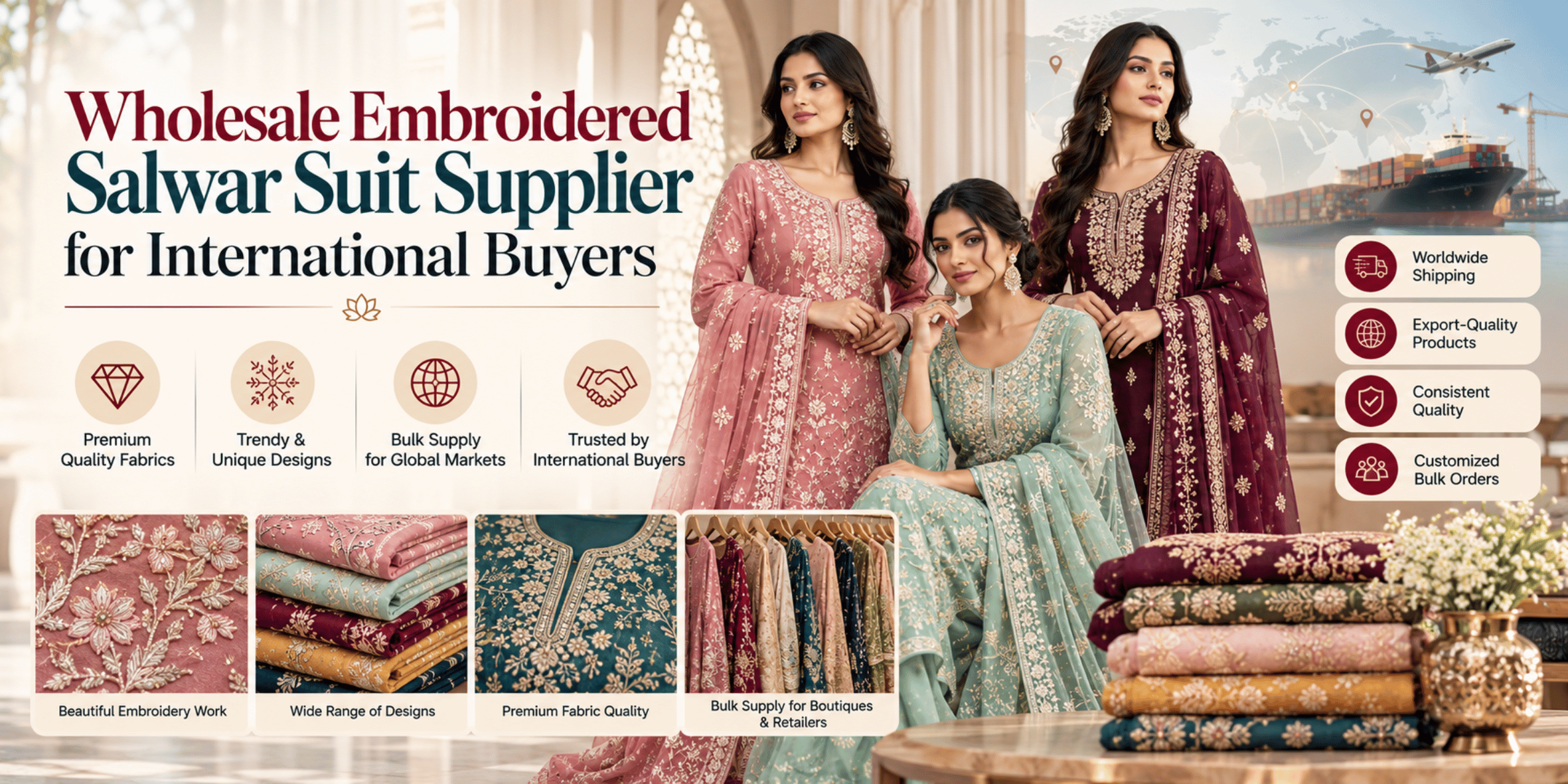
Fashionexport is an Indian ethnic wear sourcing destination for businesses searching for a reliable Wholesale Embroidered Salwar Suit Supplier for International Buyers. Through its website, Fashionexport, the company provides an online point of reference for international buyers exploring Indian ethnic fashion, wholesale clothing collections, and supplier opportunities. Retailers, fashion boutiques, clothing distributors, importers, and online store owners can explore the Indian salwar suit market to identify designs that match their customers, target prices, and seasonal requirements. Buyers can also use Instagram to follow ethnic fashion trends, discover styling ideas, present new arrivals, and understand which embroidered clothing styles may appeal to their audiences.
Embroidered salwar suits are an important category in Indian ethnic wear because they combine traditional craftsmanship with versatile designs for everyday occasions, celebrations, family functions, festive gatherings, and formal events. Their appeal comes from the variety of embroidery techniques, fabrics, colours, silhouettes, and decorative details available in the market. Depending on the collection, embroidery may include threadwork, floral patterns, geometric designs, mirror-work accents, zari details, sequins, or carefully placed embellishments. These options allow retailers to create collections for different customer preferences without relying on a single design style.
For international buyers, sourcing embroidered salwar suits involves more than comparing photographs and wholesale prices. Businesses should evaluate fabric quality, stitching, embroidery finishing, size consistency, colour accuracy, product descriptions, packaging, minimum order quantities, production timelines, and communication with suppliers. These details can influence customer satisfaction, stock management, repeat purchases, and overall profitability. A well-planned sourcing process also helps importers understand shipping costs, customs requirements, delivery schedules, and the documentation applicable to their destination markets.
The right wholesale collection should reflect the needs of the intended customer. Boutiques serving customers who prefer understated clothing may select light embroidery, soft colours, breathable fabrics, and versatile silhouettes. Occasion-wear retailers may focus on richer colours, decorative necklines, detailed sleeves, coordinated dupattas, and more elaborate embroidery. Online sellers may prefer a balanced assortment of designs, sizes, and price points so that they can test customer demand before committing to larger orders.
International buyers should request clear product specifications and confirm the details of every order before production or dispatch. Important information includes the fabric composition, embroidery technique, available sizes, measurements, colour options, included components, care instructions, packaging method, and agreed delivery schedule. Samples can help businesses assess material quality, fit, workmanship, and colour presentation before making a larger purchasing decision. Buyers should also clarify the supplier's policy for handling shortages, damaged products, manufacturing defects, and other order discrepancies.
A strong supplier relationship is built on clear communication, realistic expectations, consistent quality checks, and reliable documentation. Businesses should compare suppliers using the same criteria rather than choosing exclusively on the basis of the lowest quotation. A slightly higher product cost may be justified when the product offers better finishing, more dependable sizing, stronger packaging, or fewer quality problems. The final decision should consider the total landed cost and the suitability of the collection for the buyer's market.
Digital marketing is another important part of selling embroidered salwar suits internationally. Retailers can use Instagram posts, Reels, product videos, and styling guides to demonstrate embroidery details and show how a suit looks when worn. High-quality product photography, informative captions, accurate size charts, and searchable product titles help customers understand the items they are considering. An online store should provide clear descriptions and practical purchasing information rather than relying only on attractive images.
Fashionexport can be explored by businesses researching Indian ethnic wear and wholesale sourcing opportunities. Buyers should communicate their requirements directly and confirm current product availability, commercial terms, minimum order quantities, customization options, and export arrangements before placing an order. With thoughtful product selection, supplier evaluation, and market-specific merchandising, international retailers can build an embroidered salwar suit collection that reflects customer preferences while supporting sustainable business growth.
Fashionexport is a destination for businesses researching Indian ethnic wear, wholesale clothing collections, and international sourcing opportunities. Retailers and importers looking for a Wholesale Embroidered Salwar Suit Supplier for International Buyers should understand how to evaluate designs, fabrics, embroidery quality, pricing, order quantities, and supplier communication before making purchasing decisions. Visit Fashionexport to explore the company's online presence, and follow relevant ethnic fashion trends on Instagram to understand changing customer preferences and merchandising opportunities.
Indian ethnic wear has a broad range of styles that appeal to customers looking for traditional clothing with contemporary design elements. Salwar suits are particularly versatile because they are available in different silhouettes, fabrics, colours, embroidery styles, and levels of decoration. Depending on the design, a salwar suit may be suitable for everyday wear, office gatherings, cultural celebrations, weddings, festivals, and special occasions.
For international retailers, embroidered salwar suits offer the opportunity to serve customers with different budgets and style preferences. Some shoppers prefer lightweight suits with minimal threadwork, while others look for elaborate embroidery and coordinated dupattas for celebrations. A retailer can build a varied collection by combining understated designs, mid-range occasion wear, and premium-looking festive styles.
The demand for a particular design will differ by country, community, age group, season, and retail channel. A boutique serving customers who appreciate traditional South Asian clothing may prioritise classic embroidery and familiar silhouettes. A contemporary fashion store may prefer modern colour combinations, lighter embellishments, and streamlined cuts. Online sellers need to consider product photography, garment measurements, return expectations, and how clearly the design can be presented on a product page.
International buyers should research their intended audience before choosing a collection. Reviewing customer enquiries, sales history, search terms, competitor assortments, and social media engagement can help identify promising categories. The objective is not to purchase every available design, but to select a balanced assortment that serves a defined customer group.
India has an established textile and garment industry with experience in traditional clothing, decorative embroidery, fabric processing, stitching, and garment finishing. Buyers can explore a wide range of products, from relatively simple embroidered cotton suits to heavily embellished festive outfits.
One advantage of sourcing from India is the variety of design directions available. Depending on the supplier and production capabilities, buyers may find floral embroidery, geometric patterns, traditional motifs, contemporary layouts, contrast threadwork, decorative necklines, and coordinated dupattas. This diversity helps retailers create collections that feel distinctive rather than repetitive.
Another consideration is the ability to select different product levels. Entry-level designs may suit everyday retail, while more detailed outfits can be positioned for events and celebrations. Retailers should confirm the actual materials and workmanship of each product instead of assuming that a higher price always means superior quality.
When evaluating a Wholesale Embroidered Salwar Suit Supplier for International Buyers, businesses should assess the supplier's product range, response time, sample policy, order terms, quality-control practices, and ability to meet the buyer's requirements. A supplier should be able to explain what is included in each garment set and which product specifications can be confirmed before an order is finalised.
Before purchasing stock, define the customer segment the collection is intended to serve. Customer understanding affects product selection, selling prices, marketing messages, packaging, and the number of designs required.
Boutiques often want collections that complement their brand identity. Some focus on classic ethnic fashion, while others specialise in contemporary occasion wear. Boutique buyers may value distinctive designs, consistent quality, smaller test orders where available, and the ability to replenish successful products.
Distributors generally need products that can be supplied in commercially practical quantities. They may prioritise repeat availability, predictable sizing, clear product codes, dependable dispatch schedules, and pricing that supports resale through multiple retail channels.
Online businesses need products that photograph well and have clear specifications. Accurate measurements, fabric information, close-up images, colour descriptions, and care instructions help shoppers make informed purchasing decisions. Online retailers should also consider packaging weight, shipping dimensions, and the cost of handling returns.
Importers need to evaluate the entire purchasing process, including export documentation, shipping arrangements, customs duties, taxes, local labelling rules where applicable, and expected delivery times. They should confirm which responsibilities belong to the supplier and which must be managed by the importing business.
Stores specialising in festive and celebration clothing may require more decorative suits, coordinated dupattas, richer colours, and distinctive embroidery. These buyers should consider seasonal buying cycles and allow sufficient time for sampling, production, shipping, and merchandising.
Understanding these segments makes it easier to choose products that fit actual business needs rather than relying on general market assumptions.
Embroidery is one of the most important factors affecting the appearance, positioning, and perceived value of a salwar suit. Buyers should learn to distinguish between embroidery techniques and assess how each design fits the intended market.
Thread embroidery can create floral motifs, vines, borders, geometric patterns, and decorative neckline details. Depending on the thread, stitch density, fabric, and design, the result may look subtle or elaborate. Buyers should examine the reverse side where possible and check for loose threads, uneven stitches, and inconsistent pattern placement.
Zari-style work uses metallic-looking threads or decorative materials to create a traditional festive appearance. It may appeal to customers shopping for weddings, religious celebrations, and special events. Buyers should verify the actual material used and the care instructions, particularly when a product description uses broad terms such as “golden work” or “metallic embroidery.”
Mirror-work designs incorporate small reflective elements into embroidered patterns. They can create a distinctive festive appearance, but their placement and attachment require careful inspection. Retailers should confirm that embellishments are securely fixed and that packaging protects the garment during transportation.
Sequins add sparkle and are often used in party-wear and celebration collections. Buyers should check the attachment quality, distribution of embellishments, fabric comfort, and the likelihood of snagging. Product descriptions should clearly state the decorative features rather than suggesting that all garments have identical embellishment coverage.
Some suits combine printed fabrics with embroidery to create a layered design. This approach can offer visual detail without requiring embroidery across the entire garment. Buyers should evaluate the balance between print and stitchwork and ensure that the actual product matches the catalogue images.
Traditional motifs may appeal to shoppers who prefer familiar cultural patterns, while contemporary geometric or abstract designs can suit modern collections. Retailers can combine both categories to reach a broader customer base, provided the overall assortment remains consistent with their brand identity.
Fabric affects comfort, appearance, durability, garment structure, and price. Buyers should select fabrics according to the garment's intended use and target market.
Cotton suits can be appropriate for everyday wear and warmer conditions, depending on the fabric weight and construction. Embroidery may be concentrated around the neckline, sleeves, cuffs, or hem. Buyers should verify whether the fabric is pure cotton or a blend and ask about shrinkage and washing requirements.
Georgette is commonly used for lightweight, flowing garments and occasion-wear designs. It can work well with decorative embroidery, but the fabric's weight, transparency, lining, and drape should be assessed before ordering.
Chiffon offers a light, fluid appearance and may be used in dupattas or selected garment components. Because it can be delicate or transparent, buyers should check the finishing, lining, and handling instructions.
Silk and silk-blend fabrics can create a rich appearance suitable for festive collections. However, composition varies considerably. Buyers should confirm whether the product uses natural silk, a blend, or a synthetic alternative, and ensure that the product description accurately represents the material.
Rayon and viscose fabrics are used in many styles of ethnic clothing. Their softness and drape can suit particular designs, but care requirements and fabric performance vary. Buyers should ask for the exact composition and recommended washing method.
Crepe and blended textiles may offer different textures and draping properties. They can be suitable for contemporary designs, depending on their weight and construction. Retailers should not select fabric based on a name alone; a physical sample can provide a more reliable understanding of the product.
For every fabric category, buyers should request accurate composition details and verify whether the material is lined, whether the dupatta is included, and how the finished garment should be maintained.
A successful wholesale collection usually offers variety without becoming difficult to manage. The right balance depends on customer demand, available investment, storage capacity, sales channel, and supplier terms.
A practical assortment may include three broad levels:
Everyday embroidered suits: These may feature lighter work, practical fabrics, comfortable silhouettes, and designs suited to regular use.
Smart casual and semi-festive suits: These may include more detailed necklines, decorative sleeves, coordinated dupattas, and a broader range of colours.
Occasion-wear embroidered suits: These may feature heavier embroidery, elaborate patterns, richer fabrics, and more prominent embellishments.
The categories should match the intended market rather than follow a fixed ratio. A retailer serving everyday ethnic wear customers may require more simple designs, while an occasion-wear boutique may need a larger selection of decorative outfits.
A Wholesale Embroidered Salwar Suit Supplier for International Buyers should be evaluated according to the buyer's actual assortment requirements. Before committing to a large purchase, prepare a product list that records the style name or code, fabric, colour, size range, embroidery type, quantity, unit price, and expected dispatch date.
Product quality influences customer satisfaction, reviews, repeat purchases, and the cost of resolving complaints. A detailed evaluation process helps buyers identify problems before they affect a large shipment.
Check the texture, weight, transparency, colour, and overall feel of the fabric. Where practical, assess the material for loose threads, visible marks, uneven dyeing, or defects. If the garment includes a lining, confirm its quality and placement.
Inspect seams, hems, sleeves, side openings, necklines, closures, and other construction details. Stitching should be suitable for the fabric and garment design. Uneven seams or poorly finished edges may create problems after delivery or washing.
Look for loose threads, missing decorative elements, uneven spacing, irregular pattern placement, and rough edges. Embroidery should be appropriate for the design and securely finished. Delicate fabrics require particular care because heavy embellishment can affect drape and comfort.
Request a size chart with actual garment measurements. Confirm how measurements are taken and whether tolerances are allowed. Do not assume that a medium or large size will have the same dimensions across all suppliers or styles.
Catalogue images may differ from the physical product because of lighting, editing, screens, and photography conditions. Request clear photographs or samples and agree on the approved colour reference before production.
A salwar suit may be sold as a set containing a top, bottom, and dupatta, but the components can vary by product. Confirm exactly what is included, whether the bottom is stitched or unstitched, and whether accessories shown in photographs are part of the order.
Whenever feasible, review a sample before confirming a bulk order. Keep the approved sample or a documented reference so that the delivered goods can be checked against the agreed specifications.
Minimum order quantity, commonly called MOQ, is the smallest order a supplier is willing to accept under specified terms. It may apply per design, colour, size, style, or total order value. Buyers should confirm how the supplier calculates MOQ rather than assuming that one quantity applies to the entire collection.
Smaller businesses may prefer to test a limited range before investing in large quantities. Larger distributors may be able to purchase more stock if demand is established. The most suitable order size depends on sales forecasts, available working capital, storage, lead times, and the consequences of unsold inventory.
Before confirming quantities, ask:
Written answers reduce misunderstandings and help businesses compare quotations accurately.
Wholesale price is important, but the lowest quotation is not necessarily the most economical choice. A buyer should compare products with similar specifications and calculate the total cost of bringing the goods into the destination market.
The total landed cost may include the product price, packaging, domestic transport, international freight, insurance where applicable, customs duties, import taxes, clearance charges, currency-conversion costs, and other relevant expenses. These charges depend on the route, product classification, destination, shipping terms, and local regulations.
For a fair comparison, prepare a cost sheet for each supplier. Record the quoted price, quantity, sample cost, shipping estimate, payment terms, production timeline, and any additional charges. Confirm whether the quotation covers the complete salwar suit set or only a particular garment component.
Retailers should also consider expected selling price, payment-processing fees, marketing expenditure, returns, damaged stock, discounts, and operating costs. These factors influence the actual margin.
Rather than selecting a supplier based on price alone, compare the overall value offered. Consistent quality, accurate order fulfilment, clear communication, and reliable production planning can reduce avoidable expenses over time.
International wholesale sourcing depends on clear expectations and dependable communication. A good working relationship begins with a detailed product brief and continues through sampling, order confirmation, production, inspection, shipping, and post-delivery review.
Buyers should share their requirements in writing. Include reference photographs, fabric specifications, embroidery details, size charts, quantities, approved colours, packaging instructions, and delivery expectations. If customization is involved, clarify which elements may be changed and which must remain consistent.
Suppliers should be asked to confirm the order details and communicate any production changes promptly. Buyers should also establish who is responsible for quality inspection, freight booking, export documentation, and resolving discrepancies.
A professional relationship does not remove the need for verification. Businesses should retain quotations, invoices, sample approvals, purchase orders, inspection records, and shipping documents. These records provide a clear reference if a dispute or delivery problem arises.
Digital research allows buyers to compare product categories, review supplier information, and identify designs that may suit their markets. Websites, online catalogues, social media, and direct business communication can all support the sourcing process.
Fashionexport's website, fashionexport.in, is a starting point for businesses researching Indian ethnic wear and wholesale sourcing. Buyers should contact the business directly to confirm its current range, availability, order requirements, pricing, customization capabilities, and export terms before making commercial commitments.
Instagram can also help retailers understand styling trends, visual merchandising, and customer engagement. Buyers can review how brands present fabric details, embroidery, colours, and complete outfits. However, social media content should be treated as a discovery and marketing resource rather than a substitute for sample checks, written specifications, and supplier verification.
A structured sourcing process combines online research with practical evaluation. This helps businesses select products based on evidence rather than photographs or promotional claims alone.
International wholesale orders require careful planning because product selection, sample approval, manufacturing, quality inspection, packaging, and shipping all affect the final delivery date. Retailers should work backwards from their intended launch date to establish a realistic purchasing schedule.
The first step is to finalise the product specifications. Buyers should confirm the selected designs, fabric composition, embroidery details, colours, size ratios, quantities, and packaging requirements. Once these details are agreed upon, the supplier can provide a clearer production estimate.
A business sourcing through a Wholesale Embroidered Salwar Suit Supplier for International Buyers should request a written timeline that identifies key milestones. These may include sample approval, material procurement, production commencement, completion of stitching, final inspection, packing, and dispatch.
Production schedules can change because of material availability, order volume, design complexity, or unexpected manufacturing constraints. Buyers should therefore maintain communication with their suppliers and avoid promising customers a delivery date that has not been confirmed.
For seasonal merchandise, allow additional time for transport delays and customs clearance. A collection intended for a festival or special event may lose much of its commercial value if it arrives after the relevant selling period.
Exporting garments involves administrative requirements that vary by country, product classification, transaction structure, and shipping arrangement. Buyers should understand these requirements before confirming an international order.
Depending on the shipment, relevant documents may include a commercial invoice, packing list, transport document, certificate of origin where required, and other documents requested by the destination country or shipping provider. Additional declarations or certificates may be necessary in particular circumstances.
International buyers should confirm the applicable import duties, taxes, textile labelling requirements, customs procedures, and product regulations with qualified customs professionals or the relevant authorities in their destination market. Requirements should not be assumed to be identical across countries.
When discussing an order with a Wholesale Embroidered Salwar Suit Supplier for International Buyers, ask which export documents the supplier will provide and which responsibilities belong to the importer. Clarify the agreed shipping terms, the party responsible for booking freight, the handling of customs clearance, and the allocation of costs.
The buyer should also ensure that invoice descriptions accurately reflect the products supplied. Fabric composition, garment quantities, product values, and other relevant information should be recorded correctly.
Good documentation supports smoother communication between the supplier, freight forwarder, customs broker, and receiving business. It also creates a useful record for accounting, inventory management, and future orders.
Shipping choices depend on order size, destination, delivery urgency, budget, and the type of products being transported. Air freight may be appropriate for urgent or relatively small shipments, while sea freight may be considered for larger orders when the longer transit time is acceptable. Courier services may suit samples or smaller consignments.
Before selecting a method, buyers should compare the complete shipping cost rather than only the quoted freight rate. Additional charges may include collection, handling, documentation, customs clearance, storage, insurance, and destination delivery.
A business working with a Wholesale Embroidered Salwar Suit Supplier for International Buyers should request an estimated shipping timeline and confirm how the goods will be packed. Lightweight garments can still occupy considerable space depending on folding and packaging methods, so dimensional weight and carton measurements may affect transport costs.
Buyers should also consider shipment tracking, delivery confirmation, and the process for reporting missing or damaged cartons. Where appropriate, clarify whether cargo insurance is available and what it covers.
For the first order, it may be sensible to use a manageable shipment size while assessing the supplier's packing standards, documentation, and dispatch process. Later shipments can be planned using actual delivery experience.
Packaging protects garments during storage and transportation while helping retailers organise their inventory. The correct approach depends on fabric sensitivity, embroidery, shipping duration, destination conditions, and the buyer's retail presentation requirements.
Individual garment packaging can help keep pieces organised and reduce contact with dust or other items. Delicate embroidery may need additional protection to prevent snagging. Garments should be folded carefully so that heavy embellishments do not press against vulnerable sections of the fabric.
For wholesale cartons, buyers should confirm the number of pieces per carton, the size and weight of each carton, the labelling system, and whether the packaging allows efficient counting at receipt. Product codes and size details can simplify stock intake and reduce picking errors.
If retail-ready packaging is required, provide the supplier with exact instructions. This may include branded labels, size stickers, product information cards, or other approved packaging elements. Custom packaging should be discussed early because it can affect cost and production time.
Businesses sourcing from a Wholesale Embroidered Salwar Suit Supplier for International Buyers should confirm whether packaging costs are included in the quoted price. They should also clarify how packaging requirements will be maintained for repeat orders.
Packaging should protect the product without adding unnecessary cost or waste. The appropriate balance depends on the garment's value, shipping conditions, and the expectations of the intended customer.
A strong wholesale collection should offer variety while maintaining a clear commercial identity. Too many similar designs can make a collection difficult to differentiate, while too few options may limit its appeal to different customers.
Retailers can organise their assortment around several themes:
Everyday elegance: Lightly embroidered suits, comfortable fabrics, practical silhouettes, and versatile colours.
Contemporary ethnic wear: Modern cuts, coordinated sets, subtle embellishments, and fresh colour combinations.
Festive collections: Rich colours, decorative embroidery, statement necklines, and coordinated dupattas.
Wedding and occasion wear: More elaborate designs, premium-looking finishes, and products suited to celebrations.
Classic traditional styles: Familiar motifs, traditional colour palettes, and designs intended for customers who prefer established ethnic fashion.
The exact assortment should reflect market research, historical sales, and the retailer's positioning. A boutique that specialises in affordable daily wear should not invest heavily in elaborate occasion wear without evidence of customer demand.
When selecting designs from a Wholesale Embroidered Salwar Suit Supplier for International Buyers, record each product's intended customer, target selling price, fabric, embroidery style, and expected sales period. This information helps buyers assess whether the overall collection is commercially balanced.
Retailers should also consider the relationship between tops, bottoms, and dupattas. Coordinated components can make products easier to merchandise, while clear information about included pieces helps customers understand what they are purchasing.
Inventory management is particularly important when importing products from another country. A large order can reduce the unit price in some circumstances, but it also ties up working capital and increases the risk of unsold stock.
Retailers should begin by reviewing sales history, customer preferences, available storage, seasonal patterns, and the time needed to replenish products. Where sales information is limited, a smaller initial order can provide useful evidence before a larger commitment is made.
Create an inventory record for every design and size. Track the opening quantity, units sold, current stock, returns, damaged pieces, and reorder requirements. This makes it easier to identify successful products and detect slow-moving inventory.
A useful approach is to separate products into three groups:
Businesses should avoid reordering products solely because a supplier offers a bulk discount. The decision should account for demand, storage costs, cash flow, and the risk of style changes.
For a retailer using a Wholesale Embroidered Salwar Suit Supplier for International Buyers, dependable reorder communication can help reduce stockouts without requiring excessive inventory. Buyers should confirm whether successful designs can be repeated and whether fabrics, colours, and embroidery materials will remain consistent.
Retail pricing should cover the full cost of acquiring, importing, storing, marketing, and selling the product. It should also reflect customer expectations and the retailer's position in the market.
Begin with the landed product cost. Add relevant operating expenses, including packaging, fulfilment, payment fees, marketing, customer service, and an allowance for returns or damaged stock. The resulting cost provides a more realistic basis for setting the selling price.
Retailers should compare similar products in their market while checking that the comparison is fair. A lightly embroidered cotton suit should not automatically be compared with a heavily decorated outfit made from a different fabric.
A supplier quotation should identify whether the price is per piece or per complete set, the minimum quantity, payment terms, and any extra costs for customisation or packaging. Buyers should also confirm the currency and the period for which the quotation remains valid.
If purchasing in a foreign currency, exchange-rate changes can affect the final cost. Businesses should account for possible fluctuations when preparing quotations for their own customers.
Profitability should not be judged solely by the margin on one product. Retailers should also consider inventory turnover, discount frequency, repeat purchases, and the cost of acquiring customers. A product with a slightly lower margin may still contribute positively if it sells consistently and requires fewer returns.
Instagram can help ethnic-wear businesses present products visually, build brand recognition, and communicate with potential customers. It is especially useful for showing details that are difficult to explain through a product title alone.
Retailers can use different content formats to communicate the value of a collection.
Use clear photographs showing the front, back, neckline, sleeves, embroidery, and dupatta where included. Close-up images help customers evaluate decorative details, while full-length images demonstrate the overall silhouette.
Short videos can show how a garment drapes, how the embroidery catches the light, and how the outfit looks from different angles. Videos should represent the actual product accurately and avoid filters that significantly change the fabric colour.
Demonstrate how the same suit can be styled for a family gathering, festive event, or everyday occasion. Styling suggestions provide customers with useful context and create opportunities for multiple posts from one collection.
Share content about fabric care, embroidery techniques, size selection, and the differences between garment styles. Informative posts can answer common customer questions and help shoppers make better decisions.
Use Instagram to announce new arrivals, explain collection themes, and direct customers to the relevant product pages. Retailers should ensure that stock availability, pricing, and ordering instructions are accurate.
Businesses sourcing from a Wholesale Embroidered Salwar Suit Supplier for International Buyers can use this type of content to present their retail collections professionally. However, wholesale buyers should obtain permission before reusing supplier photography and should verify that images accurately represent the products they sell.
An effective product page answers a customer's main questions before they need to contact the store. This is particularly important for online ethnic wear, where fabric feel, fit, and embroidery quality cannot be experienced directly before purchase.
Each product page should include a descriptive title, accurate photographs, fabric composition, colour information, available sizes, garment measurements, included components, care instructions, and relevant shipping information.
Product descriptions should explain the garment's actual features. For example, describe the embroidery placement, sleeve style, neckline, fabric texture, and whether the dupatta is included. Avoid unsupported claims such as “pure silk,” “handcrafted,” or “premium quality” unless the product specifications substantiate them.
Size charts should be easy to find and consistent with the garment measurements. Where possible, explain how measurements are taken and whether they refer to the garment itself or the body measurements it is designed to fit.
Retailers should also display realistic delivery estimates, accepted payment methods, and return or exchange conditions. Clear policies help customers understand their options before ordering.
For product pages intended to rank for wholesale searches, include relevant business terms naturally. A phrase such as Wholesale Embroidered Salwar Suit Supplier for International Buyers can be used where it accurately describes the page's purpose, but it should not be repeated unnaturally in every heading or paragraph.
The main goal is to create content that helps users understand the product and helps search engines interpret the page.
Search engine optimisation can help wholesalers, exporters, and retailers attract people searching for relevant products. Effective SEO combines useful content, clear site structure, descriptive product pages, and a technically accessible website.
Choose keywords according to the intended audience and search purpose. A wholesale supplier page may target commercial buyers, while a consumer product page may focus on a specific garment style or occasion.
Related keyword ideas include:
These phrases should be used only on pages where they accurately describe the products and services offered.
Use one clear H1 heading to describe the page's main topic. Organise the rest of the content with descriptive H2 and H3 headings. Logical headings help visitors scan the content and help search systems understand how the information is organised.
Connect relevant blog posts to category pages, product pages, and sourcing information. For example, a blog about embroidered salwar suits could link to a relevant wholesale category if that category exists. Links should help readers navigate rather than simply increase the number of links on a page.
Use descriptive image filenames, relevant alt text, suitable file formats, and compressed images. Alt text should describe the image accurately rather than contain a long list of keywords.
Answer practical questions about product specifications, sampling, minimum order quantities, shipping, and quality inspection. Avoid publishing multiple articles that repeat the same information with only slight wording changes.
A page targeting Wholesale Embroidered Salwar Suit Supplier for International Buyers should provide useful information for business buyers and clearly explain what the supplier actually offers. Search visibility should be treated as a long-term result of relevance, usability, credibility, and content quality rather than a guaranteed outcome of keyword repetition.
Search experiences increasingly provide summaries that draw on information from relevant web pages. Businesses cannot guarantee that a page will appear in an AI-generated overview, but they can make their content easier to understand and evaluate.
Start with a direct answer to the main topic. Explain what the supplier offers, who the products are intended for, and which details a buyer should verify. Follow this with sections addressing common commercial questions.
Use specific and accurate statements. If the business has confirmed information about fabric options, minimum order quantities, sample availability, production timelines, or export arrangements, present those details clearly. If information varies by design or order, explain that rather than giving a universal figure.
Include practical questions and answers where they genuinely help readers. For example:
A useful article about Wholesale Embroidered Salwar Suit Supplier for International Buyers should answer these questions in straightforward language and avoid unsupported claims about quality, pricing, delivery, or market leadership.
Technical SEO also matters. Ensure important content is accessible to search crawlers, use descriptive page titles, maintain logical internal links, and provide accurate structured data when applicable. Structured data should match the visible content and must not be used to make claims that the page does not support.
For wholesale businesses, repeat customers can provide a more predictable source of revenue than relying exclusively on new enquiries. Repeat business becomes more likely when product quality, communication, and order fulfilment meet the buyer's expectations.
Suppliers should maintain clear records of previous orders, approved samples, product codes, specifications, and any agreed customisation. These records make it easier to clarify repeat orders and reduce the risk of misunderstandings.
Buyers should provide useful feedback after receiving a shipment. If a design performs well, they can share the style code, preferred sizes, and reorder quantity. If an issue occurs, they should document it with photographs, descriptions, and relevant order information.
A dependable supplier relationship also requires realistic expectations. Buyers should confirm that a design remains available before advertising a repeat collection. Suppliers should communicate changes in fabric availability, production schedules, or product specifications as early as possible.
For a Wholesale Embroidered Salwar Suit Supplier for International Buyers, maintaining consistent communication is particularly valuable because international orders involve longer lead times and additional logistics. Clear processes help both sides plan inventory, resolve discrepancies, and improve future transactions.
International buyers can reduce purchasing risks by identifying common mistakes before they place an order.
Choosing a supplier based only on price: A low quotation may exclude important costs or reflect different product specifications. Compare equivalent garments and consider the complete landed cost.
Skipping sample approval: Catalogue photographs cannot always show fabric quality, fit, stitching, and embroidery finishing accurately. Request samples when practical and document approval.
Ignoring size specifications: Standard size labels may vary between suppliers. Confirm actual measurements and acceptable tolerances.
Ordering too much too soon: Large orders can tie up capital in products that do not sell. Test demand and review sales performance before expanding the assortment.
Overlooking shipping and import costs: Freight, duties, taxes, clearance, and delivery expenses can materially change profitability. Estimate them before confirming the purchase.
Using unclear product descriptions: Buyers and customers should know exactly which components, fabrics, and embellishments are included.
Failing to document agreements: Verbal discussions may lead to confusion about prices, quantities, delivery schedules, or product specifications. Confirm important details in writing.
Making unverified marketing claims: Do not promise certifications, fabric compositions, delivery dates, or product features unless they can be substantiated.
Ignoring customer feedback: Returns, reviews, and recurring enquiries can reveal problems with sizing, product presentation, or product selection. Use this information to improve future purchasing decisions.
Fashionexport can be explored by businesses researching Indian ethnic wear and wholesale garment sourcing. Its website, Fashionexport, provides a starting point for learning more about the business and exploring relevant information online.
International buyers should directly confirm the current product catalogue, availability, minimum quantities, prices, sample arrangements, customisation possibilities, payment terms, production schedules, and export capabilities. These details should be verified before making purchasing decisions because commercial terms and product availability can change.
A buyer preparing an enquiry can make the conversation more productive by sharing the intended destination country, product category, preferred fabrics, embroidery styles, approximate order quantity, target price range, and required delivery window. Reference images and a list of required sizes can help communicate the brief.
The supplier can then respond to the specific requirements and clarify which options are feasible. Buyers should compare the response with their budget, quality expectations, and delivery needs before proceeding.
Instagram can complement this process by helping businesses follow fashion content, review styling ideas, and present their own collections. For commercial purchasing, however, written quotations, confirmed specifications, and documented terms should remain the basis of the transaction.
Buyers should review product quality, fabric composition, embroidery finishing, size consistency, pricing, MOQ, sample availability, communication, production timelines, packaging, and shipping arrangements. Export documentation and destination-country import requirements should also be considered.
Sample availability depends on the supplier and the product. Buyers should ask whether samples are available, how much they cost, and whether the sample charge can be adjusted against a later order. Sample approval should be documented before bulk production begins.
Options may include cotton, georgette, chiffon, crepe, rayon or viscose, silk, and blended fabrics. The most suitable material depends on the garment design, intended use, embroidery weight, climate, and target price. Composition should always be verified.
Compare garments with equivalent specifications. Consider fabric, embroidery, included components, size range, quantity, packaging, payment terms, shipping, customs-related expenses, and expected delivery time. Calculate the total landed cost rather than comparing unit prices alone.
Request samples, confirm written specifications, check supplier details, document payment and delivery terms, establish an inspection process, and verify shipping arrangements. Start with a manageable order if demand or supplier performance is not yet established.
Yes. Instagram can support visual product discovery through photographs, Reels, styling content, and new-collection announcements. Businesses should use accurate product images, provide clear buying information, and confirm they have permission to use any third-party photography.
Review previous sales, research the target market, establish a buying calendar, and allow time for sampling, production, shipping, and customs clearance. Avoid relying on an unconfirmed delivery estimate for time-sensitive collections.
Sizing differences can lead to customer dissatisfaction, exchanges, returns, and additional operating costs. A clear chart with garment measurements helps buyers plan their inventory and helps end customers select suitable sizes.
Include the fabric composition, colour, embroidery details, garment silhouette, available sizes, measurements, included components, lining information where relevant, and care instructions. Descriptions should reflect the actual product rather than make unsupported claims.
Track sales by style, colour, size, and selling period. Review customer feedback, return reasons, inventory turnover, and repeat purchases. Use these findings to guide reorders and future assortment planning.
Sourcing embroidered salwar suits internationally requires a balanced approach to product selection, supplier evaluation, quality control, pricing, logistics, and marketing. Buyers who define their target customers and verify product specifications before ordering are better prepared to build collections that meet market expectations.
A Wholesale Embroidered Salwar Suit Supplier for International Buyers should be assessed on more than the appearance of its catalogue. Clear communication, accurate quotations, suitable product options, dependable fulfilment, and documented order terms all contribute to a stronger sourcing process.
Fashionexport can be explored through fashionexport.in by businesses researching Indian ethnic wear and wholesale sourcing opportunities. Buyers should confirm all current commercial details directly before placing an order.
By combining careful sourcing with useful ecommerce content, effective Instagram marketing, and ongoing inventory analysis, international retailers can develop a more organised and customer-focused embroidered salwar suit business.