
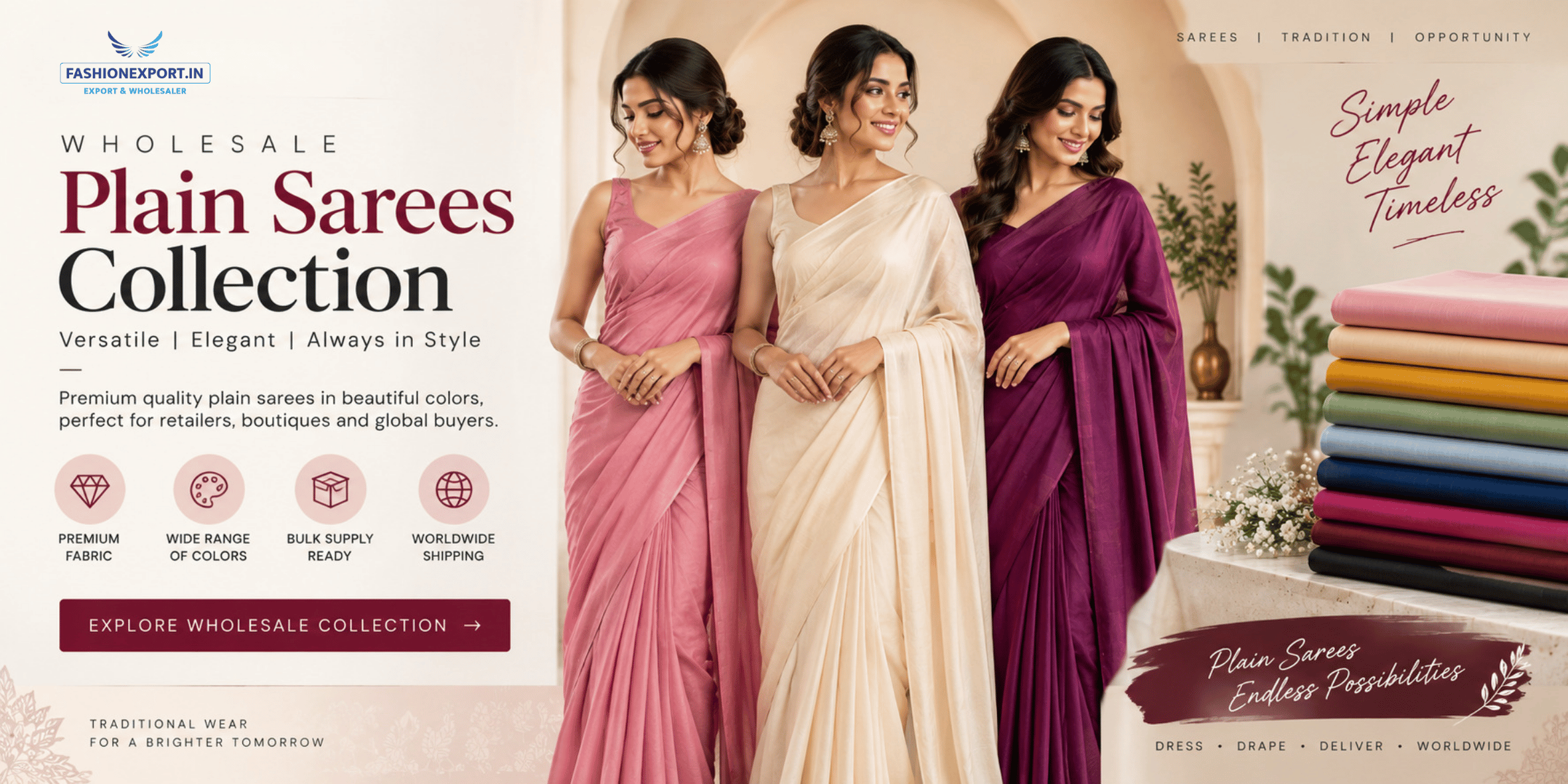
The demand for simple, versatile, and easy-to-style Indian clothing continues to create opportunities for international fashion businesses. A Wholesale Plain sarees Collection can be particularly useful for boutiques, retailers, online stores, distributors, and apparel importers that want a flexible ethnic-wear category. Fashionexport helps buyers explore Indian fashion sourcing opportunities while building collections suitable for different markets. A plain saree may have a simple appearance, but its commercial potential can be significant because customers can style it for different occasions using blouses, jewelry, footwear, handbags, jackets, and other accessories.
A Wholesale Plain sarees Collection generally refers to a range of sarees sold in bulk to businesses rather than directly to individual consumers. The defining feature is a relatively simple saree surface without extensive all-over prints, embroidery, or heavy embellishment.
The simplicity of these sarees provides flexibility. A retailer can present the same product as everyday wear, office fashion, festive minimalism, contemporary ethnic clothing, or an occasion outfit depending on styling and presentation.
Wholesale buyers may choose collections based on:
The exact product specifications should always be confirmed with the supplier before placing a bulk order.
Plain sarees are not limited to one particular customer group. Their appeal can extend from customers who prefer minimal fashion to shoppers looking for an affordable foundation for elaborate styling.
A retailer can merchandise a plain saree with:
This versatility makes plain sarees useful for businesses that want to create multiple looks from a relatively straightforward product category.
For wholesalers, another advantage is the possibility of creating collections around color families. Instead of buying random individual colors, a business can develop a coordinated palette that supports its overall seasonal merchandising strategy.
Fabric selection is one of the most important decisions when developing a Wholesale Plain sarees Collection.
Different fabrics create different customer experiences and price positions.
Cotton is widely associated with comfort and everyday wear. Cotton sarees can be positioned for summer collections, office wear, casual dressing, traditional daily wear, and customers who prefer breathable fabrics.
Depending on construction and finish, cotton sarees can have different textures and levels of softness.
Georgette can provide a lightweight and flowing appearance. Plain georgette sarees can work well for customers interested in elegant draping and contemporary styling.
Chiffon is lightweight and visually fluid. Plain chiffon sarees can be presented as elegant occasionwear or modern fashion pieces when paired with suitable blouses and accessories.
Crepe can offer a smooth appearance and attractive drape. It is often considered for contemporary fashion collections because the fabric can create a polished silhouette.
Satin-style fabrics can provide a smooth and glossy appearance. They can be suitable for evening-oriented collections and fashion-forward retail assortments.
Silk and silk-blend sarees can occupy a more premium position. Buyers targeting festive, occasion, or premium ethnic-wear customers may consider these materials.
Rayon and viscose fabrics can be considered for collections where buyers want a soft drape and commercially accessible pricing, subject to the specific construction and supplier quality.
Linen and linen blends can work particularly well for customers interested in natural-looking textures, relaxed silhouettes, and contemporary minimalism.
Color planning can have a direct impact on how a collection performs in retail.
A strong Wholesale Plain sarees Collection does not necessarily need hundreds of colors. Instead, buyers can create a balanced assortment containing several color categories.
Neutral shades can provide versatility.
Examples include:
These shades can work well as wardrobe staples and can be styled with contrasting accessories.
Pastel shades can support soft, contemporary collections.
Examples include:
Pastels can be particularly useful for spring and summer-oriented merchandising.
Bright colors can create visual impact in storefronts and online catalogs.
Examples include:
Traditional Indian color preferences can also be incorporated depending on the target customer.
Deep maroon, mustard, green, navy, wine, and similar shades can be used for festive and occasion-oriented assortments.
One of the strongest features of a Wholesale Plain sarees Collection is the ability to adapt the product to multiple customer segments.
Boutiques may use plain sarees as foundations for curated fashion looks. They can pair them with boutique blouses and accessories to create distinctive outfits.
Online retailers can create multiple product images showing how the same saree looks with different styling concepts.
Traditional clothing stores can position plain sarees as daily wear, office wear, or affordable occasionwear.
Importers may purchase plain sarees as part of a broader Indian clothing portfolio.
Private-label brands can potentially use plain sarees as a base product for branded collections, subject to supplier capabilities and agreed customization requirements.
When sourcing wholesale sarees, buyers should not judge products only from photographs.
Fabric quality can influence:
A professional sourcing process should include sampling whenever possible.
A sample allows buyers to examine the actual product before committing to a larger order.
Plain does not necessarily mean that every part of the saree must have exactly the same visual treatment.
A saree can have a simple body combined with a:
These details can add visual interest while preserving the clean appearance of the main body.
For buyers, border selection can help create multiple product tiers within one collection.
The blouse can dramatically change the appearance of a plain saree.
A simple saree can be paired with:
For retailers, this means a plain saree can become part of a broader styling strategy.
A Wholesale Plain sarees Collection can be particularly useful for everyday-wear categories.
Daily-wear customers often prioritize:
For such collections, lightweight fabrics and practical color choices can be important.
A retailer can build a dedicated daily-wear range using cotton, rayon, viscose, or other appropriate fabrics depending on the market.
Plain sarees can also fit professional wardrobes.
Office-focused collections may use:
The goal is to create a polished appearance without excessive decoration.
A plain saree can also be transformed into a festive outfit.
The saree itself may remain simple while the styling introduces:
This creates an opportunity for retailers to market plain sarees as versatile occasionwear.
Minimalist fashion has increased interest in clothing that relies on silhouette, fabric, color, and styling rather than heavy decoration.
Plain sarees naturally fit this approach.
A carefully selected fabric in a sophisticated shade can create an elegant look without extensive surface embellishment.
For international retailers, this can make plain sarees easier to introduce to customers who may be interested in Indian fashion but prefer understated clothing.
Some buyers may require customization when developing a Wholesale Plain sarees Collection.
Possible customization areas can include:
The availability of each option depends on the manufacturer's capabilities and order requirements.
Buyers should communicate customization requirements before production begins.
Private labeling allows a retailer or fashion brand to sell products under its own brand identity.
For plain sarees, private labeling can involve:
A private-label program should establish product specifications and quality standards clearly before manufacturing.
Order quantity is another important consideration.
Buyers should avoid selecting quantities purely because a product looks attractive in a catalog.
Instead, quantity planning can consider:
A broader assortment with controlled quantities may allow a new retailer to test customer preferences before significantly expanding inventory.
Quality control is essential when purchasing wholesale apparel.
For sarees, buyers can check:
For repeat orders, maintaining documented specifications can help reduce differences between production batches.
Packaging protects products during handling, transportation, storage, and delivery.
Depending on the buyer's requirements, sarees may be folded and individually packed before being placed into larger cartons.
International buyers should communicate packaging requirements clearly, especially when products are being transported over long distances.
Packaging may also be part of a private-label strategy when customized branding is required.
A commercially useful Wholesale Plain sarees Collection should balance variety with consistency.
Instead of selecting products randomly, buyers can build a structured collection.
For example, a collection might include:
Core Collection:
Everyday colors and versatile fabrics.
Premium Collection:
Higher-value fabrics and refined finishing.
Festive Collection:
Rich colors and elegant borders.
Contemporary Collection:
Modern colors and fashion-focused styling.
Seasonal Collection:
Colors and fabrics selected according to the upcoming season.
This structure makes the range easier to market and organize.
Fashionexport is positioned as an Indian fashion sourcing company for buyers interested in apparel and ethnic-wear products.
For buyers exploring plain sarees, working with an experienced supplier can simplify communication around product development, collection planning, manufacturing, packaging, and export requirements.
The Fashionexport website can be used as a starting point for exploring its broader fashion offering: Fashionexport
Buyers can also use Instagram as a visual channel to study styling ideas, product presentation, fashion trends, and collection concepts. For a B2B fashion business, Instagram can support both inspiration and product discovery.
The simplicity of plain sarees can offer several commercial possibilities.
They can be:
This flexibility is one reason plain sarees can remain relevant across changing fashion cycles.
A Wholesale Plain sarees Collection can provide international fashion businesses with a versatile foundation for developing Indian ethnic-wear assortments. The right combination of fabric, color, finishing, border treatment, pricing, packaging, and styling can transform simple sarees into commercially attractive products.
For wholesalers, retailers, boutiques, importers, and private-label brands, the key is not simply purchasing plain sarees in bulk. It is developing a collection that matches the target customer's preferences and the retailer's overall brand strategy.
Fashionexport can be part of that sourcing journey by connecting buyers with Indian fashion manufacturing and wholesale opportunities. With thoughtful product selection, quality control, appropriate quantities, and strong visual marketing through channels such as Instagram, plain sarees can become a flexible category within a broader international fashion business.
The international market for Indian ethnic fashion continues to create opportunities for wholesalers, boutiques, retailers, importers, and online fashion businesses. A Wholesale Plain sarees Collection can be particularly useful for businesses that want to offer versatile sarees without depending entirely on elaborate prints or heavy embellishments. Plain sarees can serve as everyday clothing, officewear, festive fashion, minimalist occasionwear, and styling-focused products. For businesses working with Indian suppliers, the key is to develop a collection that combines commercially relevant colors, appropriate fabrics, consistent quality, competitive pricing, and reliable production.
Fashionexport can support businesses exploring Indian apparel sourcing opportunities, including women’s ethnic fashion. Buyers can also use Instagram as a visual marketing platform to present plain sarees through different styling concepts, blouse combinations, seasonal campaigns, and customer-focused fashion content.
Indian sarees are recognized across many international markets because they combine cultural identity with a wide range of fabrics, colors, silhouettes, and styling possibilities.
A plain saree can appeal to both traditional customers and shoppers interested in contemporary minimalist fashion.
International buyers may include:
The target market determines which fabrics, colors, price points, and styling concepts are most appropriate.
A retailer serving customers who prefer lightweight clothing may prioritize fabrics with an easy drape. Another retailer serving festive shoppers may focus on richer fabrics and deeper colors.
A successful Wholesale Plain sarees Collection should be planned rather than assembled randomly.
An export-oriented assortment can be divided into product groups.
This segment can focus on comfort, practical colors, easy styling, and accessible pricing.
This range can use subtle colors, minimal borders, and polished fabrics.
Festive products can feature rich colors, refined borders, premium fabrics, and styling-friendly designs.
Premium products can use higher-value fabrics and refined finishing to target customers willing to pay more.
This category can explore modern color combinations, minimalist styling, unusual blouse concepts, and fashion-forward presentation.
This type of segmentation makes it easier for international buyers to organize their catalog and target specific customer groups.
Pricing is an important part of wholesale sourcing.
The final wholesale price may depend on several factors, including:
Buyers should compare products based on specifications rather than simply comparing the lowest quoted price.
A cheaper saree may use a different fabric or finishing standard, making direct price comparisons misleading.
MOQ means Minimum Order Quantity.
Different manufacturers and products can have different MOQ requirements.
Before placing an order, buyers should confirm:
Clear MOQ communication helps businesses plan inventory and investment.
Sampling is one of the most important stages of wholesale sourcing.
A buyer can use samples to evaluate:
Once the sample is approved, the buyer can provide the supplier with clear specifications for bulk production.
For a Wholesale Plain sarees Collection, sample approval can be especially important because fabric quality and color accuracy are central to the product's appeal.
Color consistency matters when selling multiple units of the same product.
Customers generally expect products described as the same color to have a similar appearance.
However, textile dyeing can sometimes produce minor variations depending on production conditions.
Wholesale buyers can reduce uncertainty by establishing approved color references and production standards with the supplier.
This becomes increasingly important for private-label collections where the same shades may need to be reproduced across future orders.
Private labeling allows fashion businesses to create a collection under their own brand.
A private-label saree program may involve:
For example, a retailer could create a branded minimalist saree range with carefully selected neutral colors and premium packaging.
The manufacturing partner should receive detailed specifications before production.
Some businesses do not want to purchase an existing catalog.
Instead, they may want to create a customized Wholesale Plain sarees Collection.
Custom development can involve:
The exact process depends on the supplier and product requirements.
Seasonal planning helps buyers avoid purchasing the same type of collection throughout the year.
A spring/summer range may emphasize:
A festive range may focus on:
An autumn/winter collection may use deeper tones and richer fabric appearances.
Seasonal merchandising can make a plain-saree category feel fresh throughout the year.
A strong fashion catalog can organize sarees into color stories rather than presenting hundreds of unrelated products.
For example:
Soft Neutrals:
Cream, beige, ivory, taupe, and soft grey.
Pastel Edit:
Peach, blush, lavender, mint, and powder blue.
Jewel Edit:
Emerald, ruby, sapphire, wine, and deep purple.
Classic Edit:
Black, white, navy, red, and maroon.
This approach can make the collection easier for customers to browse.
Plain sarees require strong visual presentation because the product itself relies heavily on color, fabric texture, drape, and styling.
Digital marketing can highlight these characteristics through:
A business can show the same saree in multiple styling environments to demonstrate its versatility.
Instagram is particularly relevant to visual fashion products.
For a Wholesale Plain sarees Collection, businesses can create content such as:
Instagram content should focus on the buyer's customer rather than simply showing product photographs.
For B2B businesses, content can also communicate wholesale availability, collection size, private-label options, and international sourcing.
Photography can significantly influence online product perception.
For plain sarees, useful photography can include:
Shows the overall drape and silhouette.
Shows fabric texture, border, and finishing.
Demonstrates how the saree looks when worn.
Shows possible styling options.
Helps customers understand the actual shade.
Places the product in a realistic fashion environment.
Using multiple views gives wholesale buyers more information when evaluating a product.
Search engine optimization can help businesses attract customers searching for Indian clothing suppliers.
Relevant keyword themes may include:
Long-tail keywords can also target specific buyer needs and markets.
A website should provide clear product information rather than relying only on keyword repetition.
Modern search experiences increasingly focus on direct answers, useful explanations, and clearly organized information.
For a page targeting Wholesale Plain sarees Collection, businesses can improve content clarity by using:
The goal should be to make the content genuinely useful to both search engines and human readers.
Sustainability is becoming an increasingly relevant topic in fashion sourcing.
Buyers may want to understand:
Not every supplier will offer the same sustainability options, so buyers should ask for specific information rather than making assumptions.
A longer-lasting garment can also provide value by reducing the need for frequent replacement.
International wholesale buyers should discuss packaging before production.
Important considerations can include:
Shipping requirements can vary depending on the destination country and logistics provider.
The buyer and supplier should establish responsibilities clearly before dispatch.
Businesses sourcing a Wholesale Plain sarees Collection for the first time can make avoidable mistakes.
The lowest quotation does not automatically represent the best commercial value.
Ordering bulk quantities without reviewing samples can create unnecessary risk.
A very large color assortment can make inventory management difficult.
Small measurement differences can affect customer satisfaction.
Quality expectations should be documented before production.
Buyers should understand their target customer's preferences.
Poor packaging can damage the presentation and condition of products.
A popular product can become difficult to replenish if specifications are not documented.
Before choosing a supplier, buyers can review several factors.
Consider asking:
The answers can help buyers determine whether the supplier fits their business requirements.
A long-term sourcing relationship can make future ordering more efficient.
Once a product is approved, the buyer can maintain records of:
This information can reduce communication problems during repeat production.
A retailer does not necessarily need hundreds of designs to establish a saree category.
A smaller, carefully selected Wholesale Plain sarees Collection can act as a core assortment.
The business can then expand based on actual customer demand.
For example:
Stage 1:
Launch a small selection of colors.
Stage 2:
Identify the best-performing fabrics.
Stage 3:
Add complementary colors.
Stage 4:
Introduce premium versions.
Stage 5:
Develop private-label packaging.
Stage 6:
Expand into related ethnic-wear categories.
This approach can help businesses make purchasing decisions based on market response.
Plain sarees can work as part of a larger ethnic-wear catalog.
A fashion retailer may combine them with:
This creates cross-selling opportunities and helps the retailer develop complete fashion collections.
A plain saree can be presented in different ways inside a physical store.
Retailers can organize products by:
Color-based displays can be especially effective because plain sarees naturally create strong visual blocks.
Online stores can use filters to improve product discovery.
Useful filters may include:
High-quality product descriptions should explain the fabric, color, measurements, styling potential, and care information where available.
Customers who are unfamiliar with sarees may need additional information.
Retailers can provide:
Educational content can make the buying process easier for new customers.
Fashion trends change, but simple garments can remain adaptable.
Instead of relying heavily on short-lived decoration trends, plain sarees can evolve through:
This adaptability can help retailers refresh their collections without completely changing the underlying product category.
Fashionexport is an Indian fashion business serving buyers interested in apparel and ethnic-wear sourcing.
For businesses exploring Indian sarees, working with a supplier that understands product development, wholesale requirements, and international buyer expectations can make sourcing more organized.
Buyers can explore Fashionexport online at Fashionexport and review the company's broader fashion offering.
Instagram can also be incorporated into the sourcing and marketing process by allowing fashion businesses to study visual trends, discover styling concepts, communicate collections, and build awareness among their customers.
Before confirming an order, buyers can review this checklist:
Product
Quality
Commercial
Branding
Shipping
Marketing
It is a bulk assortment of simple or minimally decorated sarees offered to retailers, wholesalers, boutiques, importers, and other fashion businesses.
Plain sarees can be versatile, easy to style, and suitable for multiple occasions and customer segments.
Depending on the target market, options can include cotton, chiffon, georgette, crepe, satin, silk blends, viscose, rayon, linen blends, and other textile constructions.
Depending on the supplier, buyers may be able to customize colors, fabrics, borders, labels, packaging, and other specifications.
Yes. Their versatility allows retailers to position them for everyday wear, officewear, festive fashion, minimalist styling, and occasionwear, depending on local customer preferences.
Review product quality, samples, MOQ, pricing, customization, communication, packaging, production capabilities, and export requirements before placing a large order.
Yes. Online stores can present plain sarees using detailed photography, videos, color filters, fabric information, styling recommendations, and product descriptions.
Instagram can showcase colors, draping, styling, fabric details, new arrivals, seasonal collections, and customer looks through posts, Stories, and short-form videos.
Many apparel manufacturers offer private-label services, but the exact options, MOQs, branding methods, and customization capabilities should be confirmed directly with the supplier.
A Wholesale Plain sarees Collection can be a flexible and commercially useful category for fashion retailers, wholesalers, boutiques, importers, and private-label brands. Its strength comes from simplicity: the saree can become a different fashion product through changes in color, blouse design, accessories, draping, presentation, and occasion.
For businesses sourcing from India, successful wholesale purchasing involves more than finding attractive products. Buyers should evaluate fabric quality, measurements, finishing, color consistency, pricing, MOQ, customization, packaging, and production capabilities.
A well-organized collection can include everyday essentials, officewear, festive colors, premium fabrics, contemporary shades, and seasonal selections. This approach gives retailers the flexibility to serve different customers while maintaining a coherent product range.
Fashionexport can be considered as part of the sourcing process for businesses interested in Indian fashion and ethnic-wear products. Through thoughtful collection planning, quality control, professional product presentation, and digital marketing through channels such as Instagram, businesses can build a stronger presence around simple yet versatile saree styles.
The most effective wholesale strategy is to understand the target market first, select suitable products second, test quality through samples, and then scale inventory based on actual business requirements. With this approach, plain sarees can become more than a basic apparel category: they can serve as a versatile foundation for a modern Indian and international fashion collection.