Meta description: Looking for a reliable Designer Ethnic Wear Exporter India? Fashionexport supplies premium sarees, lehengas, kurtas and sherwanis to boutiques and wholesalers worldwide.
Short description: Fashionexport is a trusted name in Indian ethnic fashion exports, known for premium craftsmanship, ethical sourcing, and dependable global shipping. This two-part guide explains how the export process works and why buyers choose Fashionexport as their sourcing partner.
When international boutiques, wholesalers, and retail chains go looking for a dependable Designer Ethnic Wear Exporter India, one name comes up again and again: Fashionexport. Built specifically to serve the global ethnic fashion trade, Fashionexport has become a preferred sourcing partner for buyers who want authentic Indian craftsmanship, consistent product quality, and shipping timelines they can actually plan around. Whether you run a boutique in London, a wholesale showroom in Dubai, or a growing online store in the US, the sourcing decisions you make around fabric, embroidery, sizing, and logistics directly affect your margins and your customers' experience.
This two-part guide walks through what it means to work with a genuine export partner, how the industry actually operates behind the scenes, and why Fashionexport has built its reputation among fashion buyers across the world. Part one covers what the role involves, why buyers pick Fashionexport specifically, the product categories on offer, the craft hubs behind the garments, and how quality and compliance are managed. Part two, which follows, moves into the shipping process itself, how to place a bulk or private-label order, the trends shaping the industry heading into 2026, and a detailed FAQ. If you import, retail, or private-label Indian ethnic fashion, this is the guide to bookmark.
Quick answer: A Designer Ethnic Wear Exporter India is a company that manufactures or sources traditional and fusion Indian garments — sarees, lehengas, kurtas, salwar suits, sherwanis — and ships them in bulk to retailers, boutiques, and distributors outside India, while handling documentation, quality checks, and international logistics on the buyer's behalf.
For a buyer sitting in New York, London, Toronto, or Dubai, sourcing directly from India can feel overwhelming. There are hundreds of small workshops, thousands of fabric options, and no easy way to judge who will actually deliver what was promised, on time, at the agreed quality. This is the exact gap a professional export partner is meant to fill.
A genuine exporter does far more than pack boxes and print shipping labels. The role typically includes:
Fashionexport was structured around this exact workflow. Instead of buyers having to coordinate separately with a fabric supplier, a tailoring unit, an embroidery workshop, and a freight forwarder, everything is consolidated under one accountable partner. That single point of accountability is often the biggest difference between a smooth import experience and a stressful one.
It's worth being clear about a distinction many first-time buyers miss: a manufacturer and an exporter are not always the same thing. Some manufacturers only sell domestically and have no experience with export compliance, foreign currency invoicing, or international packing standards. A true Designer Ethnic Wear Exporter India, like Fashionexport, is built around international trade from the ground up — which means smoother customs clearance, fewer shipment delays, and fewer surprises once the goods land in your country.
Another important element is communication. Time zones, language, and business etiquette differences can slow down sourcing relationships that aren't set up properly. Established exporters maintain dedicated export teams who are used to working with international buyers, understand Incoterms (FOB, CIF, EXW), and can respond to queries without the buyer having to chase for updates. This operational maturity is what separates a hobbyist supplier from a serious export partner capable of handling recurring, scalable orders.
Ultimately, choosing the right export partner shapes almost every part of a buyer's experience — pricing consistency, product quality, delivery reliability, and even how easy it is to reorder a bestseller. That's why so much of this guide focuses on the practical, operational side of exporting, not just the fashion itself.
Even experienced retailers run into avoidable problems when they source ethnic wear from India for the first time. A few patterns come up often enough that they're worth flagging directly:
Working with an established export partner generally reduces these risks, since the processes to prevent them — sampling, documentation, sizing confirmation — are already built into how the business operates, rather than being left to the buyer to manage alone.
Retailers rarely choose a sourcing partner on price alone. Price matters, but it's usually the third or fourth factor after reliability, quality consistency, and communication. Here's what typically pushes international buyers toward Fashionexport specifically.
Consistency across repeat orders. One of the hardest things to get right in ethnic fashion is matching quality and color across multiple production runs. A saree ordered in March needs to look identical to the same design reordered in September. Fashionexport maintains standardized sampling and approval processes so that repeat orders match the original approved sample, batch after batch.
Transparent pricing and MOQs. Many exporters quote vague pricing until a buyer commits to a large order. Fashionexport works with clear minimum order quantities and transparent per-piece costing upfront, so retailers can calculate landed cost and margins before placing an order rather than after.
Direct artisan and mill relationships. Because Fashionexport works directly with weaving clusters and embroidery workshops rather than through multiple layers of middlemen, buyers get better pricing and more control over customization — fabric substitutions, color changes, or size-range adjustments.
Export documentation handled end-to-end. Customs delays are one of the most common reasons international orders get stuck at ports. Fashionexport prepares complete, accurate export paperwork — commercial invoices, packing lists, certificates of origin, and HS-code-compliant declarations — reducing the chance of a shipment being held up.
A responsive, dedicated export team. Buyers working across time zones need fast, clear answers. Fashionexport's export desk is set up to respond to international queries promptly, whether that's a status update on production or a question about fabric composition for a compliance filing in the buyer's home country.
A few concrete reasons retailers keep coming back to an export partner like Fashionexport instead of juggling multiple smaller suppliers:
This is also where reputation compounds. A Designer Ethnic Wear Exporter India that consistently delivers builds long-term relationships with boutiques and distributors, who then place larger and more frequent orders because the risk of working together has already been proven out. That trust, built order after order, is arguably Fashionexport's most valuable asset — more than any single product line.
Buyers researching Indian ethnic wear exporters are usually looking for a specific mix of categories, not just "ethnic wear" as a vague label. Here's a breakdown of what a well-rounded catalog typically includes, along with a quick reference on fabric options and typical order minimums.
| Category | Common Fabrics | Typical MOQ |
|---|---|---|
| Sarees | Banarasi silk, Kanjivaram silk, georgette, chiffon, cotton | 50–100 pieces per design |
| Lehenga cholis | Silk, net, velvet, satin with embroidery | 30–75 pieces per design |
| Salwar suits | Cotton, georgette, chanderi, silk blends | 50–150 pieces per design |
| Kurtas & kurta sets | Cotton, rayon, linen, chanderi | 100–200 pieces per design |
| Sherwanis | Brocade, silk blends, jacquard | 25–50 pieces per design |
| Indo-western fusion | Georgette, crepe, satin, mixed blends | 30–75 pieces per design |
MOQs vary by exporter and can often be adjusted for first orders or sample collections, so it's always worth asking directly rather than assuming a fixed minimum applies across every category.
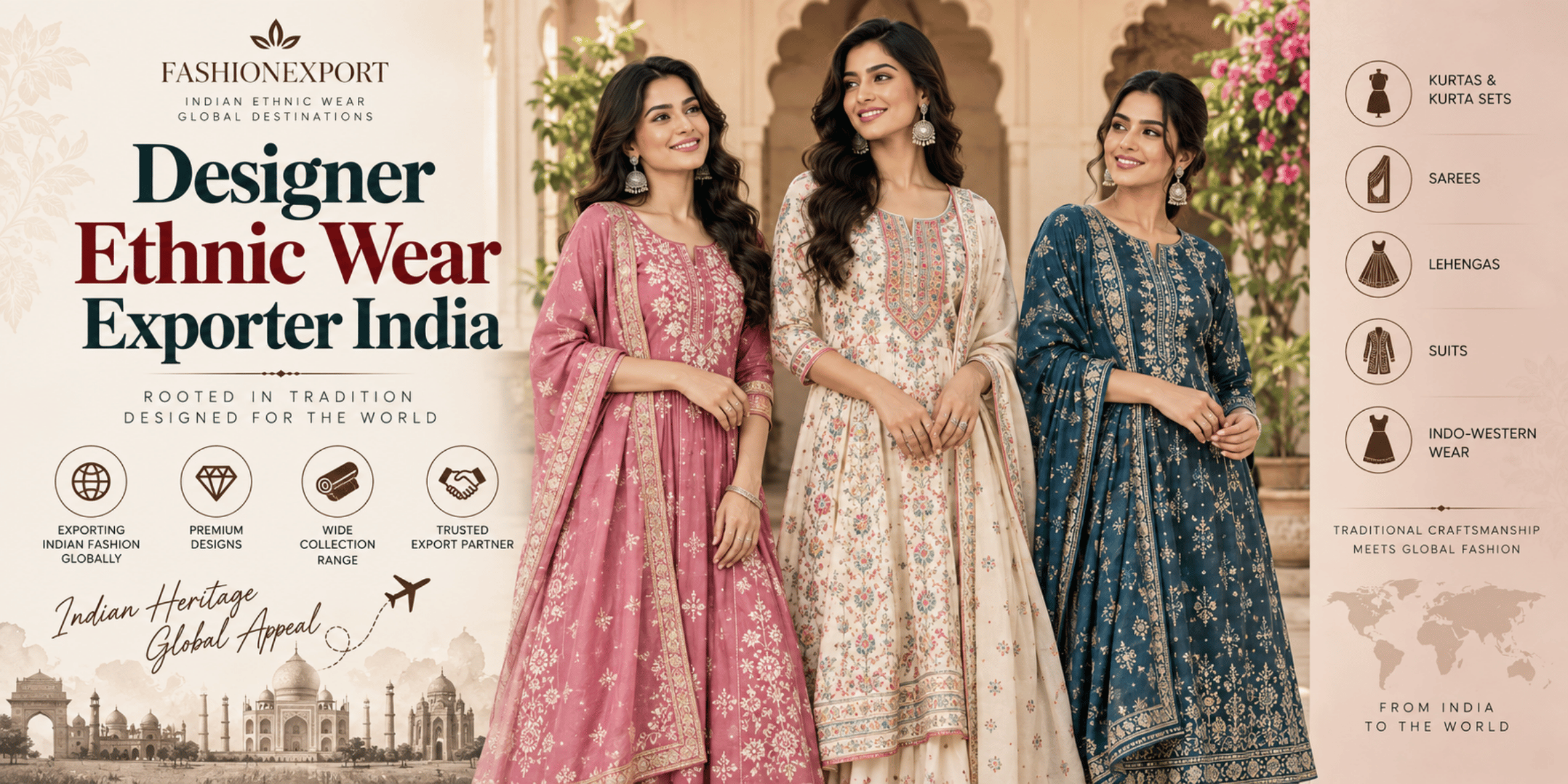
Sarees. Banarasi silk, Kanjivaram silk, chiffon, georgette, cotton handlooms, and printed daily-wear sarees. This remains one of the highest-demand categories for both bridal and everyday retail segments abroad.
Lehenga cholis. Bridal and party-wear lehengas with zari, zardozi, sequin, and mirror-work embroidery, available in a range of silhouettes from A-line to fishtail.
Salwar suits and anarkalis. Unstitched, semi-stitched, and stitched suit sets in cotton, georgette, and silk blends, popular with boutiques serving South Asian diaspora communities.
Kurtas and kurta sets. Men's and women's kurtas, kurta-pajama sets, and co-ord sets that work well for both festive and everyday-wear retail segments.
Sherwanis and men's ethnic wear. Wedding-season staples including sherwanis, bandhgalas, and Nehru jackets, often ordered in smaller volumes but at higher per-unit value.
Indo-western fusion wear. Crossover pieces — draped gowns, cape-style kurtas, jacket lehengas — designed for buyers targeting younger, fusion-fashion-focused customers.
A dependable Designer Ethnic Wear Exporter India generally supports customization across these categories, including:
Fashionexport structures its catalog specifically around this flexibility, since most international buyers are not looking for exact off-the-shelf replication of Indian domestic-market designs — they need adaptations that will resonate with their own customer base while keeping the authentic craftsmanship intact.
Understanding where and how ethnic wear is actually made helps buyers evaluate quality claims more critically. India's ethnic fashion manufacturing is geographically specialized, and a credible exporter will usually be transparent about which hubs supply which product categories.
Surat, Gujarat is India's largest hub for embroidered and embellished fabric, particularly georgette and chiffon sarees and suit pieces. Much of the machine and hand embroidery used in party-wear collections originates here.
Varanasi, Uttar Pradesh is synonymous with Banarasi silk weaving, a centuries-old handloom tradition producing some of the most sought-after bridal sarees in the world.
Jaipur, Rajasthan specializes in block printing, bandhani (tie-dye), and gota-patti embroidery, commonly used in both sarees and lehengas.
Lucknow, Uttar Pradesh is the home of chikankari, a delicate hand-embroidery technique used extensively on kurtas and suit sets.
Kolkata, West Bengal produces high-quality cotton and tant sarees, along with intricate zari work.
Kanchipuram, Tamil Nadu is renowned for its heavy silk sarees with contrasting borders, a South Indian bridal staple that commands strong demand among diaspora buyers in Southeast Asia and the Middle East.
Each of these hubs has its own supply chain, its own seasonal rhythm, and its own set of specialist weavers or embroiderers who have often practiced the craft for generations. A shipment that blends products from multiple hubs — say, Banarasi sarees alongside Surat-embroidered suits — genuinely requires coordination across separate regions of the country, which is exactly the kind of logistics an export partner is meant to simplify for the buyer.
An exporter that sources from these specialized clusters — rather than a single generic factory producing everything — is generally able to offer better authenticity and craftsmanship per category. Fashionexport maintains sourcing relationships across several of these hubs specifically so that a saree order goes to weavers who specialize in sarees, and an embroidery-heavy lehenga order goes to workshops that specialize in embellishment work, rather than forcing every product type through the same generic production line.
This matters practically for buyers: a supplier claiming to produce "everything under one roof" at uniformly high quality is often stretching the truth. Craftsmanship in Indian ethnic wear is deeply regional, and the best exporters lean into that specialization instead of pretending it doesn't exist.
Quality control is where many first-time importers get burned, and it's a legitimate area of concern buyers should ask about directly before placing a large order with any Designer Ethnic Wear Exporter India.
A proper quality-control process includes several checkpoints, not just a final look before packing:
Fashionexport runs shipments through each of these stages before goods leave the facility, which meaningfully reduces the rate of returns, disputes, and reorder corrections compared to working with a supplier that only checks quality once, at the end.
Compliance is the other half of this picture. A Designer Ethnic Wear Exporter India shipping internationally needs to manage:
On the ethical sourcing side, buyers — especially retailers in the US, UK, and EU — increasingly expect visibility into working conditions and fair wages for artisans. Fashionexport works with established, accountable production partners rather than anonymous subcontractors, which gives buyers a clearer picture of how and where their products are actually made. This is increasingly not just a nice-to-have; several Western retail chains now require this kind of supply-chain transparency as a condition of doing business at all.
Packaging is often treated as an afterthought, but it directly affects both product condition on arrival and how smoothly a shipment clears customs. A few standards worth knowing:
Fashionexport builds packaging specifications into the order confirmation stage rather than leaving it as a last-minute decision, so buyers know exactly what condition their shipment will arrive in before production even begins.
Before moving into Part 2, here's a quick recap of what this section covered:
Part 2 of this guide covers the actual export and shipping process step by step, how to structure a bulk or private-label order with Fashionexport, the trends shaping Indian ethnic fashion exports going into 2026, and a full FAQ section answering the most common questions buyers ask before choosing a Designer Ethnic Wear Exporter India. You can continue reading Part 2, or reach out directly through fashionexport.in to start a sourcing conversation.
Meta description: Continue the complete guide to sourcing from a Designer Ethnic Wear Exporter India — the shipping process, bulk ordering, 2026 trends, and FAQs, from Fashionexport.
Short description: Part two of Fashionexport's guide covers the practical side of exporting: how shipments actually move from India to your warehouse, how to place a bulk or private-label order, where Indian ethnic fashion exports are heading in 2026, and answers to the questions buyers ask most often.
In Part 1 of this guide, we covered what it actually means to work with a genuine export partner, why international retailers choose Fashionexport, the product categories on offer, the craft hubs behind the garments, and how quality control and compliance are managed. If you haven't read it yet, it's worth starting there before diving into this half, which is entirely focused on execution: how goods actually move from an Indian workshop to your storefront, how to structure an order, and what's changing in the industry right now. Throughout this guide, you'll see references to Fashionexport and how the company approaches each of these steps in practice, since the goal here is to be genuinely useful for buyers evaluating a Designer Ethnic Wear Exporter India, not just to describe the industry in the abstract.
Quick answer: The export process typically runs through six stages — order confirmation, sample approval, production, quality inspection, documentation, and international shipping — and takes anywhere from three to eight weeks depending on order size and shipping method.
Here's how the process usually unfolds, step by step:
Air freight vs. sea freight is one of the first decisions buyers need to make, and it affects both cost and timeline meaningfully:
Incoterms define exactly where responsibility shifts from exporter to buyer, and misunderstanding them is a common source of disputes:
Fashionexport works with buyers to select the Incoterm and freight method that actually fits their order size, budget, and timeline, rather than defaulting to whichever option is most convenient for the exporter. For first-time buyers especially, a CIF arrangement often removes a lot of the logistics complexity, since the exporter is managing freight booking and insurance directly.
Customs clearance at the destination is usually the most unpredictable part of the process, and it's where good documentation pays off. Missing or mismatched paperwork — an invoice that doesn't match the packing list, an incorrect HS code, or a missing certificate of origin — is the single biggest cause of shipments getting held at port. This is precisely why documentation accuracy is treated as a core part of the export process at Fashionexport, not an administrative afterthought handled after the goods are already packed.
| Factor | Air Freight | Sea Freight |
|---|---|---|
| Typical transit time | 4–7 days | 3–6 weeks |
| Best suited for | Smaller, urgent, or high-value orders | Large bulk orders with flexible timelines |
| Cost per unit shipped | Higher | Significantly lower |
| Planning lead time needed | Shorter | Longer, especially around peak season |
Before a shipment leaves India, buyers should expect (and confirm receipt of) the following paperwork:
Keeping copies of all of this documentation also makes life considerably easier if a customs query comes up after the shipment has already left India, since discrepancies are far faster to resolve with the original paperwork on hand than by trying to reconstruct it after the fact.
Buyers approach sourcing in different ways depending on their business model, and a flexible Designer Ethnic Wear Exporter India should be able to accommodate several of them.
Wholesale bulk ordering. This is the most straightforward model: the buyer selects designs from an existing catalog, agrees on quantities per design, and places a standard bulk order. It works well for retailers who want proven, ready-to-produce designs without a lengthy development cycle.
Private label manufacturing. Here, the buyer's own brand tags, packaging, and sometimes exclusive design variations are applied to the products. This is common among boutiques and online retailers who want their sourcing relationship to stay invisible to their own customers. Fashionexport supports private labeling across most product categories, with brand tags, care labels, and custom packaging built into the production run. This typically covers:
Because these elements are built into the production plan from the start rather than added as an afterthought, private-label orders don't typically take meaningfully longer than standard bulk orders, provided the branding assets are supplied early in the process.
Custom design development. For buyers with a specific design vision — a particular embroidery pattern, an exclusive color palette, or a fusion silhouette not currently in the catalog — the exporter develops new samples based on the buyer's brief. This model takes longer, since it includes a design and sampling phase before bulk production, but it results in genuinely exclusive product lines.
Getting started typically looks like this:
A practical note for first-time buyers: starting with a smaller trial order — even below the standard MOQ, if the exporter allows it — is a reasonable way to evaluate quality, communication, and reliability before committing to a large-volume order. Fashionexport works with a number of first-time buyers this way, treating the initial order as the start of a longer relationship rather than a one-off transaction.
Pricing questions come up early in almost every sourcing conversation, and it helps to understand what actually drives the per-piece cost before requesting a quote.
Fabric choice. Handloom silks like Banarasi or Kanjivaram cost considerably more than machine-woven georgette or cotton, and this is usually the single biggest factor in per-piece pricing.
Embroidery and embellishment level. Hand embroidery, zardozi work, and heavy sequin or stone detailing add significant labor cost compared to minimal or machine-embroidered designs.
Order quantity. Larger orders per design generally bring down the per-piece cost, since setup costs for cutting, printing, or embroidery templates get spread across more units.
Customization requests. Fabric substitutions, custom color-ways, and private-label branding typically carry small additional costs compared to ordering an existing catalog design exactly as shown.
Shipping method. Air freight adds noticeably more to landed cost than sea freight, which is why larger, less time-sensitive orders are usually better suited to sea shipping.
Packaging specifications. Individual polybagging, branded hang tags, and retail-ready barcode labeling all add a small per-unit cost compared to standard bulk packaging.
A transparent exporter should be able to break down a quote across these factors rather than presenting a single flat number with no explanation. Fashionexport provides itemized pricing so buyers can see exactly where their landed cost is coming from, which also makes it easier to identify where costs can be adjusted — switching a fabric, increasing quantity, or simplifying packaging — if a quote comes in above budget.
The Indian ethnic fashion export industry isn't static — buyer expectations and consumer tastes both shift year over year, and staying aware of these shifts helps retailers plan their sourcing ahead of demand rather than reacting to it.
Sustainable and traceable fabric sourcing. International retailers are increasingly asking about dye processes, water usage, and fiber sourcing, not just design and price. Exporters who can speak to these questions with real answers — rather than vague sustainability claims — have an edge with retailers in the US and EU in particular.
Size-inclusive ranges. Ethnic wear has historically been sized narrowly compared to Western fashion. Buyers are increasingly requesting extended size ranges for lehengas, sarees with pre-stitched blouses, and salwar suits, reflecting demand from a broader range of body types among their own customers.
Fusion and crossover silhouettes. Indo-western pieces — draped gowns, jacket-style lehengas, cape kurtas — continue to grow as a category, particularly among younger buyers looking for something between fully traditional and fully Western options.
Ready-to-wear bridal and occasion wear. Made-to-measure timelines don't work for most international retail models, so there's growing demand for pre-finished, standard-sized bridal and party wear that still carries premium embellishment and craftsmanship.
Digital-first product presentation. Buyers increasingly expect high-quality product photography, detailed fabric composition data, and sometimes video, before committing to an order — especially for e-commerce-focused retailers who need this content for their own listings.
D2C and smaller MOQ flexibility. As more retail happens through direct-to-consumer online stores rather than large wholesale chains, there's rising demand for exporters willing to work with smaller, more frequent orders rather than only large seasonal bulk shipments.
Buyer preferences also shift noticeably by region, which is worth factoring into any catalog selection:
Fashionexport tracks these shifts closely and adjusts sourcing, sampling, and catalog development accordingly, so that buyers working with the company aren't sourcing last year's demand patterns.
With so many suppliers claiming to be a reliable Designer Ethnic Wear Exporter India, it's worth being specific about what actually differentiates Fashionexport in practice, rather than repeating generic claims about "quality" and "trust" that every exporter makes.
Buyers can also follow Fashionexport's latest collections, behind-the-scenes craftsmanship, and new product drops on Instagram, which is regularly updated alongside the main catalog at fashionexport.in. For many international boutiques, Instagram has become a quick way to preview new designs before formally requesting a catalog or quote.
What is a Designer Ethnic Wear Exporter India? It's a company based in India that manufactures or sources traditional and fusion ethnic garments — sarees, lehengas, kurtas, sherwanis, and salwar suits — and exports them in bulk to retailers, boutiques, and distributors internationally, managing production, quality control, and shipping documentation along the way.
What is the typical minimum order quantity (MOQ)? MOQs vary by category, generally ranging from around 25 pieces per design for higher-value items like sherwanis to 100–200 pieces for categories like kurtas. Many exporters, including Fashionexport, can work with smaller trial orders for first-time buyers.
How long does production and shipping usually take? Production typically takes two to five weeks depending on order size and complexity, and shipping adds anywhere from four days (air freight) to six weeks (sea freight), depending on the method and destination.
Can I get custom designs or private labeling? Yes. Most established exporters, including Fashionexport, support private-label packaging and branding, as well as custom design development for buyers with a specific vision that isn't already in the catalog.
How is quality controlled before shipment? Through multiple checkpoints — pre-production sample approval, in-line inspection during production, and a final random inspection before packing — rather than a single check at the end.
What documentation should I expect to receive? A commercial invoice, packing list, certificate of origin where applicable, and correctly classified HS codes, all matched precisely to the physical shipment to avoid customs delays.
Which Incoterm should I choose as a first-time buyer? CIF is often the simplest option for first-time buyers, since the exporter arranges and pays for freight and insurance to the destination port, reducing the logistics the buyer needs to manage directly.
Does Fashionexport ship to the US, UK, and Middle East? Yes — Fashionexport regularly exports to buyers across North America, Europe, the UK, and the Middle East, and can advise on destination-specific labeling and documentation requirements for each region.
What happens if a shipment arrives with a defect or discrepancy? A reputable exporter will have a clear resolution process — typically involving photo documentation of the issue, a review against the approved sample and inspection records, and a resolution such as replacement, credit, or partial refund depending on the scale of the problem. It's worth confirming this process in writing before placing a large order.
Can I request fabric or color changes to an existing catalog design? In most cases, yes. Fabric substitutions and color-way changes are common requests, though they may involve a small sampling fee and a short additional lead time to confirm the change matches expectations before bulk production begins.
Choosing a Designer Ethnic Wear Exporter India is ultimately a decision about risk, consistency, and how much of the sourcing burden you want to carry yourself versus hand off to a partner who does this full-time. The right export partner doesn't just supply beautiful garments — they handle the sampling, quality control, documentation, and logistics that determine whether your order lands on time, matches what you approved, and clears customs without drama.
Fashionexport has built its process around exactly these priorities, working across India's specialized craft hubs to source sarees, lehengas, kurtas, sherwanis, and fusion pieces for boutiques, wholesalers, and distributors around the world. If you're evaluating sourcing partners for your next collection, visit fashionexport.in to browse the catalog, request pricing, or start a conversation with the export team — and follow along on Instagram for a closer look at new arrivals as they're added.