
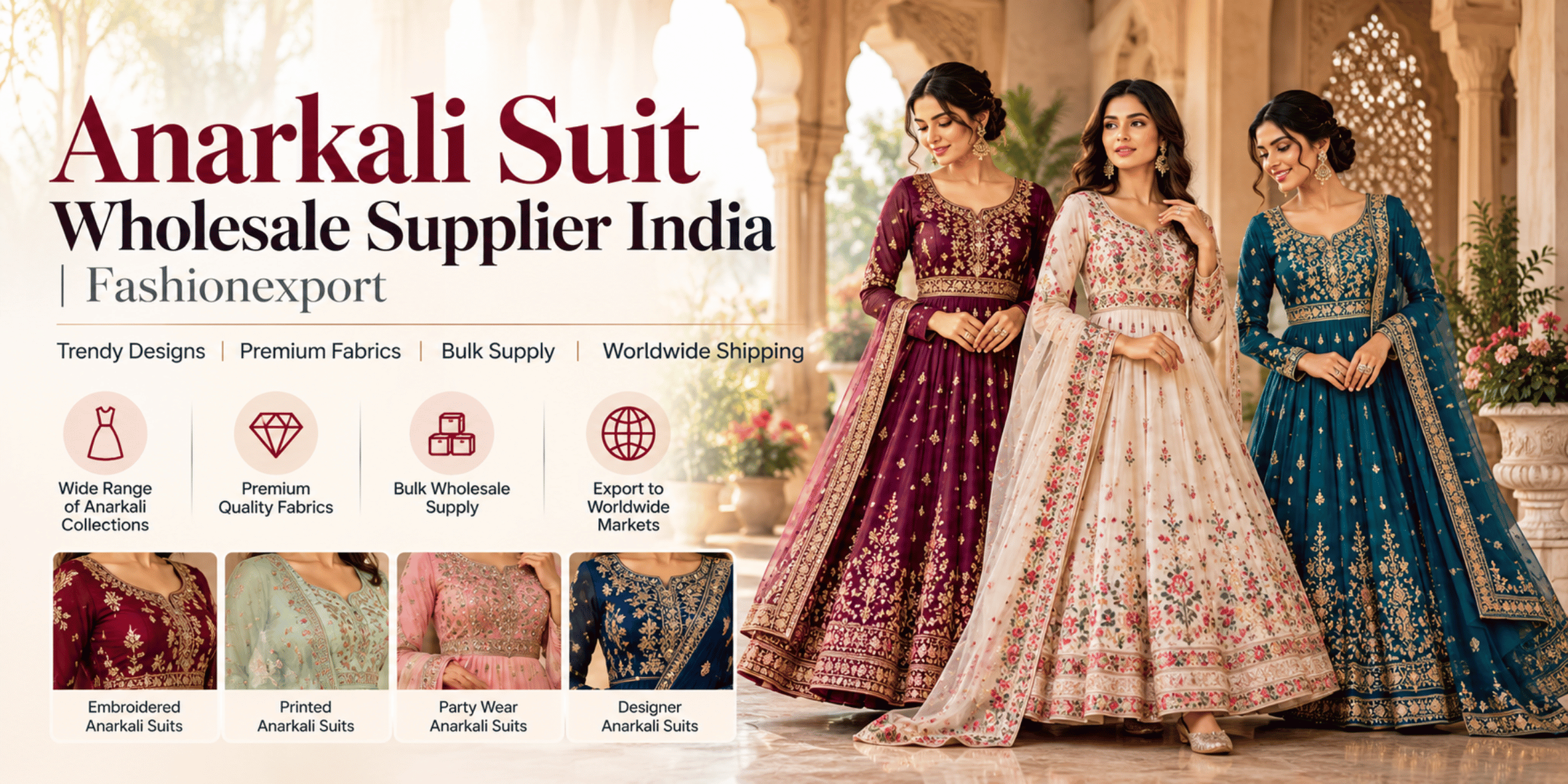
Fashionexport is an Indian ethnic wear business that international retailers can explore when researching traditional clothing, wholesale collections, and sourcing opportunities through Fashionexport. Businesses searching for an Anarkali Suit Wholesale Supplier India often want to discover elegant ethnic outfits that combine traditional Indian styling with modern fashion preferences. Anarkali suits are recognised for their flowing silhouettes, fitted bodices, flared skirts, decorative necklines, and versatile styling options. They are worn for festivals, weddings, family celebrations, cultural events, parties, and other special occasions. Their variety of fabrics, embroidery techniques, colours, and designs makes them a relevant category for boutiques, clothing retailers, importers, online stores, and wholesale distributors serving different customer segments.
International buyers can explore Anarkali suits in cotton, georgette, chiffon, rayon, silk blends, and other fabrics, depending on the design and intended use. Lightweight styles may suit everyday ethnic wear and casual celebrations, while heavily embroidered or embellished designs can be positioned for festive and occasion-wear collections. Buyers should evaluate fabric composition, stitching, embroidery finishing, lining, garment measurements, colour consistency, and the components included in each set before placing a bulk order. Accurate product specifications are especially important when garments will be sold online or shipped to customers in different countries.
Choosing a suitable wholesale supplier requires more than comparing catalogue photographs and unit prices. Retailers should clarify minimum order quantities, sample availability, payment terms, production timelines, packaging standards, customisation options, and shipping arrangements. They should also calculate the total landed cost, including applicable freight, customs duties, taxes, insurance, and clearance charges, before determining retail prices. Written quotations and approved samples can reduce misunderstandings and make it easier to compare different sourcing options.
A well-planned Anarkali collection should reflect the target market. Boutiques may prefer distinctive designs and carefully selected quantities, while distributors may prioritise repeat availability, consistent sizing, and commercially practical order volumes. Online sellers should focus on accurate product photography, detailed descriptions, size charts, and clear policies. Retailers can use Instagram posts, Reels, styling videos, and collection announcements to introduce new designs and help customers understand the appearance and use of each outfit.
Businesses researching an Anarkali Suit Wholesale Supplier India should verify the supplier's current product range and commercial capabilities directly before making purchasing decisions. Buyers should confirm whether the displayed products are available, whether samples can be arranged, which sizes and colours can be supplied, and whether custom designs or private-label options are possible. Export documentation, destination-country import requirements, and delivery schedules should also be discussed before an order is confirmed.
Fashionexport can be explored as part of the research process for Indian ethnic wear and wholesale sourcing. International buyers should communicate their preferred styles, fabric requirements, target quantities, destination country, budget, and delivery expectations clearly. This helps establish whether the available collection is suitable for their business requirements.
Successful wholesale sourcing combines thoughtful product selection, clear communication, realistic pricing, and effective merchandising. By researching customer preferences, checking garment quality, and planning inventory carefully, retailers can develop an Anarkali suit collection that serves their market while managing purchasing risks. Instagram and other digital channels can then support product discovery and customer engagement, while a well-organised ecommerce website helps shoppers find relevant styles and understand the products before ordering.
Fashionexport is a useful starting point for businesses researching Indian ethnic fashion and wholesale clothing opportunities through Fashionexport. International retailers, boutique owners, clothing distributors, and importers exploring an Anarkali Suit Wholesale Supplier India should understand the products, fabrics, quality standards, order requirements, and sourcing considerations that influence a successful purchase. Anarkali suits combine traditional Indian design with a flowing silhouette, making them suitable for different customer preferences and occasions. With thoughtful product selection and a clear buying strategy, international businesses can build collections that serve festive, casual, wedding, and occasion-wear markets.
Anarkali suits are a distinctive category of Indian ethnic clothing. They commonly feature a fitted upper section and a flared lower silhouette, although the exact construction, length, sleeve design, neckline, and level of decoration vary by style. Some designs are simple and lightweight, while others feature embroidery, decorative borders, sequins, zari-style work, prints, or coordinated dupattas.
The category offers retailers an opportunity to serve several customer groups without relying on a single design. Customers looking for comfortable everyday ethnic wear may prefer cotton or other lightweight fabrics. Shoppers preparing for festivals may look for colourful outfits with decorative details. Wedding guests and occasion-wear customers may prefer elaborate embroidery, layered designs, richer fabrics, and more prominent embellishments.
For international buyers, the first step is to identify which segment they intend to serve. Product selection should reflect the destination market, customer age groups, local fashion preferences, expected retail prices, and the type of store selling the garments.
A boutique may need a limited range of distinctive styles, whereas a distributor may require larger quantities and consistent replenishment. An ecommerce business may prioritise designs that photograph well and have clear sizing information. These different requirements should influence supplier selection from the beginning.
An Anarkali Suit Wholesale Supplier India search can help buyers identify potential sourcing options, but the phrase itself does not establish that any particular supplier has a specific stock level, price, production capacity, or export service. Buyers should verify those details directly before committing to an order.
India has a broad ethnic garment market with a variety of fabrics, silhouettes, embellishment styles, and traditional design influences. This variety gives buyers opportunities to explore collections for different customer groups and retail price points.
One important advantage is design diversity. Anarkali suits can feature floral motifs, traditional patterns, geometric embroidery, printed fabrics, contrast borders, decorative sleeves, and coordinated dupattas. Retailers can combine different styles to create a collection that feels varied while maintaining a consistent brand identity.
Another consideration is the range of possible fabric choices. Depending on the supplier and product, buyers may find cotton, georgette, chiffon, rayon, viscose, crepe, silk blends, and synthetic fabrics. Each material has different characteristics, so it is important to verify the actual composition rather than relying only on a product's marketing name.
Indian ethnic wear can also support occasion-based merchandising. Retailers can organise collections around festivals, weddings, family events, formal gatherings, and everyday use. This makes it possible to plan launches according to local demand and the retail calendar.
When evaluating an Anarkali Suit Wholesale Supplier India, international businesses should look beyond attractive designs. They should also assess product consistency, sample quality, size availability, communication, order terms, packaging, and shipping arrangements. The right sourcing partner should be able to explain its commercial terms clearly and confirm what it can supply.
A successful wholesale purchase begins with a clear understanding of the end customer. The same Anarkali suit may appeal to one market and perform poorly in another because of differences in price, occasion, climate, styling preferences, and local competition.
Boutiques often build their identity around a specific customer group. Some focus on classic ethnic wear, while others specialise in contemporary Indian fashion or premium occasion wear. Boutique buyers may value distinctive designs, manageable order quantities, consistent finishing, and access to fresh collections.
Before purchasing, boutique owners should identify the colours, silhouettes, fabric types, and price levels that complement their existing products. They should also determine whether the collection needs exclusive designs or whether similar styles are widely available elsewhere.
Distributors generally need a practical product range that can be supplied in commercially suitable quantities. They may prioritise repeat availability, standardised product specifications, size consistency, and reliable order fulfilment.
A distributor should clarify whether the same design can be reordered and whether fabrics, colours, or embroidery materials may change between production batches. These details matter when supplying multiple retail customers.
Online retailers depend heavily on product presentation. Clear photographs, accurate measurements, fabric information, and detailed descriptions help customers understand what they are buying.
Online stores should also consider return costs, packaging, shipping dimensions, and the ease of managing multiple sizes and colours. Products that look appealing in photographs still need accurate specifications to support customer satisfaction.
Importers must evaluate the full purchasing process, including payment arrangements, freight, customs clearance, applicable duties, local import regulations, and delivery schedules. They should establish which responsibilities belong to the supplier and which must be managed by the importing business.
Retailers specialising in celebrations may prefer Anarkali suits with more elaborate embroidery, decorative borders, coordinated dupattas, and distinctive silhouettes. Their buying calendar should allow time for product approval, manufacturing, shipping, and merchandising before key selling periods.
By identifying the intended customer, buyers can select an assortment that fits a genuine commercial need instead of ordering products based only on personal taste.
Anarkali suits are available in many styles. Buyers should understand these categories to build an assortment that offers variety without becoming difficult to manage.
Simple designs often feature limited embellishment, clean lines, and practical fabrics. They may be appropriate for everyday wear, casual gatherings, and customers who prefer understated ethnic clothing.
Retailers should evaluate fabric comfort, garment length, sleeve construction, and ease of care. A simple design can still offer strong visual appeal through colour, print, or silhouette.
Printed styles use floral, geometric, traditional, or contemporary patterns. They can offer variety without requiring heavy embroidery across the garment.
Buyers should check print placement, colour consistency, and the accuracy of product images. If a printed design is intended to be repeated, confirm whether the same print and colour combination will remain available.
Embroidered designs may feature threadwork, floral motifs, decorative necklines, borders, or embellishments placed on selected garment sections. The complexity of the embroidery affects the appearance and may influence the price, production time, and care requirements.
Buyers should inspect stitch quality, pattern alignment, loose threads, and the security of attached decorations. A sample is particularly useful when embroidery is a major selling point.
Festive collections may include brighter colours, more decorative details, and coordinated accessories. They can be positioned for cultural celebrations, family gatherings, and seasonal shopping periods.
Retailers should research which colours and design details are suitable for their customer base rather than assuming that every festive trend performs equally well in every country.
These designs may include elaborate embroidery, layered skirts, decorative dupattas, and more structured construction. Buyers should pay particular attention to the garment's weight, lining, fit, finishing, and packaging.
The product description should explain exactly which components are included. Accessories visible in photographs should not be assumed to be part of the order unless the supplier confirms them.
Contemporary designs may combine traditional silhouettes with updated colour combinations, simplified embellishments, modern sleeves, or different neckline treatments. These products may suit retailers whose customers prefer a balance of traditional and modern styling.
A balanced collection can combine several categories while maintaining a consistent price range and brand identity.
Fabric selection affects comfort, drape, appearance, durability, care requirements, and product cost. Buyers should consider the intended occasion and verify the composition of each garment.
Cotton can be suitable for casual and everyday designs, particularly where comfort and breathability are priorities. Its performance depends on fabric quality, weave, garment construction, and lining.
Buyers should ask whether the fabric is pure cotton or a blend and whether shrinkage or special washing precautions should be expected.
Georgette is used in flowing garments and many occasion-wear designs. Its drape can complement a flared Anarkali silhouette, but buyers should check the fabric weight, transparency, lining, and finishing.
Chiffon is lightweight and may be used for garment panels or dupattas. Because some chiffon fabrics are delicate or transparent, it is important to confirm whether lining is included and what care method is recommended.
Rayon and viscose fabrics are used in a variety of ethnic garments. They may offer a soft feel and fluid drape, but their characteristics vary by composition and construction. Buyers should request accurate fibre information.
Crepe fabrics can provide a distinctive surface texture and a drape suitable for certain contemporary designs. The exact appearance depends on the fabric type and blend. Samples can help buyers evaluate the material more accurately.
Silk and silk-blend fabrics may be used for festive and occasion-wear outfits. Buyers should verify the composition carefully because products described as silk may contain blends or synthetic alternatives.
Synthetic materials and blends are used across many price categories. They may be selected for appearance, cost, or garment construction, but the precise composition should be disclosed clearly.
When purchasing from an Anarkali Suit Wholesale Supplier India, buyers should request the fabric composition, lining details, care instructions, and product measurements in writing. These details help retailers create accurate listings and reduce customer confusion.
Embroidery can influence a garment's appearance, comfort, durability, and perceived value. A visual inspection should therefore be part of the sourcing process.
Check that the stitches are reasonably consistent and that the embroidery pattern follows the approved design. Loose threads, missing sections, uneven placement, and rough finishing may indicate a quality issue.
Metallic-looking decorative threads can create a traditional festive appearance. Buyers should confirm the actual materials used and the recommended care method. Product descriptions should not make unsupported claims about precious metals or specific materials.
Sequins and beads add texture and shine, but they should be securely attached. Inspect the garment for loose decorations, sharp edges, and areas where embellishments could snag the fabric.
Where mirror-work or reflective pieces are included, check that the components are secure and that the garment is packed in a way that protects them during transport.
Inspect the lower hem, sleeves, neckline, and dupatta borders. Uneven stitching or inconsistent border placement can affect the overall appearance.
For occasion-wear garments, check lining quality, seam finishing, and the comfort of areas that touch the skin. Heavily decorated garments should be inspected for rough internal surfaces and excess threads.
Retailers should establish a checklist before ordering so that every supplier's sample is evaluated using the same standards.
Sizing can vary across manufacturers and garment designs. Buyers should not assume that a size label alone guarantees consistent measurements.
Request a size chart that identifies how each measurement is taken. Depending on the garment, relevant measurements may include bust, waist, shoulder, sleeve length, garment length, and flare or hem circumference. The supplier should clarify whether the figures describe the garment itself or recommended body measurements.
Retailers should also confirm acceptable measurement tolerances and how size variations are handled in bulk production. A measurement tolerance should be agreed upon rather than assumed.
If the product includes a bottom garment or dupatta, request specifications for those components as well. Confirm whether the bottom is stitched, semi-stitched, or unstitched and whether alterations may be required.
For online retailers, publish the approved size chart on the product page. Include practical measurement guidance so customers can compare the garment with clothing they already own.
A sample can help verify fit and proportions before bulk purchasing. If the design is customised, approve the relevant measurements before production begins.
A sample allows the buyer to inspect the physical product before committing to a larger purchase. It can reveal details that are difficult to assess from a photograph, including fabric texture, stitching, embroidery density, colour, fit, and overall construction.
When requesting a sample, provide the supplier with a clear list of requirements. Identify the design, fabric, colour, size, embellishments, and components that must be included. If the sample is intended to represent a future bulk order, specify which details must remain consistent.
After receiving the sample, compare it against the agreed product specifications. Record any concerns and request corrections before approving production.
Ask the supplier whether the sample cost is refundable or adjustable against a bulk order, if applicable. Also confirm how much time is needed to prepare the sample and whether sample production affects the overall order schedule.
Buyers should retain photographs and written approval records. These records create a reference for the production team and make later quality checks more objective.
A sample does not eliminate every risk, but it provides a practical way to evaluate the supplier's product before a larger commercial commitment.
Minimum order quantity, commonly called MOQ, refers to the smallest quantity a supplier accepts under specified terms. MOQ may apply per design, colour, size, or complete order.
Buyers should confirm the exact MOQ calculation before preparing their purchase plan. A supplier may allow mixed sizes within one design but require a minimum quantity for each colour. Another supplier may apply a minimum order value rather than a fixed number of garments.
Small retailers may prefer limited test orders to understand customer demand. Larger distributors may require more stock to support several sales channels. The appropriate order size depends on budget, inventory capacity, expected demand, and the time required to replenish products.
Before placing an order, ask:
Written answers help buyers compare quotations accurately and avoid unexpected purchasing conditions.
Price comparison should account for the product's actual specifications. Two Anarkali suits may look similar in photographs but differ in fabric composition, embroidery, lining, stitching, included components, and finishing.
Request quotations that clearly state the product code, description, quantity, unit price, currency, payment terms, packaging, and any additional charges. Confirm whether the quotation covers a complete set and whether customisation or branding is included.
International buyers should also calculate the landed cost. Depending on the transaction, this may include domestic transport, international freight, insurance, customs duties, taxes, clearance charges, currency-conversion costs, and delivery to the final destination.
Retailers should consider their own operating expenses when calculating a selling price. These may include storage, fulfilment, payment processing, marketing, discounts, customer service, and returns.
The cheapest quotation may not represent the best overall value if it involves inconsistent sizing, weak finishing, uncertain delivery, or high rates of defective products. Buyers should compare suppliers using the same criteria and choose the option that fits their commercial requirements.
A careful pricing process helps businesses protect their margins while offering products appropriate for their target customers.
Choosing a supplier is an important business decision because it affects product quality, delivery schedules, purchasing costs, and customer satisfaction. International buyers should establish a consistent evaluation process before confirming an order.
Begin by reviewing the supplier's business information, product catalogue, communication practices, and commercial terms. Ask for a detailed quotation and confirm whether the supplier handles the product categories, quantities, and delivery requirements relevant to your business.
When researching an Anarkali Suit Wholesale Supplier India, buyers should request clear product specifications, including fabric composition, size measurements, embroidery details, colours, and included garment components. They should also clarify whether the products are ready-made, made to order, or available through a combination of both arrangements.
Samples provide a practical way to assess product quality. Where possible, compare the sample with the supplier's catalogue description and retain an approved reference for bulk production.
Buyers should also discuss the process for handling shortages, damaged goods, manufacturing defects, and discrepancies between approved samples and delivered products. Written policies make it easier to understand the responsibilities of both parties.
Supplier evaluation should be based on evidence rather than promotional claims. A professional website or attractive catalogue may help introduce a business, but neither independently proves manufacturing capacity, export experience, or product quality.
International orders involve several stages, from product selection to final delivery. Each stage requires sufficient time and clear communication.
The process generally begins with selecting designs and agreeing on specifications. The buyer then confirms quantities, sizes, colours, pricing, and payment terms. If sampling is required, approval should take place before the supplier proceeds with bulk production.
A written production schedule should identify important milestones, such as material procurement, sample approval, stitching, embroidery, final inspection, packing, and dispatch. The schedule should reflect the actual order requirements rather than rely on a general estimate.
Businesses searching for an Anarkali Suit Wholesale Supplier India should confirm the expected lead time for each order. Production may take longer when designs include complex embroidery, custom measurements, special fabrics, private labels, or non-standard packaging.
Retailers planning for a festival or wedding season should work backwards from the intended launch date. Allow time for sampling, production, transportation, customs clearance, and stock preparation.
Buyers should also establish how production updates will be communicated. Early notice of material shortages or schedule changes gives retailers more time to adjust their plans.
A documented schedule cannot prevent every delay, but it creates clearer expectations and supports better inventory planning.
International garment transactions may require several documents, depending on the destination, shipping method, customs classification, and transaction terms.
Common documents can include a commercial invoice, packing list, transport document, and certificate of origin where applicable. Other declarations or supporting documents may be required by the destination country or the relevant shipping and customs authorities.
Importers should independently confirm the requirements that apply to their products. These may include customs duties, import taxes, textile labelling rules, product declarations, and other applicable regulations.
When working with an Anarkali Suit Wholesale Supplier India, buyers should ask which documents the supplier will provide and which responsibilities remain with the importer. Confirm the shipping terms, the party arranging freight, the process for customs clearance, and how any additional charges will be handled.
Product descriptions and invoice details should accurately reflect the shipment. Quantities, values, product descriptions, and other relevant information should be consistent across the required documentation.
Businesses importing garments for resale should also maintain records of quotations, invoices, payment confirmations, inspection reports, and shipping documents. These records help with accounting, stock reconciliation, and resolving order discrepancies.
Shipping decisions depend on order size, destination, urgency, budget, and delivery requirements.
Air freight may be appropriate for urgent shipments or certain smaller consignments. Sea freight may be suitable for larger orders when longer transit times are acceptable. Courier services can be useful for samples and small packages.
Buyers should compare the complete cost of each option rather than relying only on the initial freight quotation. Additional expenses may include handling, documentation, collection, customs clearance, storage, insurance, and final delivery.
For an Anarkali Suit Wholesale Supplier India arrangement, confirm how the garments will be packed and how many pieces will be included in each carton. Carton dimensions and weight can affect shipping charges, even when the garments themselves are relatively lightweight.
The buyer should request a realistic delivery estimate and clarify how tracking information will be provided. It is also useful to establish what happens if a shipment is delayed, lost, or delivered with damaged packaging.
For a first order, businesses may prefer a manageable shipment that allows them to evaluate packaging quality, documentation, and delivery performance before increasing order volumes.
Good packaging helps protect garments during storage, transportation, and handling. The appropriate packaging method depends on fabric sensitivity, embroidery, embellishments, shipping duration, and the buyer's retail requirements.
Each garment should be folded carefully to reduce unnecessary creasing and protect decorative sections. Delicate embroidery, sequins, and other embellishments may require additional protection to minimise snagging or damage.
Wholesale cartons should be organised so that quantities and product variants can be checked easily upon arrival. Clear product codes, colour references, and size labels can help retailers receive stock more efficiently.
If retail-ready packaging is required, buyers should provide precise instructions before production. These may include branded labels, size stickers, product cards, or specific folding methods.
An Anarkali Suit Wholesale Supplier India should be asked to confirm whether packaging is included in the quotation or charged separately. Buyers should also clarify whether customised packaging will affect the minimum order quantity or delivery schedule.
Packaging should be practical and suitable for the garments being transported. It should protect the product without introducing unnecessary costs that reduce the commercial value of the order.
A strong retail assortment provides enough variety to serve different customers without creating excessive inventory complexity.
Retailers can organise their collection around several product categories:
Everyday ethnic wear: Simple silhouettes, practical fabrics, and restrained decoration.
Casual celebration wear: Printed designs, lighter embroidery, and versatile colour combinations.
Festive clothing: Decorative details, coordinated dupattas, and colours appropriate for seasonal shopping.
Wedding and occasion wear: More elaborate embroidery, distinctive silhouettes, and detailed finishing.
Contemporary ethnic fashion: Updated cuts, modern colour combinations, and a balance of traditional and current styling.
The ideal assortment depends on customer preferences, price positioning, storage capacity, and historical sales. A boutique focused on everyday clothing may not need a large collection of heavily embellished garments, while an occasion-wear retailer may require more elaborate designs.
Businesses sourcing through an Anarkali Suit Wholesale Supplier India should maintain a product selection sheet containing the design code, fabric, colour, size range, unit cost, quantity, and intended customer segment.
This information helps buyers compare options and assess whether the collection offers sufficient variety. It also supports reordering when particular products perform well.
Retailers should avoid purchasing every available style simply because it is offered at wholesale prices. Product selection should be guided by demand, brand positioning, and the available purchasing budget.
Inventory planning helps retailers maintain product availability while limiting the risk of unsold stock. This is especially important when international replenishment requires additional shipping and customs time.
Start by recording stock quantities for each design, size, and colour. Track sales, returns, damaged pieces, and remaining inventory. Reviewing this information regularly helps identify which products are performing well.
Fast-selling designs may need earlier reordering, while slower products may require different merchandising or reduced future purchases. Retailers should also monitor seasonal demand and the time required to receive a new shipment.
Before reordering from an Anarkali Suit Wholesale Supplier India, confirm that the design is still available and that its specifications have not changed. Similar-looking products may use different fabrics or embroidery materials in later production batches.
A reorder plan should consider the current stock level, expected sales during the replenishment period, supplier lead time, and available cash. It should not be based solely on a bulk discount.
For new businesses, smaller initial orders can provide useful information about customer preferences. Once sales patterns become clearer, purchasing quantities can be adjusted accordingly.
Retail pricing should account for the full cost of sourcing, importing, storing, marketing, and selling a product.
The initial calculation should include the wholesale price and relevant landed costs. Depending on the transaction, these may include freight, insurance, customs duties, import taxes, clearance charges, and currency conversion.
Retailers should then account for operating expenses, including fulfilment, payment processing, packaging, marketing, customer service, discounts, and returns.
When comparing quotations from an Anarkali Suit Wholesale Supplier India, ensure that the products have comparable specifications. Differences in fabric, embroidery, lining, garment construction, and included components may justify different prices.
Businesses should also research the price range of comparable products in their destination market. A product's retail price should reflect its features, intended audience, and the brand's market position.
Exchange-rate changes can affect the cost of imported garments. Retailers quoting prices in a different currency should consider this possibility when preparing budgets and setting selling prices.
The objective is to establish a sustainable margin while offering customers a product that meets their expectations. A lower purchase price does not necessarily produce a better business result if the garments have inconsistent quality or require frequent returns.
Instagram can help retailers showcase their collections, introduce new designs, and engage with potential customers. Visual content is particularly useful for ethnic wear because it can show the garment's silhouette, colour, embroidery, and styling possibilities.
Photograph the front, back, neckline, sleeves, embroidery, and dupatta where included. Use clear lighting and ensure that the images represent the actual colour and appearance of the garment.
Short videos can demonstrate the flare, drape, movement, and decorative details of an Anarkali suit. Close-up shots can help customers see the embroidery more clearly.
Show how different accessories or footwear can complement an outfit. Styling content can help customers understand how a garment may be worn for a celebration, family gathering, or festive event.
Introduce new arrivals through posts and Reels, then direct customers to the relevant product or collection page. Ensure that product availability and purchasing information remain accurate.
Publish helpful information about fabric care, garment measurements, embroidery techniques, and size selection. Educational posts can answer customer questions and build confidence in the purchasing process.
Retailers researching an Anarkali Suit Wholesale Supplier India can also use Instagram to study fashion presentation and merchandising trends. However, supplier photographs should not be reused commercially without appropriate permission, and promotional images should not replace physical product checks.
A well-organised product page helps shoppers understand a garment before placing an order. This is important for online ethnic wear because customers cannot physically examine the fabric or try on the outfit in advance.
Each product page should include a descriptive title, clear photographs, fabric composition, colour, size options, measurements, included components, and care instructions.
Explain the actual design features. These may include the neckline, sleeve length, embroidery placement, silhouette, lining, and dupatta details. If the bottom garment is unstitched or semi-stitched, state that clearly.
Avoid unsupported claims about fabric composition, craftsmanship, certifications, or product origin. Accurate descriptions reduce confusion and help customers make informed decisions.
For international orders, display relevant shipping information, expected delivery estimates, and applicable return or exchange terms. Customers should understand these conditions before purchasing.
Retailers can use relevant phrases such as Anarkali Suit Wholesale Supplier India on appropriate wholesale landing pages and sourcing articles. Consumer-facing product pages, however, should focus primarily on the individual garment and its actual features.
Good product pages combine useful information, clear navigation, fast-loading images, and accurate policies. These elements can improve the shopping experience and support organic search visibility.
Search engine optimisation helps businesses make their websites easier to discover and understand. A useful SEO strategy combines relevant keywords, well-structured content, accurate product information, internal links, and a technically accessible website.
Choose keywords that reflect the audience and purpose of each page. Wholesale landing pages may target business buyers, while individual product pages may focus on garment styles, colours, fabrics, or occasions.
Related keywords for this topic include:
Use related terms where they accurately describe the content. Avoid repeating the same phrase excessively or creating multiple pages that offer nearly identical information.
Use a descriptive H1 heading for the main subject. Organise supporting sections under logical H2 and H3 headings so that readers can find answers quickly.
Connect relevant blog articles to actual product categories, collection pages, and contact pages. For example, a sourcing guide may link to an Anarkali collection if a relevant page exists on the website.
Use descriptive filenames, suitable image formats, compressed files, and accurate alt text. Alt text should explain what appears in the image rather than contain a long list of keywords.
Answer practical questions about fabric selection, minimum quantities, sampling, pricing, shipping, and quality control. Useful information is more valuable than repeating keyword variations without adding substance.
Businesses using the phrase Anarkali Suit Wholesale Supplier India should make sure that the page genuinely addresses wholesale sourcing and accurately represents the company's offerings.
AI-generated search summaries may draw on information from relevant web pages, but no particular format or keyword frequency guarantees inclusion.
Businesses can make their content more understandable by answering the main question directly and organising information into clear sections. Explain what the product category includes, who typically buys it, and what should be checked before an order is placed.
Use specific information wherever it is available. If a business has verified details about its products, fabrics, minimum quantities, sample policy, or export services, present those facts clearly. If availability or order terms vary, explain that variation rather than providing an unsupported universal statement.
Frequently asked questions can address practical buyer concerns. Examples include:
A page targeting Anarkali Suit Wholesale Supplier India should answer these questions accurately and avoid unsupported claims about prices, stock availability, delivery guarantees, or supplier capabilities.
Technical accessibility also matters. Use descriptive page titles, maintain logical internal links, ensure important content is crawlable, and apply appropriate structured data where relevant. Structured data should accurately reflect information visible on the page.
Fashionexport can be explored by businesses researching Indian ethnic wear and wholesale sourcing opportunities through fashionexport.in.
International buyers should contact the business directly to confirm its current catalogue, product availability, minimum quantities, prices, sampling arrangements, customisation options, payment terms, production schedules, and export capabilities.
A well-prepared enquiry should include the destination country, preferred Anarkali styles, fabric requirements, embroidery preferences, quantity, target budget, and required delivery window. Reference photographs and a list of required sizes can also help communicate expectations.
Buyers should request written confirmation of the commercial terms and verify that the available products meet their needs before making a commitment. The relevant supplier should also clarify which shipping and export services it can provide.
Instagram can complement the sourcing process by offering inspiration for styling, visual merchandising, and product presentation. For wholesale transactions, however, direct communication and documented product specifications remain essential.
Businesses researching an Anarkali Suit Wholesale Supplier India should treat Fashionexport as a starting point for supplier research and verify current product and service details directly before ordering.
Choosing only by price: Compare the complete product specifications and landed cost rather than choosing the lowest quotation automatically.
Skipping sample approval: A photograph may not show the actual fabric feel, fit, stitching, or embroidery finishing.
Ignoring size charts: Size labels can vary. Confirm actual garment measurements and agreed tolerances.
Ordering too much inventory: Large orders can tie up capital in designs that do not sell. Test demand where practical.
Overlooking import costs: Freight, customs duties, taxes, clearance charges, and currency conversion may affect profitability.
Failing to document the order: Confirm product details, quantities, payment terms, and delivery expectations in writing.
Using inaccurate product descriptions: Clearly state the fabric composition, included components, and actual embellishment details.
Ignoring seasonal lead times: Plan ahead for production, shipping, and customs clearance before launching time-sensitive collections.
Making unverified promotional claims: Do not promise specific delivery dates, product certifications, or fabric properties unless they can be substantiated.
Neglecting customer feedback: Use sales data, reviews, and return reasons to improve future product selection.
Avoiding these mistakes can help businesses establish more organised sourcing and inventory processes.
Review product quality, fabric composition, embroidery finishing, size consistency, pricing, minimum order quantities, sample availability, communication, production timelines, packaging, and shipping arrangements. Verify export documentation and destination-country requirements where applicable.
Sample availability depends on the supplier and product. Ask about sample costs, preparation time, shipping charges, and whether sample costs can be adjusted against a later order.
Depending on the design, fabrics may include cotton, georgette, chiffon, rayon, viscose, crepe, silk blends, and synthetic materials. Always verify the exact composition and care requirements.
Compare equivalent specifications, including fabric, embroidery, lining, sizes, included components, packaging, order quantity, and payment terms. Add applicable shipping and import expenses to estimate landed cost.
Request samples, document specifications, verify supplier information, confirm delivery terms, establish quality checks, and maintain records of orders and payments. Smaller initial orders can help when supplier performance or customer demand is uncertain.
Yes. Product images, Reels, styling suggestions, and collection announcements can help retailers present their garments. Accurate visuals and clear product information are important.
Research customer preferences, review sales data, define a target price range, and select a balanced range of styles. Consider storage, working capital, seasonal demand, and replenishment times before placing an order.
Anarkali suits offer international retailers a versatile category of Indian ethnic wear, with options ranging from simple everyday designs to elaborate festive and occasion-wear outfits. Building a successful collection requires careful attention to fabrics, embroidery, fit, pricing, supplier terms, shipping, and customer preferences.
A reliable sourcing process begins with clear product specifications and realistic commercial expectations. Buyers should review samples, compare equivalent quotations, calculate landed costs, and confirm delivery and import requirements before placing a bulk order.
Fashionexport can be explored through fashionexport.in by businesses researching Indian ethnic wear and wholesale sourcing opportunities. Buyers should verify current product availability, pricing, order conditions, and export capabilities directly.
By combining careful supplier research, organised inventory planning, accurate ecommerce content, and effective Instagram marketing, retailers can build a more informed and customer-focused Anarkali suit business.