
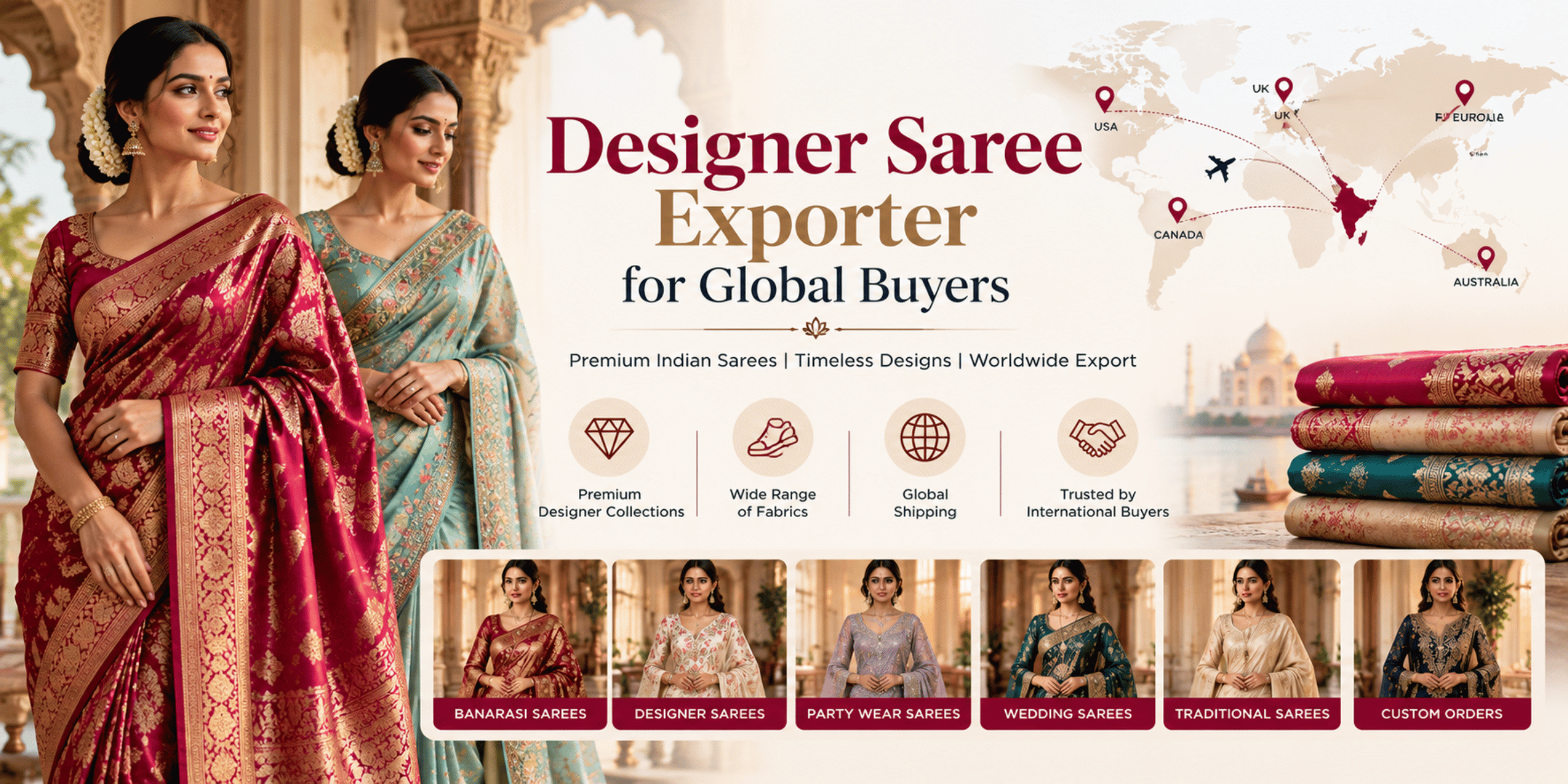
Fashionexport helps international fashion buyers explore Indian ethnic wear and wholesale fashion collections, making it relevant for businesses searching for a Designer Saree Exporter for Global Buyers. Indian sarees are recognized for their variety of fabrics, colors, embroidery, prints, silhouettes, borders, and traditional craftsmanship. For international retailers, wholesalers, boutiques, and ecommerce businesses, sourcing designer sarees from India can provide access to collections that combine cultural heritage with modern fashion preferences.
The global fashion market has created opportunities for Indian ethnic wear to reach customers far beyond India. Sarees are purchased for weddings, festivals, cultural celebrations, parties, special occasions, and contemporary styling. As customer preferences become more diverse, international buyers increasingly look for suppliers that can provide different designs, fabrics, price points, and customization possibilities.
A Designer Saree Exporter for Global Buyers is a supplier or export-oriented fashion business that provides designer sarees to buyers outside India. Such buyers can include international boutiques, fashion retailers, online stores, distributors, wholesalers, department stores, ethnic-fashion businesses, and private-label brands.
The role of an exporter can extend beyond simply supplying products. International buyers may require assistance with product selection, samples, specifications, customization, packaging, branding, order coordination, documentation, and shipment preparation.
For a retailer, the right supplier can make it easier to develop a collection that matches its target market. Instead of selecting products randomly, buyers can organize their purchasing strategy around customer demographics, seasonal demand, retail pricing, fabric preferences, and fashion trends.
India has a long-established textile and garment industry with extensive experience in saree production. Different regions have developed distinctive weaving, printing, embroidery, dyeing, and embellishment traditions.
This variety allows international buyers to source multiple product categories from one country. A retailer may want lightweight printed sarees for everyday wear, embellished sarees for parties, embroidered sarees for weddings, and premium designs for festive collections.
Indian saree manufacturing also provides opportunities for contemporary interpretation. Traditional design elements can be combined with modern colors, fabrics, borders, embellishments, and styling details to create products suitable for younger and international audiences.
For global retailers, this combination of traditional identity and contemporary design can provide a broader assortment.
A strong wholesale collection usually includes several product categories rather than relying on one design style.
Embroidered sarees can include thread work, sequins, motifs, borders, floral patterns, geometric details, and other decorative elements. They can be positioned for weddings, parties, festive events, and special occasions.
Printed sarees can provide an accessible option for everyday fashion and seasonal collections. Floral, abstract, geometric, digital, traditional, and contemporary prints can be used to create different visual identities.
Party wear sarees often focus on visual impact. Shimmer fabrics, sequins, metallic accents, decorative borders, and contemporary color combinations can appeal to customers looking for occasion-focused outfits.
Wedding collections can include heavily embellished styles, traditional-inspired designs, rich fabrics, embroidery, and decorative borders. Retailers serving wedding customers may build separate collections for brides, wedding guests, family members, and celebration events.
Festive sarees can combine traditional aesthetics with modern styling. They can be promoted around cultural celebrations, religious festivals, holiday seasons, and special shopping periods.
Lightweight sarees can be useful for international customers who want comfortable ethnic fashion. Fabrics such as chiffon, georgette, crepe, and lightweight blends can offer easier movement and practical wear.
Fabric plays a major role in the appearance, comfort, price, and positioning of a saree. International buyers should consider the climate and lifestyle of their target market before finalizing a collection.
Georgette can provide a flowing appearance and is frequently used for contemporary saree designs. Chiffon is lightweight and suitable for elegant styling. Crepe can provide a smooth drape, while satin can create a more polished and occasion-focused appearance.
Organza has a structured and lightweight visual character that can work well for modern designer collections. Cotton and cotton blends can be suitable for customers looking for breathable and practical products. Rayon and viscose can provide additional options for affordable fashion collections.
Silk and silk-blend fabrics may be considered for premium and traditional collections.
A Designer Saree Exporter for Global Buyers should be able to communicate fabric specifications clearly so buyers can make appropriate purchasing decisions.
International retailers should avoid building their entire collection around one category. A balanced assortment can include multiple price levels, colors, fabrics, and design styles.
For example, an online boutique could organize its assortment into:
This approach gives customers multiple reasons to browse the collection.
Retailers can also organize products by color. Neutral colors can appeal to customers seeking versatile styling, while brighter shades can support festive and celebration-focused collections.
A saree collection designed for one market may not necessarily perform identically in another market. Retailers should understand the preferences of their own customers.
Factors can include:
International buyers can use their previous sales data to identify which categories deserve greater purchasing attention.
Minimum order quantity is an important part of international sourcing. Buyers should understand the supplier's MOQ before planning a collection.
Large retailers may purchase substantial quantities of selected designs, while smaller boutiques may prefer smaller mixed collections.
A buyer can ask about:
Understanding these requirements early can make purchasing more predictable.
Samples allow international buyers to evaluate the actual product before committing to a larger order.
A sample can help the buyer assess:
For customized orders, sample approval is particularly important. The approved sample can become a reference point for subsequent production.
Quality control should be considered throughout the sourcing process rather than only after production.
Retailers can establish specifications for:
Consistent quality becomes particularly important when products are sold under a retail or private-label brand.
A Designer Saree Exporter for Global Buyers can help international buyers coordinate product requirements and maintain clearer communication during sourcing.
Customization allows retailers to create collections that match their own market.
Possible customization areas can include:
For example, a boutique may want a particular color palette for its seasonal collection. Another retailer may want a private-label package featuring its own brand name.
Customization can help a retailer differentiate its collection from standard wholesale products.
Private labeling is particularly relevant for established fashion businesses. Under a private-label model, the products can be developed or sourced for sale under the retailer's own brand.
The buyer may need to define:
Private-label sourcing usually requires more planning than standard wholesale purchasing, making communication and sample approval important.
Pricing is another major factor when sourcing designer sarees.
International retailers should calculate the complete landed cost rather than looking only at the supplier's product price.
Potential costs may include:
Once these factors are understood, the retailer can establish an appropriate retail pricing structure.
Indian sarees can be marketed across different seasons and occasions.
International retailers can plan collections around:
Seasonal planning helps buyers avoid last-minute purchasing and gives suppliers more time to prepare production.
Instagram has become an important visual platform for fashion discovery. International buyers can use Instagram to explore saree designs, styling ideas, color combinations, embroidery details, and new collections.
Fashion businesses can also use Instagram to communicate their own product launches. Product photography, short videos, styling reels, close-up embroidery shots, and collection presentations can help customers understand the products.
For a supplier, maintaining an active Instagram presence can also make it easier for potential buyers to discover new designs.
Good product photography is important for international ecommerce retailers because customers cannot physically inspect the saree before ordering.
Product images should ideally communicate:
Close-up images can help customers understand intricate details.
Retailers should also provide accurate descriptions rather than relying entirely on photographs.
Search engines and AI-powered search systems need clear information to understand product pages.
An international saree retailer can make product information easier to interpret by clearly stating:
Structured information can improve the clarity of ecommerce pages for both customers and search systems.
International sourcing is often more efficient when buyers develop long-term relationships with reliable suppliers.
A long-term relationship can make it easier to:
Rather than treating every order as a separate transaction, retailers can develop a structured sourcing process.
Fashionexport provides an online platform where international buyers can explore Indian fashion products and learn more about sourcing opportunities.
For businesses searching for a Designer Saree Exporter for Global Buyers, the Fashionexport website can serve as a starting point for exploring Indian ethnic fashion collections.
International buyers can review product categories, understand the supplier's offering, communicate requirements, and develop purchasing plans based on their target market.
A successful international saree business depends on product selection, supplier reliability, quality consistency, pricing, presentation, and market understanding. Indian sarees provide international retailers with a wide range of traditional and contemporary fashion possibilities.
By carefully evaluating suppliers, requesting samples, defining specifications, planning seasonal collections, and understanding customer preferences, international buyers can create stronger saree assortments.
A professional Designer Saree Exporter for Global Buyers can support this process by providing product variety, customization possibilities, wholesale sourcing, and export-oriented coordination.
For international retailers, the goal should be to build a collection that combines attractive design, dependable quality, suitable pricing, and clear product information. With structured sourcing and consistent communication, Indian designer sarees can become a valuable part of a global fashion retail strategy.
The international saree market offers opportunities for retailers that understand how to combine Indian design heritage with the expectations of modern global customers. A Designer Saree Exporter for Global Buyers can help businesses source products for boutiques, ecommerce stores, ethnic fashion retailers, wholesalers, distributors, and private-label brands.
While product quality is central to successful sourcing, international buyers also need to consider collection planning, branding, packaging, inventory, digital marketing, customer education, and repeat purchasing. A well-organized sourcing strategy can help a retailer build a recognizable saree collection rather than simply purchasing individual products.
Before placing a bulk order, buyers should evaluate the supplier across several areas.
Important considerations include:
No single factor should be considered independently. A low product price, for example, does not necessarily provide the lowest overall sourcing cost if quality, packaging, or communication creates additional problems.
International buyers often need a supplier capable of supporting different collections throughout the year.
A supplier's product range may include:
Collection depth also matters. Retailers may want multiple colors or variations of a popular design.
A Designer Saree Exporter for Global Buyers with a broad product offering can give retailers greater flexibility when planning seasonal assortments.
International fashion retailers need to respond to trends while maintaining a consistent brand identity.
For example, a retailer specializing in modern ethnic fashion may prefer:
A retailer serving traditional customers may focus more heavily on:
The important point is that trend selection should be connected to the retailer's customer base.
Retailers can organize their saree inventory according to customer groups.
These customers may prefer practical fabrics, comfortable designs, moderate pricing, and versatile colors.
These customers may search for party wear, wedding wear, festive sarees, embroidery, and decorative details.
Premium customers may look for distinctive designs, higher-value fabrics, detailed craftsmanship, limited collections, and exclusive branding.
Younger shoppers may respond to contemporary colors, lighter fabrics, modern styling, fusion looks, and social-media-friendly designs.
Segmenting the collection can make ecommerce navigation and physical retail merchandising easier.
Color selection should be connected to the retailer's market and collection theme.
A balanced assortment can include neutral shades, pastel tones, bright colors, deep shades, metallic accents, and seasonal colors.
Retailers should avoid purchasing excessive quantities of one color unless their historical sales data supports that decision.
A useful approach is to combine proven colors with a smaller number of experimental shades. This allows a retailer to introduce newness while maintaining familiar options.
For many saree customers, the blouse is an important part of the purchase decision.
International buyers should confirm whether the saree includes:
Clear product information can reduce customer confusion after purchase.
Packaging protects products during transportation and also contributes to brand presentation.
Retailers should discuss packaging requirements before production.
Depending on the business model, packaging can include:
Premium retailers may require more customized presentation, while value-focused businesses may prioritize efficient and protective packaging.
A Designer Saree Exporter for Global Buyers can be particularly valuable to retailers developing private-label collections.
Private-label branding can help a retailer establish a unique identity. The retailer may determine the collection name, packaging, labels, color direction, and product positioning.
Private-label projects should begin with clear specifications. Buyers should communicate their expectations regarding materials, measurements, embroidery, packaging, and branding before production begins.
A structured sampling process can reduce misunderstandings.
The buyer can review the sample and provide feedback on:
Once the sample is approved, the production requirements should be documented clearly.
This becomes particularly important for repeat orders because the retailer may want the next production batch to match the previously approved product.
International retailers should plan orders well in advance.
Production timing can depend on:
Custom and private-label products can require additional planning compared with ready-to-ship products.
Retailers should therefore communicate seasonal launch dates to suppliers as early as possible.
Inventory management is critical because international businesses must balance product availability with inventory investment.
Too little inventory can result in missed sales. Too much inventory can increase storage costs and reduce cash flow.
Retailers can monitor:
This information can guide future wholesale orders.
When a design performs well, retailers may want to reorder it.
Before placing the reorder, buyers should confirm whether:
Keeping clear product records can make repeat ordering easier.
Some retailers may want exclusive designs or collections.
Exclusive collections can be based on:
For a boutique, exclusivity can help differentiate its product assortment from competitors.
Sustainability has become an increasingly visible consideration in fashion sourcing.
International buyers may ask suppliers about:
Retailers should communicate specific sustainability requirements rather than using broad claims.
If a business promotes an environmental attribute, the supporting product or supply-chain information should be accurate and verifiable.
Climate can influence product selection.
For warmer markets, retailers may explore breathable or lightweight fabrics. For cooler markets, heavier fabrics and layered styling may be more relevant.
International retailers can also create seasonal collections based on their local climate rather than simply following the Indian fashion calendar.
Some international customers may be familiar with sarees, while others may be discovering them for the first time.
Retailers can make sarees easier to understand by providing:
Instagram can be particularly useful for visual styling education.
Instagram can support several stages of the customer journey.
Retailers can use it for:
For B2B suppliers, Instagram can also function as a visual portfolio where potential buyers discover designs and collections.
Online retailers should organize their saree catalog clearly.
Useful categories can include:
Filters can include color, fabric, occasion, price, pattern, and collection.
Good organization allows customers to find suitable products more quickly.
Search-friendly content should answer real customer questions.
A product page can explain:
This provides useful information to both customers and search engines.
For B2B pages, retailers can create dedicated landing pages around terms such as wholesale sarees, Indian saree supplier, designer saree exporter, private-label sarees, and Indian ethnic fashion sourcing.
AI-powered search systems generally benefit from content that provides direct, clearly organized answers.
For a saree sourcing website, important information should be easy to identify.
For example:
Product: Designer Saree
Fabric: Georgette
Use: Party and occasion wear
Market: International wholesale
Customization: Available depending on requirements
Order Type: Wholesale and private label
Clear information helps users understand the product without reading unnecessary marketing language.
Clear communication is one of the most important parts of export sourcing.
International buyers should provide:
Suppliers should respond with clear information about availability, pricing, MOQ, sampling, production, and shipment planning.
A written specification can reduce misunderstandings.
International orders can involve commercial and shipping documentation.
Buyers should discuss documentation requirements with the supplier and relevant logistics or customs professionals based on the destination country.
The exact requirements can vary according to the destination, product classification, shipping method, and applicable regulations.
Planning documentation early can help reduce avoidable delays.
A Designer Saree Exporter for Global Buyers can become a long-term sourcing partner when communication and order management remain consistent.
Long-term relationships can provide advantages such as:
Retailers can also provide suppliers with feedback about customer preferences and product performance.
International buyers should avoid making purchasing decisions based only on photographs.
Other common mistakes include:
A structured sourcing checklist can prevent many of these issues.
Before confirming an order, international buyers can review:
This checklist can make international purchasing more organized.
Fashionexport provides an online destination for businesses exploring Indian fashion products for wholesale and international sourcing.
Retailers searching for a Designer Saree Exporter for Global Buyers can use Fashionexport to explore available fashion categories and understand the type of Indian ethnic wear that may suit their business.
The supplier relationship should begin with clear requirements. Buyers can communicate their target market, preferred products, expected quantities, design direction, and customization requirements to determine whether the available sourcing options fit their needs.
Sarees can also become part of a broader Indian ethnic fashion collection.
International retailers may expand into:
This can help retailers create a more complete Indian fashion assortment.
Cross-selling can also increase customer choice by allowing shoppers to build complete outfits.
International retailers should evaluate their saree collection using actual sales data.
Useful metrics can include:
These measurements can guide future sourcing decisions.
Customer reviews and direct feedback can reveal useful information about:
Retailers can share relevant product feedback with their supplier to improve future collections.
Once a retailer has developed a successful saree collection, it may explore additional geographic markets.
However, expansion should consider differences in:
A product that performs well in one market should not automatically be assumed to perform identically elsewhere.
Repeat purchasing can become more efficient when buyers maintain accurate product records.
For every successful design, retailers can maintain information about:
This information creates a useful foundation for future purchasing.
A Designer Saree Exporter for Global Buyers supplies designer and fashion sarees to international retailers, wholesalers, boutiques, ecommerce businesses, distributors, and private-label brands.
Yes. International retailers can source Indian sarees through wholesale and export-oriented suppliers, subject to the supplier's MOQ, product availability, commercial terms, and destination requirements.
Buyers can explore embroidered, printed, party wear, wedding, festive, lightweight, traditional-inspired, and contemporary designer sarees.
Customization may include fabric, color, print, embroidery, border, packaging, labels, and other product specifications depending on the supplier and order requirements.
Samples allow buyers to evaluate product quality, fabric, color, finishing, measurements, embroidery, and overall appearance before placing a larger order.
Private-label sourcing can allow retailers to sell sarees under their own brand, subject to supplier capabilities, minimum quantities, customization requirements, and agreed specifications.
Instagram can help retailers and suppliers showcase collections, demonstrate styling, introduce new products, publish reels, and visually communicate product details to potential customers.
Buyers should review product quality, design range, fabric options, MOQ, samples, customization, packaging, communication, production timelines, and export-related requirements.
International saree sourcing requires more than finding attractive designs. Retailers need a supplier that can understand product specifications, quality expectations, quantities, branding requirements, seasonal planning, and international purchasing needs.
A Designer Saree Exporter for Global Buyers can provide an important connection between Indian fashion production and international retail businesses. By evaluating suppliers carefully, approving samples, defining specifications, planning inventory, and developing clear branding, retailers can create collections that serve their customers effectively.
Fashionexport provides an online platform for international businesses interested in Indian fashion sourcing. Buyers can explore the company's product offerings through its website and use Instagram for additional visual fashion discovery.
For international retailers, successful saree sourcing is ultimately about creating the right combination of design, quality, pricing, presentation, and customer relevance. A structured approach can make the purchasing process clearer and support long-term collection development.
Whether the objective is wholesale purchasing, boutique sourcing, ecommerce retail, private labeling, or international distribution, Indian designer sarees provide a broad range of opportunities for global fashion businesses. With careful supplier evaluation and consistent communication, retailers can build distinctive collections that connect Indian fashion craftsmanship with customers around the world.