
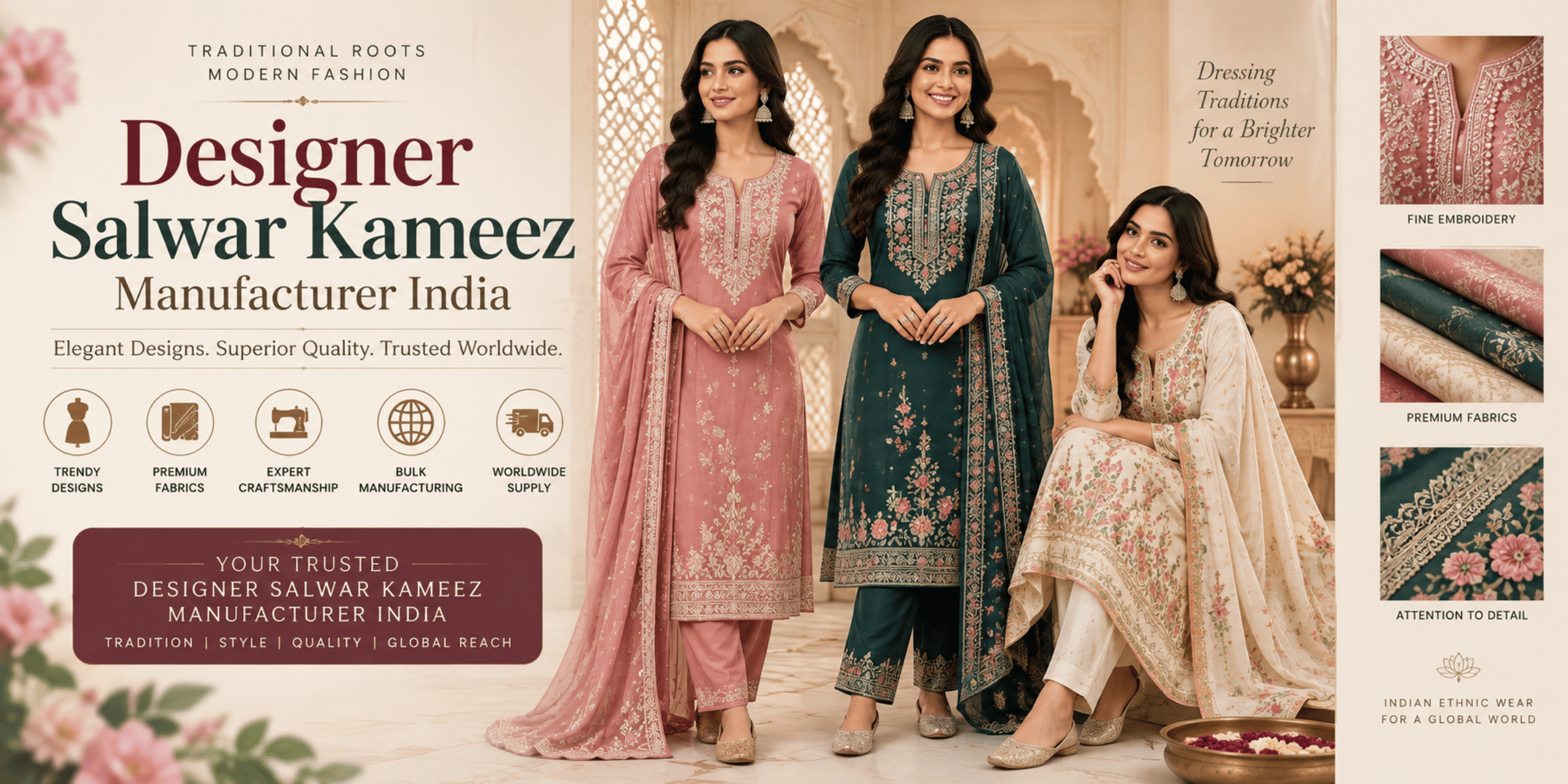
The demand for stylish, comfortable, and culturally inspired ethnic clothing continues to grow across domestic and international fashion markets. For boutiques, retailers, online fashion stores, wholesalers, and private-label brands, choosing the right Designer Salwar Kameez Manufacturer India can make a significant difference in product quality, collection variety, pricing, and customer satisfaction. Fashionexport is an Indian fashion manufacturing and sourcing company helping businesses explore a wide range of Indian ethnic wear collections. Buyers can explore the company and its offerings through Fashionexport and connect with the brand through Instagram for new fashion updates, collection inspiration, and product ideas.
Salwar kameez is one of India's most recognizable traditional clothing categories. The outfit generally combines a kameez or kurta with salwar trousers and may be paired with a dupatta. Modern designers have transformed this classic combination into numerous silhouettes suitable for festive occasions, parties, weddings, celebrations, office wear, casual use, and everyday fashion.
The contemporary salwar kameez market is highly diverse. Customers look for attractive prints, detailed embroidery, premium fabrics, comfortable cuts, fashionable necklines, stylish sleeves, coordinated dupattas, and modern trouser designs. This diversity creates opportunities for businesses that work with an experienced Designer Salwar Kameez Manufacturer India.
A professional manufacturer can develop collections around specific market requirements rather than producing only generic designs. This allows buyers to create collections that match their target customers, price points, seasons, and retail channels.
Designer salwar kameez combines traditional Indian aesthetics with modern fashion preferences. Its versatility is one of the main reasons it remains relevant across different customer groups.
The outfit can be designed in lightweight fabrics for summer, richer materials for festive collections, embellished styles for weddings, and comfortable printed versions for everyday wear.
Several factors contribute to its popularity:
For retailers, this versatility makes salwar kameez an adaptable category that can support multiple product segments.
A reliable Designer Salwar Kameez Manufacturer India plays an important role in turning fashion concepts into finished garments. Manufacturing involves much more than stitching fabric together. It can include design development, fabric selection, pattern making, cutting, embroidery, printing, stitching, finishing, quality inspection, packaging, and order coordination.
A professional manufacturing process begins with understanding the buyer's requirements. The manufacturer may consider the target market, collection type, preferred fabric, size range, colors, embellishment level, quantity, and budget.
This approach helps businesses receive products that are more closely aligned with their commercial objectives.
Design development is one of the most important stages in ethnic wear manufacturing. A successful collection needs a balance between traditional inspiration and contemporary fashion.
Designers can work on:
An experienced Designer Salwar Kameez Manufacturer India can help buyers transform these concepts into commercially practical garments.
The design should not only look attractive on a display image. It should also be comfortable, manufacturable, consistent in sizing, and suitable for the intended retail price.
Fabric selection directly influences the appearance, comfort, durability, and pricing of salwar kameez.
Different collections may require different materials. Cotton is widely suitable for comfortable everyday garments, while rayon can offer a soft drape and contemporary appearance. Georgette and chiffon can create flowing silhouettes, while silk-based fabrics can provide a richer festive look.
Other options may include:
The right material depends on the garment's purpose and target market. A manufacturer should consider fabric behavior during cutting, stitching, washing, printing, embroidery, and finishing.
Printed salwar kameez remains an important category because prints provide significant design flexibility.
Manufacturers can develop floral, geometric, abstract, traditional, digital, ethnic, and contemporary patterns. Print placement can also be customized to create different visual effects.
For example, a large floral print can create a statement appearance, while small repetitive motifs may be suitable for daily wear.
A Designer Salwar Kameez Manufacturer India can develop printed collections around seasonal color palettes and customer preferences.
Printed collections are particularly useful for businesses that need visually attractive products at accessible price points.
Embroidery can transform a simple salwar kameez into a more premium garment. It can be used around necklines, sleeves, yokes, hems, borders, cuffs, and dupattas.
Different embroidery techniques can create different levels of visual richness. Light embroidery may be appropriate for semi-formal collections, while heavier embellishment can be used for wedding and festive clothing.
Popular decorative approaches may include:
The key is maintaining a suitable balance between design detail, garment comfort, production time, and cost.
Festive fashion creates opportunities for more decorative salwar kameez designs. Customers often look for richer colors, intricate details, attractive dupattas, and elegant silhouettes during celebrations.
Manufacturers can create collections featuring jewel tones, metallic accents, embroidery, decorative necklines, and premium-looking fabrics.
A good festive collection should offer variety while maintaining a consistent design identity.
For retailers, coordinated collections can make merchandising easier because multiple garments can be displayed together according to color, occasion, or design story.
Wedding and party wear salwar kameez can occupy a premium segment. These designs may feature elaborate embroidery, embellishment, layered silhouettes, rich fabrics, or statement dupattas.
The construction quality becomes particularly important in this category because embellishment adds weight and complexity to the garment.
A reliable Designer Salwar Kameez Manufacturer India should pay close attention to attachment quality, seam strength, finishing, lining, and overall garment balance.
Premium buyers also expect attractive packaging and consistent presentation.
Wholesale buyers increasingly look for customization rather than simply purchasing standard products. Customization allows businesses to differentiate their collections from competitors.
A buyer may request:
The level of customization depends on order quantity, manufacturing capability, design complexity, and production requirements.
Private-label manufacturing allows retailers and fashion brands to sell garments under their own brand identity.
A private-label project may involve creating a collection according to a brand's visual direction and applying its labels, packaging, tags, or other branding elements.
Working with a Designer Salwar Kameez Manufacturer India can help emerging fashion businesses build a recognizable ethnic wear collection without establishing their own manufacturing facility.
Private-label buyers should clearly communicate their design requirements, quality expectations, packaging needs, size specifications, and delivery schedules.
Quality control is essential because even attractive designs can create customer complaints if construction quality is inconsistent.
A professional production process should check different stages of manufacturing.
Quality inspection may include:
Attention to these details helps reduce production defects and improves consistency between different pieces in a wholesale order.
Sizing is particularly important for online fashion businesses because customers cannot physically try garments before purchasing.
Manufacturers should maintain consistent measurements across production batches. Buyers should provide clear measurement charts and communicate whether measurements should follow standard sizing or custom specifications.
A well-organized sizing system can improve customer confidence and reduce returns.
Common measurement considerations include:
The exact measurements depend on the design and target market.
Wholesale manufacturing enables businesses to purchase garments in larger quantities, generally making the per-unit production cost more competitive.
For boutiques and retailers, wholesale sourcing can provide access to broader collections without requiring them to manufacture each garment themselves.
A Designer Salwar Kameez Manufacturer India can support wholesale buyers by providing multiple designs within a single collection.
This allows retailers to build product variety while maintaining a consistent sourcing relationship.
Boutiques often need products that feel distinctive rather than mass-market. Designer salwar kameez can provide opportunities for boutique owners to create curated collections.
A boutique-focused collection might include a limited number of designs with carefully selected colors, fabrics, embroidery, and silhouettes.
Manufacturers can work with boutique buyers on smaller design ranges, subject to production requirements and order quantities.
The goal is to create a collection that reflects the boutique's target customer and pricing strategy.
Seasonal planning can help businesses maintain fresh inventory throughout the year.
Different seasons may influence fabric, colors, silhouettes, and decorative details.
Summer collections may emphasize lightweight fabrics and breathable constructions. Festive collections may introduce richer colors and decorative details. Wedding-season collections may focus on premium embroidery and statement silhouettes.
Working with a Designer Salwar Kameez Manufacturer India allows buyers to plan collections around their commercial calendar.
Color selection has a major visual impact on ethnic wear. Manufacturers and buyers can create collections using coordinated palettes rather than selecting colors randomly.
For example, a collection may combine:
A coordinated palette helps retailers create visually appealing displays and online catalogues.
The growth of online shopping has changed how ethnic wear is presented to customers. Product photography, descriptions, sizing information, fabric details, and styling suggestions now influence purchasing decisions.
Manufacturers supporting online fashion brands should provide consistent product specifications and accurate samples.
High-quality product images can show details such as embroidery, print quality, fabric texture, neckline construction, and dupatta design.
Instagram has become an important platform for fashion discovery. Fashion businesses can use Instagram to showcase new collections, styling ideas, behind-the-scenes manufacturing, product launches, and seasonal campaigns.
Fashionexport can also be followed on Instagram for fashion inspiration, collection updates, and ethnic wear content.
For manufacturers, social media visibility can help buyers understand the brand's design direction and product capabilities before starting a sourcing relationship.
Selecting the right Designer Salwar Kameez Manufacturer India requires more than comparing prices.
Buyers should evaluate:
A manufacturer that understands the buyer's market can often provide more useful long-term value than a supplier selected only for the lowest price.
Clear communication helps reduce mistakes during manufacturing. Buyers should provide product specifications in an organized format.
Important information can include:
When both sides understand the specifications, production becomes easier to manage.
Fashion businesses often benefit from developing long-term relationships with reliable manufacturers.
A consistent relationship can improve communication and make future product development more efficient. Manufacturers can better understand a buyer's preferred fabrics, sizing, design direction, quality expectations, and packaging requirements.
For this reason, selecting a Designer Salwar Kameez Manufacturer India should be considered a strategic sourcing decision rather than a one-time purchase.
Fashionexport provides businesses with an opportunity to explore Indian fashion manufacturing and sourcing solutions. Buyers looking for ethnic wear can connect with Fashionexport to discuss product categories, design requirements, manufacturing needs, and collection planning.
The company can be explored through Fashionexport, while Instagram can be used as an additional channel for discovering fashion updates and collection inspiration.
For retailers, boutiques, wholesalers, and private-label brands, choosing the right manufacturing partner can help create collections that balance design, quality, pricing, and market demand.
The Indian ethnic wear industry continues to provide strong opportunities for wholesalers, retailers, boutiques, online fashion stores, exporters, and private-label brands. Among the many traditional clothing categories, designer salwar kameez remains an important choice because it combines cultural identity, comfort, versatility, and contemporary fashion. Businesses looking for dependable sourcing can work with an experienced Designer Salwar Kameez Manufacturer India to develop collections according to their target customers, preferred price range, seasonal requirements, and market trends. Fashionexport supports businesses looking for Indian fashion sourcing and manufacturing solutions and can be explored through Fashionexport.
Wholesale sourcing allows fashion businesses to build a wider product catalogue without managing their own manufacturing infrastructure. Instead of developing every garment internally, retailers and wholesalers can work with manufacturers that already have experience in design development, production, quality inspection, finishing, and packaging.
Wholesale buyers can select collections according to different customer segments. A retailer may require affordable daily-wear styles, while a boutique may focus on embroidered premium designs. An online store may need highly photogenic contemporary designs, whereas an ethnic fashion wholesaler may require a broader combination of traditional and modern products.
A capable Designer Salwar Kameez Manufacturer India can help businesses explore different product categories while maintaining consistent manufacturing standards.
Boutiques generally look for collections that provide a distinctive visual identity. Instead of stocking only basic mass-market products, boutique owners can select carefully curated styles based on their customers.
A boutique collection may include:
The advantage of working with an experienced manufacturing partner is that buyers can discuss their preferred design direction before production.
Private labeling is increasingly relevant for fashion businesses that want to develop their own brand identity. Rather than selling products under a manufacturer's name, a private-label business can develop collections under its own branding.
Private-label manufacturing can include customized labels, tags, packaging, color selections, fabrics, embroidery, prints, and other product specifications.
For a growing fashion brand, an established Designer Salwar Kameez Manufacturer India can become an important part of its supply chain.
Before production, the buyer and manufacturer should establish clear specifications for design, measurements, fabrics, colors, branding, packaging, quantities, and delivery expectations.
Custom manufacturing allows businesses to move beyond ready-made designs. A buyer may have a particular concept inspired by a seasonal fashion direction, customer demand, or brand identity.
The manufacturer can work from:
The final production process should balance the desired design with technical manufacturing requirements.
Custom collections can be particularly valuable for businesses that want exclusive products instead of competing with identical products sold by multiple retailers.
Indian ethnic clothing has a strong connection with Indian communities around the world, while contemporary ethnic fashion also attracts customers interested in South Asian design.
International retailers and boutiques may source Indian garments for:
An experienced Designer Salwar Kameez Manufacturer India can help international buyers source products from India's established textile and garment ecosystem.
Export-oriented buyers should consider product specifications, packaging, documentation, delivery planning, and the requirements of their destination market.
For international buyers, manufacturing quality is only one part of successful sourcing. Product consistency and communication are equally important.
Export-focused collections should have clear information about:
Clear product information helps buyers prepare accurate catalogues and communicate effectively with their customers.
Not every customer wants the same type of salwar kameez. Understanding customer segments helps manufacturers and buyers create more effective collections.
Daily-wear customers usually prioritize comfort, practical fabrics, attractive prints, and easy maintenance.
Cotton, rayon, and other comfortable fabrics can be considered depending on the intended market.
Festive customers may prefer brighter colors, embroidery, decorative details, and more elaborate dupattas.
Wedding collections often require richer fabrics, heavier embroidery, embellishment, and premium presentation.
Younger customers may prefer fusion silhouettes, modern prints, contemporary colors, shorter or longer kurta options, and updated trouser combinations.
A diversified collection allows retailers to serve multiple segments.
Traditional clothing does not need to remain limited to traditional silhouettes. Modern fashion designers frequently reinterpret classic garments through updated proportions, fabrics, prints, and styling.
Modern salwar kameez can feature:
This combination of tradition and modern design can make ethnic wear more appealing to younger consumers.
Sustainability is becoming increasingly important in fashion sourcing. Businesses can consider responsible production practices when developing new collections.
Potential considerations include:
Sustainable manufacturing is not only an environmental consideration. Durable products can also provide stronger value to customers.
Efficient pattern cutting can help manufacturers use fabric more effectively. Proper planning of garment panels and production layouts can reduce unnecessary material waste.
Manufacturers can also improve efficiency by organizing production batches around similar fabrics, colors, and construction requirements.
For wholesale orders, production planning becomes especially important because large quantities magnify both efficiencies and mistakes.
Wholesale customers depend on consistency. If one garment meets expectations while another has significant differences in size, color, stitching, or embellishment, the retailer may face customer complaints.
Quality checks should therefore be performed throughout the production cycle.
Important inspection points include:
A professional Designer Salwar Kameez Manufacturer India should treat quality assurance as part of production rather than as an activity performed only at the end.
Samples provide an important opportunity to evaluate a design before larger production.
A buyer can inspect:
If adjustments are necessary, they can be discussed before bulk production begins.
Sample approval can help reduce the risk of producing a large quantity with an incorrect specification.
Production planning becomes increasingly important as order volumes increase.
Manufacturers may need to coordinate:
Proper sequencing helps avoid unnecessary production delays.
Buyers should also provide specifications early enough for the manufacturer to plan materials and production capacity.
Packaging is part of the customer experience. For premium and private-label brands, product presentation can influence how customers perceive the overall value of a garment.
Depending on the market, packaging can include:
Wholesale buyers should discuss packaging expectations before production begins.
A fashion retailer should ideally have a balanced catalogue instead of relying on a single design category.
For example, a salwar kameez catalogue may include:
This product mix gives customers different choices across price and occasion categories.
Pricing depends on several factors, including fabric, design complexity, embroidery, construction, quantity, packaging, customization, and overall product specifications.
Wholesale businesses should calculate more than the garment's manufacturing price. They should also consider:
A reliable manufacturing partner can help businesses understand how design choices influence production costs.
A highly detailed garment may look impressive but may not always be commercially practical. Likewise, a very simple design may not provide enough differentiation.
Successful collections generally balance:
Design + Quality + Comfort + Price + Market Demand
Manufacturers and buyers should consider these factors together rather than evaluating design in isolation.
India has a long-established textile and garment ecosystem with access to diverse fabrics, traditional craftsmanship, printing techniques, embroidery capabilities, and modern garment production.
This combination allows fashion businesses to explore products ranging from simple daily-wear garments to highly decorated festive collections.
For international buyers, working with an Indian manufacturer can also provide access to traditional design knowledge combined with modern fashion production.
Technology continues to influence garment manufacturing. Digital design tools, computerized embroidery, digital printing, inventory systems, production planning software, and online communication can make collaboration more efficient.
Digital tools can also help manufacturers and buyers exchange product specifications more clearly.
For custom collections, digital references can make it easier to communicate:
Technology therefore complements rather than replaces traditional garment expertise.
Once a collection is manufactured, effective marketing becomes important.
Fashion brands can promote salwar kameez through:
Instagram is particularly useful for visual fashion content. Brands can post product photographs, styling videos, collection launches, behind-the-scenes content, and customer styling ideas.
Fashionexport can also be explored through its website and Instagram presence for fashion collection inspiration and business updates.
Product photography is especially important for online fashion businesses.
Images should clearly show:
Clear images help customers understand what they are purchasing.
For online retailers, product descriptions should be informative and easy for both users and search engines to understand.
A good description can clearly state:
Natural language is preferable to excessive keyword repetition.
Look for manufacturing quality, design capability, fabric choices, customization options, communication, quality control, production consistency, packaging, and reliable order coordination.
Yes. Depending on the manufacturer's capabilities and order requirements, buyers may customize fabrics, colors, prints, embroidery, measurements, labels, tags, packaging, and other specifications.
Cotton, rayon, georgette, chiffon, crepe, viscose, silk blends, jacquard, linen blends, and other suitable fabrics can be used depending on the design and intended market.
Yes. Designer salwar kameez can be developed for wholesale collections serving boutiques, retailers, online stores, exporters, and private-label fashion businesses.
Yes. International buyers can source Indian ethnic wear for boutiques, retail stores, online businesses, celebrations, and South Asian fashion markets, subject to their specific import and commercial requirements.
Quality control is essential for maintaining consistent sizing, stitching, fabric quality, embroidery, print placement, finishing, and overall garment appearance.
Yes. Seasonal collections can be planned around weather, festivals, wedding seasons, color directions, customer demand, and retail calendars.
The future of salwar kameez is likely to combine traditional aesthetics with contemporary fashion preferences. Customers increasingly want clothing that reflects cultural identity while also offering comfort, versatility, and modern styling.
Manufacturers can respond through innovative fabrics, new silhouettes, digital prints, refined embroidery, coordinated sets, customizable designs, and more efficient production.
The growth of online fashion retail is also creating opportunities for manufacturers to serve businesses beyond their local markets.
A capable Designer Salwar Kameez Manufacturer India can support this evolution by combining design development, manufacturing expertise, quality control, customization, and efficient sourcing.
Fashionexport is positioned to support businesses looking for Indian fashion sourcing and manufacturing solutions. The company can be considered by wholesalers, retailers, boutiques, exporters, and private-label brands that want to explore Indian ethnic wear collections.
Businesses can visit Fashionexport to learn more about the company's fashion offerings and connect with the brand.
Following Fashionexport on Instagram can also provide an additional way to discover fashion inspiration, collection updates, ethnic wear designs, and new product ideas.
Before placing an order, buyers should prepare a clear product brief.
The brief can include:
Buyers should also confirm production specifications and approve samples where appropriate.
Clear planning at the beginning can help both the manufacturer and buyer manage expectations.
A successful ethnic wear business requires more than attractive garments. It requires consistent product quality, reliable sourcing, appropriate pricing, effective presentation, and strong customer communication.
Manufacturing partnerships become particularly valuable as a business grows.
A retailer that starts with a small collection may eventually require hundreds or thousands of pieces across multiple designs. Having an established manufacturing relationship can make scaling easier.
Designer salwar kameez continues to offer significant opportunities for wholesalers, boutiques, retailers, exporters, online fashion stores, and private-label brands. Its combination of tradition, comfort, design flexibility, and modern styling makes it suitable for a wide range of customers and occasions.
Choosing the right Designer Salwar Kameez Manufacturer India can help businesses develop collections that match their target market while maintaining attention to fabrics, design, sizing, customization, production quality, and presentation.
From printed daily-wear suits to embroidered festive collections, premium party wear, customized private-label products, and export-oriented ranges, the possibilities are broad. Businesses that carefully plan their product requirements and establish clear communication with their manufacturing partner can build stronger and more consistent ethnic wear collections.
Fashionexport provides a platform for businesses interested in exploring Indian fashion manufacturing and sourcing. By combining design possibilities with manufacturing support and an understanding of ethnic fashion, Fashionexport can be considered by businesses looking to develop or expand their salwar kameez collections.
For more information and fashion sourcing opportunities, visit Fashionexport and explore Fashionexport's Instagram for additional fashion inspiration and collection updates.