
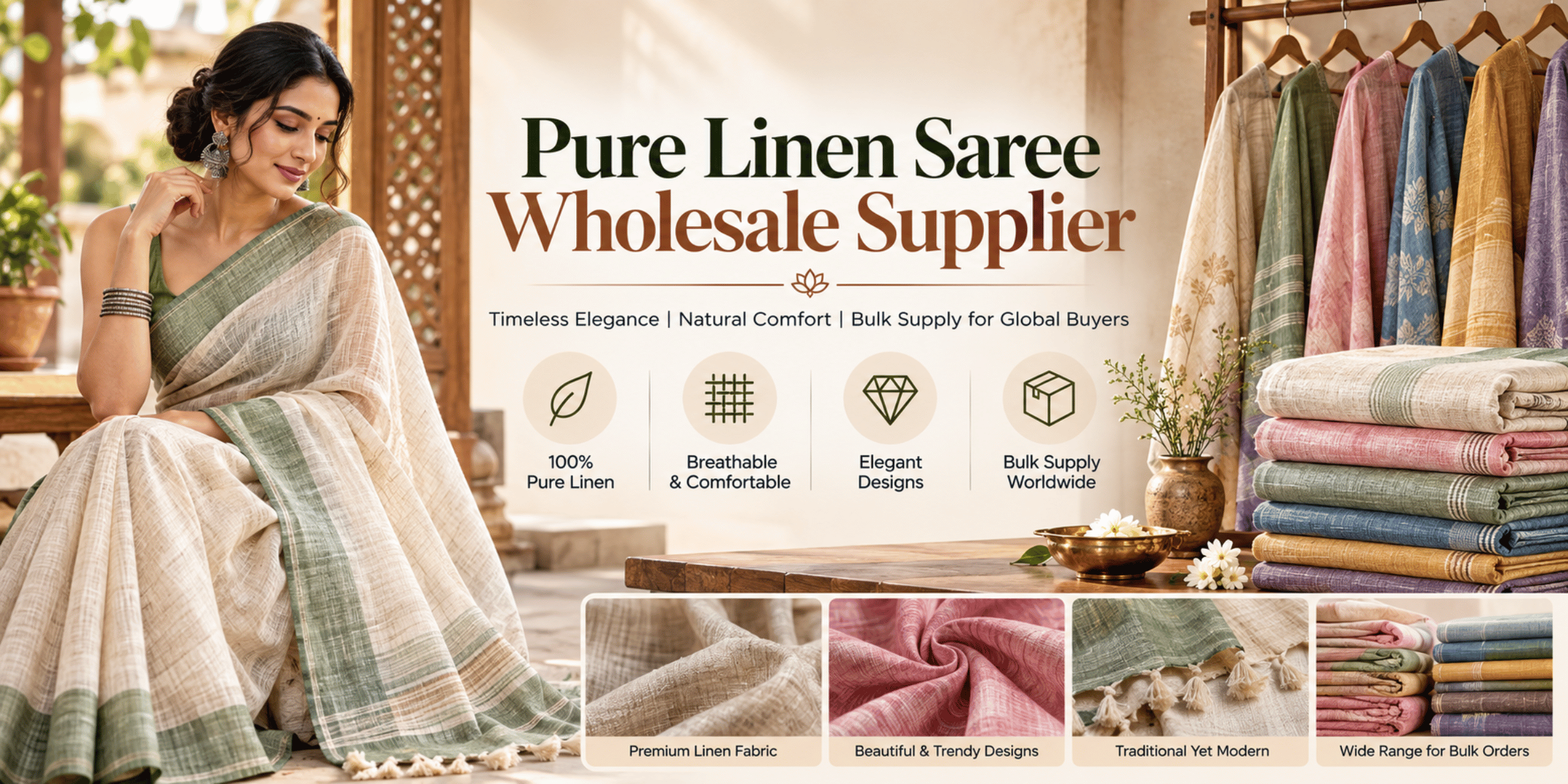
Fashionexport is a Surat-based ethnic wear sourcing partner that helps boutiques, retailers, wholesalers, and importers around the world buy Indian sarees directly from manufacturers. If you are searching for a reliable Pure Linen Saree Wholesale Supplier, this two-part guide explains what you need to know before placing a bulk order. It covers what pure linen is, which weaves and finishes sell best, how to check fabric quality, how pricing and export work, and how to choose the right partner. Visit Fashionexport to explore current saree collections, and follow Fashionexport on Instagram for new arrivals and fashion updates.
A Pure Linen Saree Wholesale Supplier is a business that manufactures, sources, or aggregates linen sarees and sells them in bulk to boutiques, retail stores, online sellers, and international importers. Instead of buying single pieces at retail prices, buyers purchase full catalogs, sets of designs, or fixed quantities at wholesale rates, which leaves room for a healthy resale margin.
Linen sarees have grown into one of the most requested categories in Indian ethnic wear over the last few years. They are known for a breathable, textured feel, a natural matte sheen, and an effortless drape that works equally well for office wear, casual outings, and understated festive looks. Office-goers, working professionals, and customers who prefer minimal, fuss-free fashion ask for linen sarees again and again, so demand stays steady across India and in export markets such as the USA, the UK, Canada, Australia, Malaysia, Singapore, Mauritius, and Fiji.
Key points for quick reading:
Who buys from a wholesale supplier? Typical buyers include daily-wear and office-wear boutiques, multi-designer showrooms, online resellers, corporate gifting companies, and overseas retailers who serve customers looking for comfortable, breathable ethnic wear. A boutique owner may want fifteen to twenty exclusive colours. An online seller may want lightweight, easy-to-ship pieces that photograph cleanly. An importer may want large volumes with consistent texture and weight across every lot.
How does a supplier differ from a retailer? A retailer sells one saree at a time to the end customer, so the price includes retail markup, shop rent, and marketing cost. A wholesaler sells in quantity, so the price per piece is lower, but the buyer commits to minimum quantities. A manufacturer-supplier goes one step further by controlling weaving and finishing. That improves consistency, allows customization, and makes repeat orders easier. When you search for a Pure Linen Saree Wholesale Supplier, you are usually looking for this manufacturer-supplier model, because it gives the best mix of price, quality, and reliability.
Why is India the right place to source? India has a long-standing linen weaving tradition, with clusters in West Bengal, Tamil Nadu, and other textile belts producing high-quality linen and linen-blend fabrics. Surat in Gujarat is well known for large-scale textile trading and finishing, which gives buyers access to a wide range of linen sarees, from handwoven jamdani-style pieces to printed and embellished designs that suit everyday retail budgets.
What makes linen different from other saree fabrics? Cotton sarees are soft and absorbent but can crease quickly. Silk sarees are rich and formal but heavier and warmer. Linen sits between the two: it breathes well like cotton, holds its shape with a subtle structured drape like silk, and develops a natural, slightly crinkled texture that many customers find appealing rather than a flaw. For a retailer, this means linen sarees appeal strongly to customers who want comfort, versatility, and an understated premium look.
What should a buyer expect from a good supplier? A trustworthy partner shares clear product details, provides real photos and videos, explains the fabric composition honestly, offers reasonable minimum order quantities, and supports the buyer after the sale. This is where an experienced sourcing partner such as Fashionexport adds value. The company works with retailers and importers across more than forty countries and understands the practical needs of bulk ethnic wear buyers, including packaging, documentation, and timelines.
The sections that follow cover the background of linen weaving in India, the main saree types, how to judge quality, and why sourcing from a specialist Pure Linen Saree Wholesale Supplier can protect both your margins and your reputation.
Linen has moved from a niche, high-end fabric to one of the most searched saree categories among working women, minimalist dressers, and festive shoppers who want something lighter than silk. Understanding why this shift happened helps a retailer explain the value of linen sarees to customers and stock the category with confidence.
Comfort in daily wear. Linen fibres are naturally breathable and absorb moisture well, which makes linen sarees comfortable for long working hours, warm climates, and travel. Customers who previously avoided sarees for daily office wear because of heat or discomfort have found linen to be a practical alternative to synthetic fabrics.
A natural, premium texture. Linen has a distinct slubby texture and a soft sheen that looks elegant without needing heavy embellishment. This natural richness lets customers wear a plain linen saree for formal meetings or pair a printed linen saree with simple jewellery for festive days, which adds to the fabric's everyday versatility.
Sustainability appeal. Linen is made from the flax plant and is often marketed as a more sustainable, biodegradable fibre compared to fully synthetic fabrics. Many customers, especially younger and export-market buyers, actively look for natural-fibre clothing, and linen fits that preference well.
Strength and durability. Linen fibres are strong and tend to improve in softness with wear and washing, so sarees made from pure linen can last through regular use without losing shape quickly. This durability supports word-of-mouth recommendations and repeat purchases.
Design flexibility. Linen takes dye and print beautifully, which allows suppliers to offer solid colours, block prints, ikat-style patterns, jamdani motifs, and tissue or zari borders on linen base fabric. This flexibility lets a single Pure Linen Saree Wholesale Supplier serve very different customer segments, from minimal office wear to festive linen with zari borders.
Who is buying linen sarees today? Working professionals who want comfortable yet stylish daily wear form the largest segment. Beyond them, gifting buyers choose linen sarees for corporate gifting and festive hampers because the fabric feels premium without being overly ornate. Boutique owners add linen to their collections to balance heavier silk and georgette ranges, giving customers a lighter, year-round option.
How should you build a starter range? A practical approach is to divide your first order into three groups:
This structure keeps your inventory balanced and helps you learn which segment your customers prefer before you increase volumes.
What about care and practicality? Linen is known for natural creasing, which some customers see as part of the fabric's character and others find inconvenient. A good Pure Linen Saree Wholesale Supplier will guide you on which linen variants are easier to maintain, such as linen-cotton blends sold alongside pure linen ranges, so you can offer options for customers with different lifestyle needs. Always label pure linen and blended linen separately, since customers expect accurate information.
Working with a supplier who offers wide variety makes it easier to test the market. The right Pure Linen Saree Wholesale Supplier will let you mix solids, prints, and embellished designs in one order, share fresh catalogs regularly, and recommend combinations based on season and destination market. Fashionexport supports buyers who want assorted ethnic collections, so retailers can explore linen sarees alongside other categories from a single sourcing partner.
Next, we look at the main types of linen sarees you can stock, followed by how to judge fabric quality.
Linen sarees come in different weights, weaves, and finishes, and smart retailers build a balanced range instead of buying only one style. When you speak with a Pure Linen Saree Wholesale Supplier, ask which of the following categories are available and in what quantities.
Plain pure linen sarees. These sarees use a simple weave with a smooth, even texture, finished in solid colours. They are the most versatile option, suitable for office wear, daily styling, and as a neutral base for customers who prefer minimal accessories. A strong range of plain linen sarees is often the backbone of a linen collection.
Printed linen sarees. Block prints, digital prints, and floral or geometric patterns on a linen base combine comfort with visual interest. These sarees work well for casual outings, daytime festive events, and younger customers who want pattern without heavy embellishment.
Linen by linen sarees. This is a popular weave where fine linen yarn is combined with a slightly textured border, giving a richer finish than a basic plain linen saree while staying lightweight. These sarees suit customers who want a step up from plain linen without moving to a heavier fabric.
Jamdani work linen sarees. Hand-woven or machine-replicated jamdani motifs on linen create a traditional, artisanal look. These sarees usually carry a higher price point and appeal to customers who want a handcrafted feel for festive or gifting occasions.
Linen sarees with zari or tissue borders. Adding a zari border or a tissue pallu to a linen base elevates the saree for small celebrations, family functions, and corporate events, while keeping the overall weight much lighter than a silk saree.
Linen-cotton blend sarees. Though not pure linen, many suppliers sell linen-cotton blends alongside pure linen ranges. These are more crease-resistant and often more affordable, giving retailers an entry-level option to pair with their pure linen stock. Always label blends clearly and separately from pure linen pieces.
Beyond fabric type, buyers should understand common finishing styles, because these affect design and price:
Which type sells best? It depends on your market. Office-wear and daily-wear retailers usually prefer plain and printed linen sarees in practical colours. Boutiques serving festive and gifting customers often choose jamdani work and zari-border linen sarees. Online sellers commonly lean towards printed and solid linen pieces because they photograph well and reduce return risk. Overseas buyers frequently combine several styles: a strong base of solid and printed linen for daily wear, a smaller range of jamdani or zari-border pieces for festive gifting, and a few linen-cotton blends for budget-conscious shoppers.
What about design details? Look closely at the border width, pallu design, print clarity, and colour depth. A clean solid colour with a subtle woven border suits office-wear customers. A detailed block print or jamdani motif suits festive and gifting customers. Also check whether the saree comes with a matching or contrast blouse piece, since customers expect coordinated unstitched blouse fabric, and missing blouse details can lead to complaints.
Working with a supplier who offers wide variety makes it easier to test the market. The right Pure Linen Saree Wholesale Supplier will let you mix plain, printed, and embellished styles in one order, share fresh catalogs regularly, and recommend combinations based on season and destination market. Fashionexport supports buyers who want assorted ethnic collections, so retailers can explore linen sarees alongside kurtis, salwar kameez, and other categories from a single sourcing partner.
Next, we look at how to judge whether the fabric, weave, and finish quality justify the price.
Quality is where wholesale buyers either protect or lose their margins. A linen saree that looks good in a photo but feels rough, crumples excessively, or loses colour after one wash can lead to returns and bad reviews. Use the checks below before you commit to bulk quantities from any Pure Linen Saree Wholesale Supplier.
Check the fibre composition. Ask the supplier to state clearly whether the saree is one hundred percent pure linen or a linen blend with cotton, viscose, or polyester. Pure linen feels slightly stiff when new, has a natural slubby texture, and softens with wash and wear. Blended linen can still look excellent and cost less, but it should be labelled honestly so your customers know exactly what they are buying.
Feel the texture and weight. Pure linen has a distinctive crisp yet breathable handle. Rub a small section of fabric between your fingers. It should feel natural and slightly textured, not overly smooth or plasticky, which can indicate heavy blending or finishing chemicals.
Check the weave density. Turn the saree over and examine the weave closely. A well-made linen saree has an even, consistent weave without thin patches or loose threads. Uneven weaving can cause the fabric to tear or fray more easily over time.
Look at colour and dye quality. Colours should look even across the body, border, and pallu, with no patchy or uneven dyeing. Ask about colour fastness, especially for deep or bright shades, since poor dyeing can bleed during the first wash.
Review the print quality, if applicable. For block-printed or digitally printed linen sarees, check that the print lines are sharp, the pattern repeats evenly, and the colours do not bleed into each other.
Compare the border and pallu finishing. The border and pallu are the focal points of a linen saree. Edges should be neatly finished without loose threads, and any added zari or embroidery should sit flat without puckering the base fabric.
Confirm the blouse piece. Check whether the blouse fabric matches or complements the saree in colour and texture, and confirm the length so customers are not disappointed.
Ask for real photos and videos. Studio images can hide texture details that matter for linen specifically, such as the natural crinkle and drape. Request natural-light photos, close-up shots of the weave, and short videos that show how the saree falls and moves. A reliable supplier will share these without hesitation.
Request a sample order. Before placing a large order, buy a small number of pieces. Test them for feel, colour, washing behaviour, and packaging. This costs a little more per piece but removes major risk, especially for a fabric like linen where texture matters as much as appearance.
Verify consistency across lots. One good sample does not guarantee that a bulk order will match. Ask how the supplier controls quality across production, whether there is a checking stage before dispatch, and what happens if defects are found.
Ask about the origin of the linen yarn. Some suppliers import linen yarn, while others use regionally sourced linen. Either can produce excellent sarees, but knowing the source helps you understand pricing and consistency.
Buyers often ask which certification matters most for linen. There is no single universal certification for linen sarees in the way Silk Mark applies to silk, so documentation should support your own physical inspection, not replace it. The best practice is to combine supplier transparency, sample testing, and a track record of consistent quality. A specialist Pure Linen Saree Wholesale Supplier will welcome these questions and explain the answers, because informed buyers become long-term customers.
Fashionexport takes a similar approach to ethnic wear sourcing, with clear product information, quality checks before shipping, and responsive support through WhatsApp and email. Whichever partner you choose, keep a simple quality checklist and use it for every shipment. Consistency, not one lucky order, is what builds a profitable saree business.
Retailers choose to buy linen sarees in bulk for reasons that go beyond price. A good supply relationship affects your inventory turnover, customer satisfaction, and brand image. Here is why sourcing through a Pure Linen Saree Wholesale Supplier makes commercial sense.
Strong and growing demand. Office-wear customers, daily saree wearers, and festive shoppers looking for a lighter alternative to silk all contribute to steady demand for linen sarees. This category has grown quickly in popularity, which gives you a product with rising search interest and fresh customer appeal.
Better margins. Buying in wholesale quantities lowers the cost per piece. When you resell at fair retail pricing, the difference forms your margin. Because linen sarees carry a premium, natural-fibre positioning, retailers can price them comfortably above basic synthetic sarees while still offering customers good value.
Wide price ladders. A single supplier can offer entry-level printed linen, mid-range plain linen, and premium jamdani or zari-border linen. This lets you serve budget shoppers, daily-wear customers, and festive gifting buyers without dealing with several vendors.
Faster stock refresh. Fashion moves quickly, and linen customers especially appreciate fresh prints and new colourways each season. Suppliers who launch new catalogs regularly help you keep your shelves or website looking current, which encourages repeat visits.
Customization and private label options. Some manufacturers can adjust colours, borders, prints, and packaging. This helps boutiques and brands build an identity instead of selling the same designs as everyone else. Even small changes, such as an exclusive colour palette or branded packaging, can make your linen saree offer stand out.
Lower sourcing risk. Working with an established supplier reduces the chance of poor-quality lots, missed deadlines, and unclear communication. You also gain a single point of contact for reorders, replacements, and questions.
Access to broader ethnic wear categories. Many customers who buy a linen saree also buy blouses, kurtis, or other daily-wear and festive pieces for the same wardrobe update. A supplier that offers multiple categories lets you cross-sell and increase basket size. Fashionexport presents sarees alongside kurtis, salwar kameez, lehengas, gowns, and dress materials, so retailers can explore a wider assortment from a single source.
Export-friendly service. International retailers need help with packing, invoicing, and shipping, and linen's lightweight nature makes it especially export-friendly compared to heavier silk sarees. A supplier used to overseas orders can guide you through the process and reduce delays. Fashionexport works with buyers in more than forty countries, including the USA, UK, Canada, Australia, Malaysia, Fiji, and Mauritius, which shows how routine international shipping can be when the supplier is prepared.
What about the risks? Wholesale buying has challenges. Minimum order quantities may tie up cash, colours can look slightly different on screen than in person, and linen's natural texture can be mistaken for a flaw by customers unfamiliar with the fabric. You can manage these risks by starting with a sample order, educating your customers about linen's natural character, and keeping a clear record of communication with your supplier.
How do customers benefit? Shoppers get access to comfortable, breathable, naturally elegant sarees at reasonable prices, better choice, and reliable availability for daily wear, office functions, and light festive occasions. Happy customers return, recommend your shop, and share photos on social media, which fuels organic growth.
When is the best time to buy? Plan ahead of seasonal transitions and festive periods. Summer and early festive season often see a spike in demand for lightweight linen sarees, so placing orders a few weeks in advance gives your supplier time to prepare stock and gives you time to photograph and list the sarees.
To sum up, working with a dependable Pure Linen Saree Wholesale Supplier helps you sell a product with growing customer appeal, at margins that make business sense, with less risk and more variety. In Part 2, we cover how to choose the right partner, understand pricing and MOQs, handle export logistics, and sell pure linen sarees successfully.
Choosing a partner is the most important decision in your sourcing journey. The right Pure Linen Saree Wholesale Supplier will support your business for years, while the wrong one can cost you money, time, and customer trust. Use the checklist below to compare options fairly.
Verify business credibility. Look for a real address, working phone numbers, a professional email, and an active website. Fashionexport openly lists its Surat address, WhatsApp numbers, and email on its website. That openness makes it easier to communicate and to hold the supplier accountable.
Study the catalog depth. A strong supplier shows many designs, colours, prints, and price levels, and updates the catalog regularly. If the same few linen sarees appear everywhere, you may struggle to differentiate your store.
Demand honest descriptions. Product pages should name the fibre composition, weave type, print method, blouse details, and approximate weight or length. If descriptions are vague or copied, ask questions before ordering.
Ask about production capacity. Find out whether the supplier can handle repeat orders and larger quantities without delays. A supplier that works well for ten pieces may struggle at five hundred.
Check quality control. Ask how sarees are inspected before dispatch, how defects are handled, and whether photos or videos are shared before shipping. A documented process is far better than a verbal promise.
Understand customization options. If you plan private label work, confirm whether the supplier can change colours, prints, add your labels, or use custom packaging, and at what minimum quantity.
Compare communication quality. Notice how quickly and clearly the supplier replies. Fast, specific answers are a strong sign of professionalism. Slow or evasive replies usually get worse after payment.
Review policies. Read the shipping, refund, and cancellation policies carefully. Fashionexport publishes pages on international buying, shipping rates, logistic partners, and refunds, which gives buyers a clear starting point for discussion.
Look for export experience. If you are buying from outside India, confirm that the supplier has shipped to your country before and understands packing, invoicing, and courier options. Linen's lightweight nature makes it a practical export category, so ask specifically about linen packing to prevent creasing during transit.
Ask for references and reviews. Customer feedback, marketplace ratings, and social media activity all help you judge reliability. Fashionexport's website shows reviews from buyers in countries such as Malaysia, the United States, and Australia, and its Instagram page shows regular product updates.
Consider location and sourcing hub. Surat is a major hub for large-scale textile trade and finishing, giving buyers access to a wide range of linen sarees at competitive wholesale prices. Knowing where a supplier's goods actually come from helps you judge price, variety, and lead times.
Start with a trial order. Never make your first order your largest. A sample lot lets you test the product, packaging, and delivery experience together.
Red flags to avoid:
Questions worth asking every supplier:
Keep a simple comparison sheet with columns for price, MOQ, lead time, quality notes, and communication score. When you evaluate two or three shortlisted companies side by side, the best Pure Linen Saree Wholesale Supplier for your business usually becomes obvious. The goal is not to find the cheapest offer, but the most reliable combination of quality, service, and value.
Pricing is the topic every buyer asks about first, yet it is hard to answer with a single number, because linen sarees vary widely in weight, print complexity, and embellishment. Rather than quoting fixed prices that may be outdated, it is better to understand what drives the cost so you can judge any quotation with confidence.
What affects the price of a pure linen saree?
What is MOQ? MOQ stands for minimum order quantity. Some suppliers sell by full catalog, some by a fixed number of pieces per design, and some by mixed lots. Ask each Pure Linen Saree Wholesale Supplier to explain their MOQ clearly, including whether you can combine different colours and prints in one order. Lower MOQs are useful for new retailers, while higher MOQs typically bring better per-piece pricing.
How do you calculate profit? Use landed cost, not just the supplier price. Landed cost equals product cost plus packing, freight, insurance, customs duty and taxes where applicable, payment fees, and any local handling charges. As a simple illustration, if a linen saree lands at 100 units of your currency, selling at 150 to 180 units can create a healthy margin, depending on your market and positioning. These numbers are only an example, so always calculate with your own costs and competitor prices.
Payment terms. Wholesale suppliers commonly use advance payment, or a partial advance with the balance before dispatch. Payment options may include bank transfer, online payment gateways, or other methods, depending on the supplier and your country. Confirm accepted methods, currency, and bank charges in writing before paying. Fashionexport's website offers several currency options for international browsing and publishes policy pages, and buyers should confirm payment terms for each order directly with the team.
Protect yourself in every transaction. Get a written quotation or proforma invoice with product details, quantity, price, delivery timeline, and payment terms. Keep chat records. Pay only to the account named on the invoice. Check that the dispatched goods match the confirmed list before final payment when possible.
Customization and private label. Many manufacturers can adjust colours, prints, borders, or designs and can use your branding on tags and packaging. Customization usually means higher MOQs and longer lead times, so plan early. Start with small changes, such as an exclusive colour range, and expand when you see how customers respond.
Sampling. Sample pieces are usually charged at a higher price per piece and may carry shipping fees. Treat them as a low-cost insurance policy, especially for linen, where texture and drape are best judged in person. Ask whether sample costs can be adjusted against a confirmed bulk order.
Seasonal pricing. Prices can shift with raw material availability and demand spikes around summer and festive seasons. Ordering ahead of these periods helps you secure better availability and avoid rush charges.
Negotiation tips. Be specific about quantities, ask about combined orders, and discuss repeat-order discounts. A transparent Pure Linen Saree Wholesale Supplier will share a clear price breakdown and explain any change in cost. Serious suppliers respect informed buyers who ask for value instead of demanding unrealistic discounts. Building a long-term relationship often brings better terms than pushing for the lowest price on a single order.
Currency and taxes. Exchange rates and import taxes change over time, so review them before finalising your price list. If you sell online, add marketplace fees, advertising, and return costs to your calculation so that your margin stays real, not theoretical.
With clear knowledge of pricing drivers, MOQ, and payment terms, you can negotiate confidently and avoid hidden costs. Next, we look at how export shipping works from India.
International buyers often worry about shipping, customs, and delays. The process is manageable when you understand each step and work with a supplier who has exported before. Here is a simple roadmap from inquiry to delivery.
Step 1: Inquiry and catalog sharing. Share your target market, budget, preferred prints, colours, and quantity. The supplier should reply with relevant catalogs, photos, and videos. Fashionexport buyers usually start through the website, WhatsApp, or email.
Step 2: Quotation and samples. Receive a written quotation including price, MOQ, lead time, packing details, and shipping options. Order a small sample lot if you are new to the supplier, especially to check the linen's weight and texture in hand.
Step 3: Order confirmation and payment. Confirm the final design list, quantities, and colours. Pay the agreed advance against a proforma invoice.
Step 4: Production, quality check, and packing. The supplier prepares or pulls stock, checks each saree, folds it carefully, and packs it to minimise creasing during transit, which matters more for linen than for most other fabrics. Ask for photos of the packed cartons.
Step 5: Documents. Typical export paperwork includes a commercial invoice, a packing list, and the carrier's airway bill or bill of lading. Depending on your country, additional documents such as certificates of origin may be required. Ask your customs broker or local authority what your country requires.
Step 6: Dispatch. Choose the shipping method that suits your order. International courier suits small and urgent shipments, air cargo suits medium volumes, and sea freight suits large, non-urgent consignments. Because linen sarees are lightweight, shipping costs per piece are often lower than for heavier silk categories. Fashionexport provides shipping policy and logistic partner information for buyers, which helps clarify options.
Step 7: Tracking and customs clearance. You will receive tracking details. Import duties, VAT, GST, or other local taxes differ by country, so check them before you finalise your selling price.
Step 8: Delivery and inspection. Inspect the parcel on arrival. Count the pieces, compare them with the invoice, and photograph any damage before opening everything. Report problems quickly, following the supplier's stated policy.
How long does export shipping take? Transit time depends on the method, destination, customs processing, and season. Courier is usually the fastest, while sea freight is the slowest but most economical for bulk. Always add buffer time for festivals, holidays, and peak seasons.
How to reduce shipping costs. Linen is already a lightweight fabric compared to silk, which helps keep courier and air freight costs down. Consolidating several prints and colours in one shipment, choosing the right shipping method, and ordering before peak periods can lower costs further.
Which countries can you ship to? Fashionexport serves buyers in more than forty countries, including the USA, UK, Canada, Australia, Malaysia, Singapore, Mauritius, Fiji, and many more. Because import rules change, confirm requirements for your destination before ordering.
Common mistakes to avoid. The most frequent errors are ordering during peak season without a buffer, ignoring import taxes in pricing, skipping packaging checks for crease prevention, and failing to keep documents. Another mistake is choosing a supplier without checking export experience. Working with a specialised Pure Linen Saree Wholesale Supplier who understands overseas shipping saves time and prevents costly surprises.
Returns and damages. Discuss the policy in advance. Ask what counts as a valid complaint, how quickly you must report it, and how replacements or credits are handled. Clear written terms prevent disputes.
Building repeat export business. After your first successful shipment, plan a regular ordering rhythm, for example every two or three months, timed with your sales calendar. Repeat orders improve pricing, priority, and communication. The strongest relationships between buyers and any Pure Linen Saree Wholesale Supplier develop when both sides share forecasts, feedback, and photos of best-selling designs.
Buying well is only half the job. Selling well turns your stock into cash. These practical steps help retailers, boutiques, and online sellers move pure linen sarees faster.
Photograph like a professional. Use natural light, a clean background, and multiple angles: full drape, pallu, border, close-up of weave texture, and the saree in movement. Linen's natural texture photographs best in soft, diffused light rather than harsh direct light.
Write clear product descriptions. Include fibre composition, weave type, colour name, length, blouse details, care instructions, and suitable occasions. Use natural language that customers search for, such as "beige pure linen saree for office wear" or "printed linen saree for daily use." Clear details reduce questions and returns.
Create collections, not just listings. Group sarees by use case (office wear, casual, festive, gifting), by colour, or by print style. Collections help customers browse faster and encourage buying more than one piece.
Time your launches. Prepare your stock ahead of summer months and early festive season, when demand for lightweight, breathable sarees rises. Announce arrivals a few weeks in advance and keep bestsellers in reserve for reorder.
Use social media effectively. Instagram is a natural fit for linen sarees because the fabric's texture and drape photograph beautifully in natural light. Post short reels showing the fall of the fabric, close-ups of prints, and styling ideas for office and festive wear. Fashionexport shares fashion updates on its Instagram page, a good example of consistent visual storytelling, and retailers can follow the page for ideas and new arrivals. Use WhatsApp catalogs and broadcast lists to reach repeat customers, and encourage buyers to post photos wearing your sarees.
Educate your customers. Explain what makes pure linen different from blended fabrics, why natural creasing is part of the fabric's character, and how to care for it properly. Educated customers value what they buy and are less likely to compare only on price.
Offer styling guidance. Suggest minimal jewellery and clean blouse designs for office-wear linen sarees, and slightly more detailed accessories for festive linen pieces with zari borders. Simple styling tips increase customer confidence.
Provide care instructions. Recommend gentle washing or dry cleaning depending on the dye and embellishment, advise ironing on a medium setting while the fabric is slightly damp to manage creasing, and suggest storing sarees folded in breathable cotton cloth. Good care advice builds trust and prolongs the life of each piece.
Price with confidence. Position pure linen sarees according to fibre quality and finishing, not just competitor prices. Offer entry-level printed linen, mid-range plain linen, and premium jamdani or zari-border linen so customers can choose within their budget. Bundle sarees with matching blouse stitching or accessories to raise order value.
Track what sells. Keep a simple record of which colours, prints, and finishes sell fastest, and use it in your next order. Reorder winners, clear slow movers with seasonal offers, and share your findings with your supplier so future catalogs match your customers' taste.
Handle returns gracefully. Set a clear return policy and follow it consistently. Fast, polite service turns a possible complaint into a loyal customer.
Build local trust. For boutiques, host small styling events or linen-focused showcases ahead of summer. For online sellers, share customer testimonials, unboxing videos, and behind-the-scenes clips. Trust drives repeat business in ethnic wear more than any discount.
Working with a partner who supports your sales, not just your purchase, makes a difference. A collaborative Pure Linen Saree Wholesale Supplier will share new arrivals, sales tips, and reorder guidance, helping you grow steadily instead of guessing.
Fashionexport is one such sourcing option for retailers who want sarees along with wider ethnic wear categories, and you can view current collections at https://fashionexport.in/ at any time.
What is a Pure Linen Saree Wholesale Supplier?
It is a manufacturer or supplier that sells pure linen sarees in bulk to retailers, boutiques, online sellers, and importers. Buyers get wholesale rates, catalog-based ordering, and repeat supply, often with customization and export support.
What is the minimum order quantity for linen sarees?
MOQ differs by supplier, print type, and design. Some sell by catalog or set, others by pieces. Ask for the exact MOQ in writing and check whether you can mix colours and prints.
Are linen sarees always one hundred percent linen?
No. Some sarees are pure linen while others are linen blended with cotton, viscose, or polyester. Ask for the exact fibre composition before ordering, especially if your customers specifically search for pure linen.
Why do linen sarees crease easily, and is that a quality issue?
Natural creasing is a known characteristic of linen fibre and is not usually a quality defect. It can be reduced with proper ironing and storage, and many customers see it as part of the fabric's natural, relaxed character.
Can I order samples before a bulk order?
Yes, most suppliers allow sample orders, usually at a higher per-piece price. Samples help you check fibre feel, weight, colour, print quality, and packing before committing to larger quantities.
Do suppliers ship linen sarees internationally?
Export-focused suppliers do. Linen's lightweight nature often makes shipping more economical than heavier fabrics. Confirm documents, duties, and delivery timelines for your country before ordering.
How do I know a linen saree is good quality?
Check the fibre composition, weave evenness, dye consistency, print clarity, and border finishing. Request real photos, videos, and samples, and buy from suppliers with clear policies.
Which linen sarees sell best?
Plain and printed linen sarees sell well for daily and office wear, while jamdani work and zari-border linen sarees suit festive occasions and gifting. A balanced range across these categories works best for most retailers.
Where can I find a reliable supplier?
Compare credibility, catalog depth, quality control, communication, and policies. Fashionexport supplies sarees and other ethnic wear to buyers in over forty countries and can be contacted through its website, WhatsApp, or email.
Conclusion
Pure linen sarees have earned a strong place in Indian ethnic wear because they combine natural comfort, understated elegance, and everyday versatility. For retailers and importers, the key to success is a partner who offers honest fibre descriptions, consistent quality, fair pricing, and dependable export support. Choosing the right Pure Linen Saree Wholesale Supplier helps you protect margins, delight customers, and scale confidently.
Start small, test samples, track your bestsellers, and build a relationship with a supplier who values long-term growth. Whether you run a boutique in Surat, an online store in Canada, or a saree shop in the UK, the same principles apply: verify, sample, compare, and reorder what sells.
Ready to source? Visit Fashionexport to explore saree, kurti, salwar kameez, lehenga, and dress material collections, and follow Fashionexport on Instagram for new arrivals and fashion updates. If you are comparing options for a Pure Linen Saree Wholesale Supplier, send your requirements to the team and start with a sample order today.