
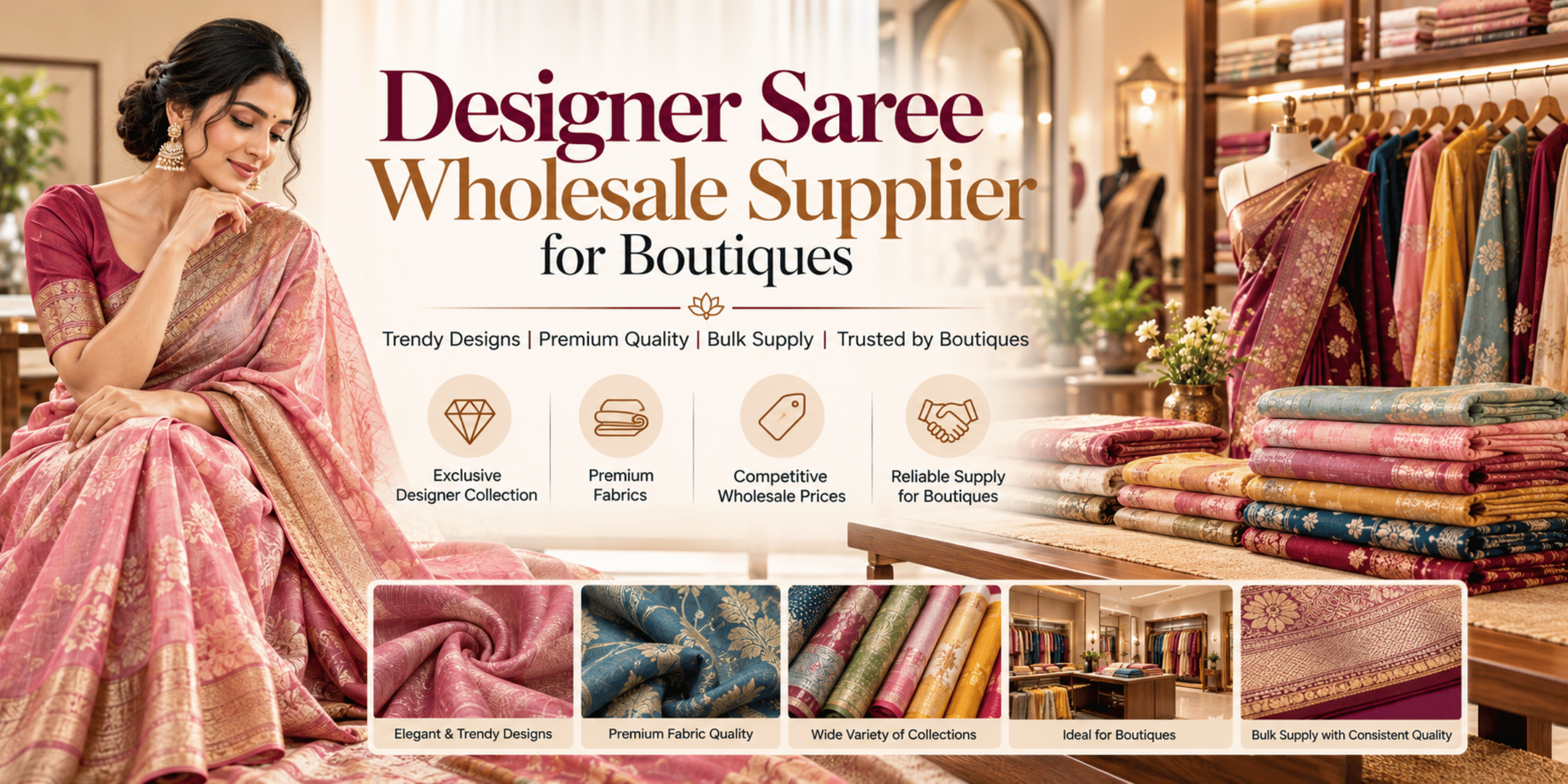
Designer Saree Wholesale Supplier for Boutiques
Finding the right Designer Saree Wholesale Supplier for Boutiques is an important step for fashion businesses that want to build attractive, profitable, and distinctive saree collections. Boutiques often need products that offer more design value than mass-market fashion while still providing practical wholesale pricing, consistent quality, flexible quantities, and reliable sourcing. Indian sarees are particularly suitable for boutique collections because they are available in a wide variety of fabrics, colors, prints, embroidery styles, borders, embellishments, and traditional or contemporary designs.
Fashionexport helps businesses explore Indian fashion and wholesale ethnic-wear opportunities through its online platform, Fashionexport. Boutique owners and fashion retailers can use Fashionexport as a starting point when researching Indian saree collections for their stores, ecommerce businesses, and international customers. Instagram can also be useful for discovering new saree designs, styling inspiration, collection launches, product photography, and visual fashion trends.
A Designer Saree Wholesale Supplier for Boutiques can provide different saree categories according to the boutique's customer profile. These may include designer sarees, embroidered sarees, printed sarees, party wear sarees, festive sarees, wedding sarees, lightweight sarees, contemporary sarees, and traditional-inspired collections. Having multiple categories allows boutique owners to create an assortment that appeals to different occasions and customer preferences.
Fabric selection is another major consideration. Georgette, chiffon, crepe, organza, satin, cotton, rayon, viscose, silk blends, and other fabrics can offer different levels of comfort, appearance, drape, and pricing. Boutique owners can select fabrics according to their target customers, climate, season, and retail positioning.
Quality consistency is especially important for boutiques because customers often associate product quality with the reputation of the store. Buyers should evaluate fabric quality, stitching, embroidery, print accuracy, borders, finishing, measurements, and packaging before placing large wholesale orders. Samples can help boutique owners understand the actual product before committing to inventory.
Customization and private labeling can provide additional opportunities for boutique businesses. A boutique may want particular colors, embroidery patterns, packaging, labels, or exclusive designs that match its brand identity. Working with a suitable supplier can make it easier to develop collections that are more distinctive than standard wholesale products.
Boutique owners should also consider minimum order quantities, pricing, production timelines, packaging, shipping, and reorder availability. These factors influence the total cost and profitability of a collection.
A strong boutique saree collection should balance trend-driven products with dependable bestsellers. New designs can attract attention, while classic colors and versatile styles can support repeat sales. Retailers can use sales data, customer feedback, Instagram engagement, and seasonal demand to determine which products should be reordered.
For boutiques, choosing a Designer Saree Wholesale Supplier for Boutiques is therefore not simply about finding the lowest price. It is about finding a sourcing partner that can provide suitable designs, dependable quality, reasonable wholesale terms, customization options, and consistent communication.
Fashionexport provides an online platform for businesses interested in Indian ethnic fashion and wholesale sourcing. Boutique owners can explore product possibilities, identify suitable collections, and develop a purchasing strategy based on their target customers and market.
With careful supplier selection, product planning, sample evaluation, and effective merchandising, Indian designer sarees can become an important part of a boutique's product range. A well-planned collection can help boutiques offer customers distinctive Indian fashion while maintaining a practical wholesale-to-retail business model.
Boutique fashion businesses need more than attractive products to build a successful saree collection. They need dependable sourcing, effective inventory planning, strong merchandising, consistent quality, and a clear understanding of their customers. Working with a suitable Designer Saree Wholesale Supplier for Boutiques can help simplify these areas and give boutique owners greater control over their product assortment.
A boutique may begin with a small selection of designer sarees and gradually expand based on customer demand. Over time, sales information can reveal which colors, fabrics, designs, and price ranges perform best. This information can then be used to improve future wholesale purchasing decisions.
Inventory planning is one of the most important parts of wholesale fashion retail.
A boutique should avoid purchasing large quantities simply because a product looks attractive. Instead, buying decisions should consider customer demand, previous sales, seasonal opportunities, available budget, storage capacity, and expected turnover.
A practical inventory plan can divide products into:
Bestsellers should generally receive priority for replenishment, while experimental products can be purchased in smaller quantities until customer response becomes clearer.
Overstock can reduce cash flow and occupy valuable storage space.
Boutique owners can reduce overstock risk by:
The goal is not simply to have a large inventory. The goal is to maintain an inventory that supports sales.
A boutique can track several indicators to identify strong-performing products.
These include:
For example, if a particular embroidered saree receives high engagement on Instagram and sells quickly in the store, the boutique may consider purchasing similar designs or reordering the same product.
New collections can create excitement, but they should be introduced strategically.
A boutique can launch new products through:
Instead of releasing a large collection without preparation, the boutique can build anticipation before the products become available.
Merchandising influences how customers perceive a collection.
A boutique can organize sarees by:
For example, a wedding section could feature richly embellished sarees, while a contemporary section could include lightweight fabrics and modern prints.
Clear organization can help customers browse more easily.
A strong boutique should aim to develop a recognizable product identity.
This can involve selecting a consistent combination of:
Over time, customers may begin to associate these characteristics with the boutique.
A Designer Saree Wholesale Supplier for Boutiques can support this strategy when the supplier is able to provide suitable designs and customization possibilities.
Boutiques may want products that are not widely available in competing stores.
Exclusive designs can be developed through:
Exclusivity can be particularly valuable for boutique businesses because it reduces direct product comparison with mass-market retailers.
Private labeling can help a boutique transition from being a reseller of wholesale products to developing its own fashion identity.
A private-label saree program may include:
Before starting a private-label project, the boutique should clearly define its brand positioning and target customer.
A structured private-label process can include:
Identify the target age group, lifestyle, purchasing power, and preferred occasions.
Choose the number of designs, fabrics, colors, and price categories.
Review samples and provide feedback before bulk production.
Confirm fabric, measurements, colors, embroidery, labels, and packaging.
Finalize quantity and production requirements.
Create photographs, videos, website content, and social media campaigns.
This approach can make the launch more organized.
Packaging should protect the product while also supporting the boutique's brand image.
Depending on the business model, packaging may include:
Premium packaging may be useful for high-end boutique collections, while simple protective packaging can be appropriate for value-focused products.
Boutiques increasingly need to think about packaging waste.
Where appropriate, businesses can explore packaging materials that reduce unnecessary plastic or excessive layers.
However, packaging decisions should balance sustainability with product protection, especially for international shipments where products may travel long distances.
Boutiques outside India may source Indian sarees to serve customers interested in ethnic, cultural, occasion, and contemporary fashion.
International boutique buyers should consider additional factors such as:
A supplier experienced with international buyers can make communication more straightforward.
The relationship between a boutique and supplier should be based on clear communication.
Before ordering, the buyer should provide information about:
The supplier can then provide information about availability, pricing, MOQ, production, and other relevant requirements.
Communication should continue after the order is confirmed.
Boutiques may need updates regarding:
Clear communication can reduce unexpected issues and help the buyer plan inventory arrival.
If a boutique identifies a quality problem, it should document the issue clearly.
Useful information can include:
Clear documentation makes it easier for both sides to understand the issue and discuss an appropriate solution.
A successful product should not be treated as a one-time opportunity.
Boutiques can create a reorder list containing:
This information makes future purchasing faster and more accurate.
A boutique can divide products into three groups:
High-performing: Reorder regularly.
Moderate-performing: Monitor and reorder according to demand.
Low-performing: Reduce future purchasing or discontinue.
This system helps align inventory with actual customer behavior.
Customers can provide valuable information that sales numbers alone cannot reveal.
Boutiques can ask customers about:
Feedback can then be shared with the supplier when developing future collections.
Instagram can become an important part of a boutique's marketing strategy.
A boutique can create content around:
Short-form video can be especially useful for showing how a saree moves and looks when worn.
Reels can show details that static images cannot communicate as effectively.
A reel can demonstrate:
Boutiques can also create series such as “New Sarees This Week” or “Three Ways to Style a Designer Saree.”
Boutiques can collaborate with fashion creators whose audiences match their target customers.
Potential collaborations may focus on:
The best partnerships are based on audience relevance rather than follower count alone.
A boutique selling sarees online should make the website easy to navigate.
Useful categories can include:
Product filters can include:
This structure helps customers reach relevant products more quickly.
Every saree product page should answer common buyer questions.
Important information includes:
Accurate information can improve customer confidence and reduce unnecessary inquiries.
Boutiques can create content around both transactional and informational search terms.
Commercial keywords can include:
Informational topics can include:
Combining product pages with useful educational content can create a stronger search presence.
A physical boutique should also optimize for local searches.
Useful information can include:
Local SEO can help customers discover the boutique when searching for sarees in their area.
AI-powered search systems can better understand pages that provide direct, structured information.
Boutique websites can use clear headings and concise answers.
For example:
What is a designer saree?
A designer saree is a saree developed with distinctive design elements such as specialized prints, embroidery, embellishments, premium fabrics, or contemporary styling.
Who buys designer sarees?
Designer sarees can be purchased for weddings, parties, festivals, celebrations, formal occasions, and premium everyday styling.
Can boutiques purchase designer sarees wholesale?
Yes, boutiques can source designer sarees through wholesale suppliers, subject to product availability, MOQ, pricing, and supplier terms.
This format makes information easy for customers and search systems to interpret.
Seasonal content can support both SEO and sales.
Boutiques can publish content around:
Each article can link naturally to relevant product categories.
Boutique websites can strengthen their online visibility by earning relevant backlinks.
Potential opportunities include:
The quality and relevance of links matter more than simply obtaining a large number of backlinks.
International boutiques should consider their complete landed cost when sourcing Indian sarees.
The calculation can involve:
Product Cost + Shipping + Applicable Duties/Taxes + Packaging + Other Costs = Estimated Landed Cost
Understanding this number helps the retailer establish a realistic selling price.
The exact import charges can vary by destination, product classification, and local regulations, so buyers should confirm applicable requirements for their market.
International buyers may purchase products using currencies different from the supplier's domestic pricing currency.
Boutiques should account for exchange-rate movements when preparing budgets.
It can be useful to maintain a purchasing budget with some flexibility rather than assuming that currency rates will remain unchanged.
Once a boutique has established a successful saree collection, it can expand into complementary categories.
Possible additions include:
This allows customers to discover more complete ethnic-fashion options.
A boutique can increase average order value by recommending complementary products.
For example, a saree product page can suggest:
Cross-selling can make the shopping experience more useful while increasing the value of each purchase.
A boutique should regularly review the performance of its saree collection.
Useful measurements include:
The results can be compared across fabrics, colors, price ranges, and product categories.
Slow-moving inventory should be identified early.
Possible strategies include:
The objective is to recover inventory value while maintaining a strong customer experience.
A reliable Designer Saree Wholesale Supplier for Boutiques can become an important part of a boutique's growth strategy.
A productive relationship depends on:
Both buyer and supplier benefit when expectations are communicated clearly.
Instead of waiting until inventory becomes low, boutique owners can discuss future collections in advance.
They can share information about:
This can help the supplier understand the boutique's long-term requirements.
Fashionexport provides a platform for businesses exploring Indian ethnic fashion and wholesale sourcing.
Boutique owners can visit Fashionexport to explore Indian fashion products and identify potential sourcing opportunities.
For boutiques, the ideal supplier is one that aligns with the store's product positioning, target audience, quality expectations, and purchasing requirements.
Fashionexport can be considered as part of the research process for businesses looking to source Indian ethnic fashion for their collections.
Boutiques should evaluate design variety, fabric quality, MOQ, pricing, samples, customization, packaging, communication, production capability, and consistency.
There is no universal ideal MOQ. Smaller boutiques may prefer lower quantities per design, while larger stores may benefit from volume purchasing. The appropriate MOQ depends on the boutique's sales volume and available inventory budget.
Customization may be possible for colors, fabrics, prints, embroidery, borders, labels, packaging, and other specifications depending on the supplier.
Yes. Designer sarees can work well for ecommerce because they are visually distinctive and can be promoted through product photography, video, social media, and search marketing.
Boutiques can use reels, styling videos, product photography, new-arrival posts, customer content, influencer collaborations, festival campaigns, and behind-the-scenes videos.
This can be a useful strategy for testing customer response, particularly for new collections. However, the ideal purchasing strategy depends on the boutique's customer base and historical sales.
Samples allow buyers to evaluate actual fabric, color, finishing, embroidery, measurements, and overall product quality before committing to a larger quantity.
Yes, private-label collections can be developed when the supplier supports customized branding and the boutique meets the required order quantities and specifications.
Boutiques can reduce dead stock through smaller test orders, sales tracking, seasonal planning, customer feedback, timely promotions, and reordering proven products instead of purchasing excessive quantities.
A successful boutique saree business depends on the quality of its collection and the strength of its sourcing strategy. The right Designer Saree Wholesale Supplier for Boutiques can help boutique owners access diverse Indian fashion designs while supporting wholesale purchasing, customization, private labeling, and repeat collection development.
Boutiques should focus on understanding their customers before placing orders. Fabric, design, color, price, occasion, and quality should all match the expectations of the target market.
Inventory should be managed using actual sales information, while successful products should be prioritized for reordering. New designs can be introduced in controlled quantities so that boutiques can measure customer response before making larger investments.
Digital marketing also plays an important role. Instagram provides an effective visual platform for showcasing sarees, while ecommerce websites can provide detailed product information and support online purchasing. SEO content can help boutiques reach customers searching for specific saree styles, fabrics, occasions, and collections.
For businesses sourcing from India, supplier communication is equally important. Clear specifications, sample approvals, packaging requirements, production timelines, and order records can create a smoother purchasing process.
Fashionexport offers an online starting point for businesses exploring Indian fashion and wholesale sourcing. Boutique owners can research collections, identify suitable products, and develop sourcing plans based on their market requirements.
Ultimately, the best Designer Saree Wholesale Supplier for Boutiques is not simply the supplier offering the lowest wholesale price. It is the supplier that can consistently support the boutique's product vision, quality expectations, purchasing requirements, and long-term growth.
With thoughtful collection planning, careful supplier selection, effective merchandising, Instagram marketing, ecommerce optimization, and data-driven inventory management, boutiques can build a strong saree business that combines Indian fashion with modern retail opportunities.