
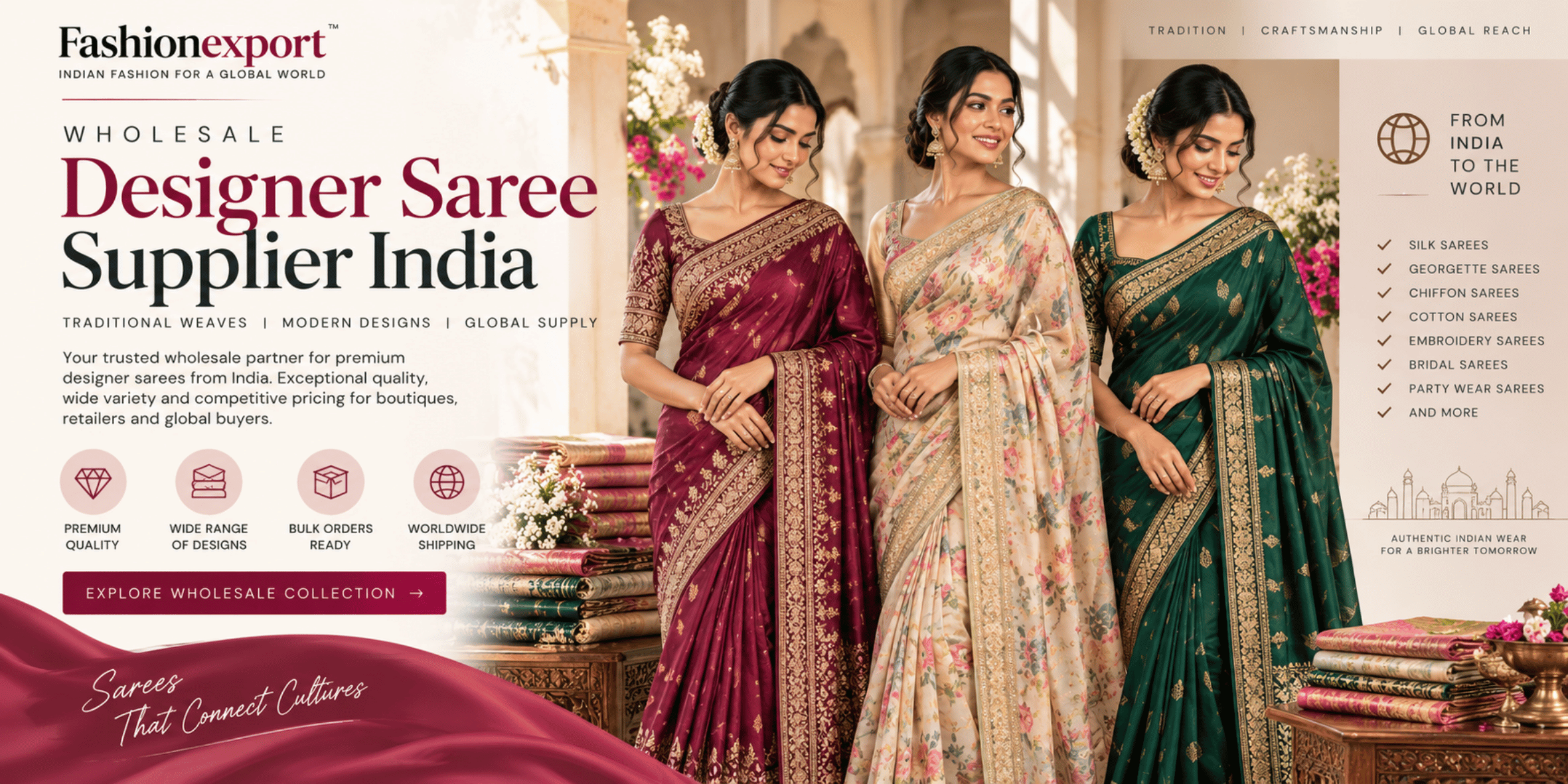
Fashion retailers, boutiques, wholesalers, importers, online stores, and international fashion businesses are increasingly looking toward India for distinctive ethnic fashion collections. Fashionexport provides an Indian fashion sourcing option for businesses searching for quality-oriented clothing collections and reliable wholesale opportunities. If you are researching a Wholesale Designer Saree Supplier India, understanding product quality, fabrics, designs, customization, pricing, sourcing, and export requirements can help you make better purchasing decisions. You can explore the Fashionexport website at Fashionexport to learn more about Indian fashion sourcing and wholesale clothing opportunities.
Designer sarees have an important place in the Indian fashion industry because they combine traditional silhouettes with modern fabrics, colors, embellishments, prints, embroidery, and styling. For international retailers, they can also provide an opportunity to introduce Indian fashion to customers looking for distinctive occasion wear and ethnic clothing.
A Wholesale Designer Saree Supplier India is a business that supplies designer sarees in wholesale quantities to retailers, boutiques, distributors, resellers, importers, online stores, and other fashion businesses. Unlike individual retail purchasing, wholesale sourcing focuses on commercial quantities, product consistency, pricing, collection development, and ongoing supply.
A wholesale supplier may offer ready-made collections or work with buyers on customized designs. Depending on the supplier's capabilities, buyers may be able to discuss fabrics, colors, embellishments, prints, borders, blouse pieces, packaging, labels, and other product specifications.
For a retailer, working directly with a supplier can simplify the process of building a saree collection. Instead of purchasing random individual products, buyers can develop coordinated assortments containing multiple colors, designs, fabric types, and price points.
India has a long-established textile and apparel ecosystem with expertise in weaving, dyeing, printing, embroidery, embellishment, garment finishing, and fashion production. Sarees are an important part of this ecosystem.
For international buyers, India can offer access to a wide variety of traditional and contemporary saree styles. A sourcing partner can help buyers identify products suitable for different markets and customer segments.
Indian sarees can be positioned for several retail categories, including:
The broad variety allows businesses to create collections that are not limited to one customer profile.
A diverse Wholesale Designer Saree Supplier India can offer several design categories to help buyers create a balanced inventory.
Embroidery can transform a simple saree into an occasion-focused fashion product. Depending on the design, embroidery may be concentrated around the border, pallu, blouse piece, or throughout the saree.
Embroidered sarees can be suitable for wedding events, festive celebrations, receptions, parties, and boutique collections.
Printed sarees can provide an affordable way to introduce attractive patterns and colors into a wholesale collection. Floral, geometric, abstract, traditional, contemporary, and digital-inspired prints can appeal to different customer groups.
Printed designs can also be useful for retailers seeking everyday or semi-formal products.
Party wear sarees often focus on attractive fabrics, elegant embellishments, modern colors, shimmer effects, sequins, embroidery, or statement borders.
Retailers can position these products for customers shopping for birthdays, celebrations, receptions, festive parties, and evening occasions.
Festive collections can include vibrant colors, traditional motifs, decorative borders, embroidery, prints, and embellishments. These products can be promoted around cultural celebrations and seasonal shopping periods.
Contemporary sarees combine the traditional saree format with modern colors, fabrics, prints, styling, or minimal detailing. These designs can appeal to younger customers and fashion-conscious shoppers.
Fabric is one of the most important factors when evaluating a wholesale saree collection. The fabric influences appearance, drape, comfort, weight, durability, and perceived value.
Georgette is popular for lightweight fashion sarees. It can provide a flowing drape and works well with embroidery, prints, embellishments, and contemporary designs.
Chiffon is lightweight and creates an elegant drape. It is frequently associated with party wear, evening styles, and feminine fashion collections.
Crepe fabrics can provide a smooth and structured appearance. Depending on the construction, crepe sarees can work across casual, semi-formal, and occasion-focused categories.
Satin creates a smooth and visually polished appearance. Satin sarees can be positioned toward party wear and contemporary fashion collections.
Silk and silk-blend fabrics can provide a more traditional or premium appearance. These fabrics are often considered for festive, wedding, and special-occasion collections.
Rayon and viscose can provide soft drape and comfort. These fabrics can be suitable for commercially priced fashion sarees.
Cotton sarees can appeal to customers looking for breathable and comfortable clothing. Cotton blends can combine comfort with additional styling characteristics.
Organza has a lightweight and structured appearance. It can create an elegant silhouette and is often used in contemporary and occasion-focused collections.
Color selection can influence the commercial performance of a saree collection. A retailer should consider both evergreen colors and seasonal fashion shades.
Classic colors such as black, white, red, navy, maroon, green, beige, cream, and pink can provide dependable options. Meanwhile, pastel shades, jewel tones, metallic colors, muted neutrals, and seasonal shades can help create a more contemporary assortment.
A wholesale buyer should avoid building an entire collection around one color family. Instead, a balanced assortment can contain:
This approach gives retailers greater flexibility when merchandising their products.
Embellishment can significantly change the appearance and positioning of a designer saree.
Common decorative techniques and elements may include:
Buyers should evaluate embellishment quality carefully. Decorative elements should be securely attached and consistently finished throughout the product.
Borders can create a strong visual identity for a saree. A minimal border may create a contemporary appearance, while a wide decorative border can create a more traditional or festive look.
Retailers can maintain variety by combining narrow borders, broad borders, contrast borders, embroidered borders, printed borders, metallic detailing, and minimal edge finishing.
A successful wholesale collection should reflect the customers a retailer serves.
Boutiques often require visually distinctive designs that help differentiate their collections. Limited-edition colors, detailed embroidery, unusual prints, and contemporary silhouettes may be suitable for boutique merchandising.
Online stores need products that photograph well and communicate their value through digital presentation. Sarees with visible detailing, strong color contrast, and attractive draping can work effectively in ecommerce catalogs.
Retailers specializing in traditional Indian clothing may focus more heavily on classic fabrics, traditional colors, decorative borders, embroidery, and culturally inspired patterns.
International retailers may require a combination of traditional aesthetics and contemporary styling. Lightweight fabrics and easy-to-style designs can be attractive for customers who are new to sarees.
When purchasing from a Wholesale Designer Saree Supplier India, buyers should think about the complete collection rather than individual products.
A commercial collection can contain different price levels, fabrics, colors, embellishment levels, and occasions.
For example, a retailer could create three broad groups:
Entry-level collection: Simple fabrics, printed designs, minimal embellishment, and accessible pricing.
Mid-range collection: Better detailing, embroidery, premium fabrics, and more elaborate borders.
Premium collection: Detailed embroidery, luxury fabrics, statement embellishments, and occasion-focused designs.
This structure allows a retailer to serve customers with different budgets.
Inventory planning is important because saree demand can vary according to season, location, customer preferences, and marketing strategy.
Instead of purchasing excessive quantities of every design, buyers can analyze previous sales and identify their strongest categories.
Important questions include:
These insights can help buyers create more focused wholesale orders.
Minimum order quantity, or MOQ, is an important consideration when selecting a supplier.
MOQ can vary depending on the product, customization level, fabric, embroidery, packaging, and production requirements. Buyers should clarify MOQ before confirming an order.
For customized products, the MOQ may be different from ready-stock products because customization can require additional production planning.
A buyer should discuss:
Clear communication at this stage can reduce misunderstandings.
Samples are particularly important for customized or high-value wholesale orders.
A buyer can use samples to assess:
Once the sample is approved, buyers should maintain a clear record of the approved specifications.
Quality control is essential for wholesale fashion businesses because product inconsistencies can lead to customer complaints and returns.
A supplier should inspect products for visible defects before dispatch.
Important quality checks include fabric condition, color consistency, print alignment, embroidery placement, loose threads, border finishing, embellishment attachment, stains, tears, stitching, and packaging.
For international buyers, consistent quality becomes even more important because returning or replacing products can be more complicated.
Designer sarees should be packed appropriately to protect them during storage and transportation.
Depending on the product, packaging may include protective bags, folding, individual packaging, outer cartons, labels, product tags, or customized branding.
International buyers should discuss packaging requirements before production, particularly when products will be shipped across long distances.
Some retailers want to sell sarees under their own brand rather than the supplier's name. Private labeling can help businesses build a distinct market identity.
A private-label project may involve:
Availability depends on the supplier and order requirements, so buyers should discuss private-label expectations before placing an order.
Customization can help retailers develop collections that are different from mass-market products.
A retailer may want to customize:
When working on a custom collection, clear specifications are important. Reference images, color references, measurements, fabric requirements, and finishing details can help reduce communication problems.
Fashion demand changes throughout the year. Retailers can plan collections around weddings, festivals, holidays, summer fashion, winter events, party seasons, and regional celebrations.
A seasonal buying strategy can help businesses avoid purchasing large quantities of products that become difficult to sell after the relevant season.
For example, lighter colors and breathable fabrics may be promoted for warm-weather collections, while richer colors and embellished designs may be positioned for festive and wedding seasons.
A Wholesale Designer Saree Supplier India should be able to communicate product details clearly with buyers.
International sourcing can involve differences in terminology, measurements, currencies, shipping expectations, and product specifications. Clear communication can reduce errors.
Before ordering, buyers should clarify:
Keeping specifications in written form can make the process easier to manage.
Fashionexport can be considered by businesses looking for Indian fashion sourcing and wholesale clothing opportunities. Buyers interested in developing saree collections can explore available product categories and discuss their business requirements with the company.
The objective of a professional sourcing relationship should be to create a clear process from product selection through order fulfillment.
For retailers, this can include identifying suitable products, reviewing samples, confirming specifications, planning quantities, preparing packaging, and organizing delivery.
Instagram has become an important visual platform for fashion businesses. Sarees are particularly suitable for visual marketing because their colors, fabrics, embroidery, borders, and draping styles can be demonstrated through photographs and videos.
Retailers can use Instagram to showcase:
Short-form video can also demonstrate how a saree moves and drapes, which static product images cannot always communicate effectively.
Good product photography can increase the perceived value of designer sarees.
A product listing can include:
Consistent photography across a collection makes an ecommerce store look more professional.
Search engine optimization can help fashion businesses reach buyers who are actively searching for wholesale products.
Useful keyword themes can include:
Content should answer buyer questions clearly instead of repeatedly inserting keywords without context.
Modern search results increasingly rely on content that directly answers user questions.
For a wholesale saree website, useful content should explain:
Clear headings, short paragraphs, descriptive lists, FAQs, and direct answers can make information easier for search engines and users to understand.
The international demand for Indian ethnic fashion creates opportunities for boutiques, wholesalers, ecommerce businesses, distributors, importers, and fashion retailers looking for distinctive products. A reliable Wholesale Designer Saree Supplier India can help businesses develop collections that combine traditional Indian aesthetics with contemporary fashion preferences. For companies entering the Indian saree market, the objective should not simply be to purchase attractive products, but to develop a commercially balanced collection with suitable fabrics, colors, designs, quality standards, pricing, packaging, and supply planning.
Indian sarees appeal to customers for different reasons. Some customers purchase them for weddings and cultural celebrations, while others are attracted by their distinctive craftsmanship, colors, fabrics, embroidery, and styling possibilities.
International retailers can position designer sarees toward several customer groups:
A retailer does not necessarily need to target only customers who already understand traditional sarees. Contemporary product photography, styling information, blouse suggestions, and simple educational content can help introduce sarees to new customers.
A Wholesale Designer Saree Supplier India can offer a wide range of designs, but international buyers should select products according to their specific customer base.
For example, a boutique serving customers who prefer minimal fashion may focus on lightweight fabrics, subtle embroidery, pastel colors, and contemporary prints. Another retailer specializing in weddings may require heavily embellished sarees, richer colors, detailed embroidery, and premium fabrics.
Before purchasing, buyers should define their target market.
Consider:
This information can make wholesale buying more strategic.
Pricing is one of the most important considerations when sourcing designer sarees.
The wholesale price can depend on several factors, including:
A buyer should compare products based on complete specifications rather than price alone.
Two sarees may look similar in photographs while having different fabric quality, embroidery density, finishing, packaging, or production standards.
International buyers should calculate their complete landed cost rather than considering only the supplier's wholesale price.
Potential cost components can include:
Understanding the complete cost structure helps retailers establish realistic selling prices.
A strong wholesale saree collection does not have to consist entirely of premium products.
Retailers can create a tiered assortment.
This category can focus on attractive designs, simpler fabrics, prints, minimal detailing, and accessible price points.
This category can include better fabrics, embroidery, decorative borders, and additional finishing.
Premium products can feature detailed embroidery, elaborate embellishment, premium fabrics, statement borders, and occasion-focused designs.
A mixed collection allows businesses to serve customers with different budgets.
Private labeling can help a retailer create a distinct identity.
When working with a Wholesale Designer Saree Supplier India, buyers interested in private labeling should discuss branding requirements at the beginning of the project.
Private-label requirements can include:
Not every supplier offers identical private-label services, so buyers should confirm available options before placing a production order.
Some fashion businesses want products that are not identical to what competitors are selling.
An exclusive collection may be developed through:
Exclusivity should be discussed clearly because the commercial meaning of an "exclusive" product can vary. Buyers should define whether exclusivity applies to a design, color, market, region, customer, or period.
Custom saree production should normally begin with clear specifications and sample development.
A buyer can provide:
The supplier can then develop the product according to the agreed specifications.
Once the buyer approves a sample, the approved version should be used as a reference for bulk production.
Color consistency is particularly important when retailers order the same product repeatedly.
Differences can occur due to fabric batches, dyeing processes, lighting, photography, and screen settings.
For commercial orders, buyers should communicate color requirements clearly and use physical samples or standardized references where appropriate.
Product photography should also be created under consistent lighting conditions so customers see a reasonably accurate representation of the product.
For certain fabrics, buyers may want more technical specifications rather than relying only on photographs.
Depending on the material, useful information can include:
A professional buyer should ask for the specifications relevant to the product category.
A Wholesale Designer Saree Supplier India should have a suitable quality-control process for bulk orders.
Quality inspection can include checking:
The exact inspection process can vary according to the supplier and product.
Lead time should be discussed before confirming an order.
Ready-stock products may have different availability compared with customized or made-to-order products.
Production time can be influenced by:
International buyers should also allow time for transportation and customs processing.
Fashion retailers need to consider when products will arrive, not simply when they are ordered.
A collection intended for a major festive season should be planned well in advance.
A seasonal buying calendar can include:
This timeline can reduce last-minute pressure.
Wedding fashion can create opportunities for designer saree retailers.
A wedding-oriented collection can include:
Retailers can also organize collections according to wedding functions such as engagement events, receptions, ceremonies, and evening celebrations.
Festive collections can emphasize color, traditional inspiration, embroidery, prints, and decorative details.
A retailer can create dedicated online categories for festive sarees and promote them through social media, email marketing, search optimization, and seasonal campaigns.
Instagram can be particularly useful for showing complete festive looks rather than simply displaying folded sarees.
For online retailers, product merchandising is as important as product sourcing.
Each saree listing should communicate essential information clearly.
Useful product information can include:
High-quality product information can reduce uncertainty for online customers.
Instagram can help fashion businesses showcase their products visually.
A retailer can create different content formats around the same saree.
For example:
Post: Full product image.
Reel: Saree draping or styling video.
Carousel: Fabric, border, pallu, blouse, and close-up details.
Story: New-arrival announcement.
Highlight: Saree collection, fabrics, festive wear, or customer reviews.
This creates multiple opportunities to promote one product.
Short-form videos can show details that are difficult to communicate through a single image.
A reel can demonstrate:
Retailers can also use models or mannequins depending on their brand strategy.
A Wholesale Designer Saree Supplier India can also support retailers through product-focused content and search-friendly descriptions.
Useful content topics include:
Such content can attract customers at different stages of the buying journey.
Internal links help connect related pages on an ecommerce or wholesale website.
A saree article can link to:
For Fashionexport, relevant internal links can help visitors move from informational content toward product and business information.
Search engines and AI-powered search experiences benefit from clearly organized information.
A wholesale saree article can use:
Instead of writing vague promotional statements, businesses should explain what they offer and how buyers can use the information.
For example, a direct answer to "What should buyers check before ordering wholesale sarees?" can mention fabric, quality, MOQ, customization, pricing, lead time, packaging, and shipping.
Sustainability has become an important consideration for many fashion businesses.
Retailers may ask suppliers about:
The specific sustainability practices available will depend on the manufacturer and production process.
Rather than making unsupported environmental claims, businesses should communicate only verified product and manufacturing information.
International shipments can travel through multiple stages before reaching a retailer.
Suitable packaging can help protect products from:
Buyers should discuss packaging requirements before dispatch, especially for premium collections.
If a retailer uses branded packaging, packaging specifications should be finalized before bulk production.
International buyers should discuss applicable documentation with their supplier and logistics provider.
Depending on the transaction and destination, documentation requirements can vary.
Potential documents may include commercial invoices, packing information, shipping documents, and other export or customs paperwork.
Because import regulations differ by destination, buyers should confirm requirements with the relevant customs authorities or professional logistics partners.
A single successful order does not necessarily establish a strong supplier relationship.
Long-term partnerships can develop through:
A retailer should evaluate supplier performance over multiple orders where possible.
Buyers can reduce sourcing problems by avoiding several common mistakes.
The lowest quotation may not provide the best commercial value if fabric quality, finishing, packaging, or consistency is lower.
For customized products, skipping sample approval can increase the risk of receiving products that do not match expectations.
MOQ should be understood before planning the collection.
Terms such as "premium quality" can mean different things to different businesses. Specific product requirements are more useful.
A collection with excessive duplication can make merchandising difficult.
International buyers should calculate total landed costs.
Even high-quality sarees can perform poorly online if photographs do not show fabric, color, embroidery, and styling clearly.
When evaluating a Wholesale Designer Saree Supplier India, buyers can create a practical checklist.
Does the supplier offer enough variety for your target market?
Are fabric, stitching, embroidery, and finishing consistent?
Can the supplier accommodate your required colors, designs, labels, or packaging?
Can the supplier handle your expected order quantities?
Are specifications, pricing, timelines, and requirements communicated clearly?
Can products be packaged appropriately for your market?
If you are an international buyer, can the supplier support your required export process?
Can successful products be reproduced consistently?
A retailer does not always need hundreds of different products.
A focused core collection can be easier to manage.
For example, a business might begin with:
Sales data can then guide future purchasing decisions.
Once a retailer identifies successful products, the business can expand around those categories.
If lightweight sarees perform well, the retailer may add more colors and prints.
If embroidered sarees receive strong demand, the business may expand the embroidery range.
If customers prefer particular colors, those shades can become part of future collections.
This data-driven approach can reduce unnecessary inventory risk.
Sarees can be marketed alongside other Indian clothing categories.
A retailer may create collections that include:
Cross-selling can help increase the number of products customers explore.
Boutiques can organize sarees according to customer needs instead of displaying products only by supplier or collection number.
Possible categories include:
This organization can make shopping easier.
Online retailers can create filters based on:
Clear filters help customers narrow large collections.
Customers unfamiliar with Indian sarees may need additional information.
A retailer can explain:
Educational content can improve customer confidence.
Trust is important in B2B fashion sourcing.
A retailer or importer should expect clear product information and professional communication.
Suppliers can support trust by providing:
Buyers can also help by providing complete specifications and realistic requirements.
Fashionexport can serve businesses exploring Indian fashion sourcing and wholesale opportunities. Buyers interested in designer sarees can use the company website to learn more about its fashion offerings and determine whether its capabilities align with their sourcing requirements.
For a growing fashion business, the objective should be to establish a sourcing process that can support both initial orders and future collection development.
A supplier relationship can become more valuable when product selection, sampling, quality control, customization, packaging, and repeat ordering are handled systematically.
The designer saree category can continue evolving as traditional Indian fashion interacts with contemporary global styling.
Future collections may combine:
This creates opportunities for retailers to position sarees for both traditional and modern customers.
Look at product quality, fabric options, design variety, customization, MOQ, pricing, production capacity, packaging, communication, and delivery requirements.
Customization may be possible depending on the supplier. Buyers should discuss fabric, color, embroidery, borders, labels, packaging, and minimum quantities before placing an order.
Yes, designer sarees can be positioned for international boutiques serving customers interested in Indian fashion, ethnic wear, weddings, cultural events, and contemporary occasion wear.
There is no universal quantity. The appropriate order depends on the retailer's budget, customer base, storage capacity, sales expectations, MOQ, and collection strategy.
Depending on the collection, fabrics can include georgette, chiffon, crepe, satin, silk blends, rayon, viscose, cotton blends, organza, and other fashion textiles.
Private-label opportunities may be available depending on the supplier and order requirements. Buyers should discuss labels, packaging, tags, and customization before production.
Instagram can showcase product photography, fabric details, embroidery, draping videos, styling ideas, new arrivals, festive collections, and customer looks.
Buyers should provide product references, quantities, fabric preferences, colors, design requirements, packaging specifications, branding requirements, delivery expectations, and other relevant details.
Before placing a wholesale designer saree order, buyers can review the following checklist:
Choosing a Wholesale Designer Saree Supplier India is an important step for businesses that want to develop a reliable Indian ethnic fashion collection. The right sourcing process involves much more than finding attractive designs. Buyers should evaluate fabric, quality, colors, embellishment, pricing, MOQ, customization, packaging, production, communication, and delivery requirements.
Fashionexport gives retailers, wholesalers, boutiques, and international fashion businesses an opportunity to explore Indian fashion sourcing. By combining a suitable product assortment with professional merchandising, strong photography, Instagram marketing, SEO content, and careful inventory planning, businesses can build a more organized saree collection.
For international buyers, successful sourcing begins with understanding the target customer and selecting products that match market demand. A balanced collection can include affordable everyday options, contemporary designs, festive sarees, party wear, embroidered styles, and premium occasion pieces.
A long-term approach is particularly valuable. Rather than treating every purchase as a separate transaction, retailers can analyze sales performance, identify successful colors and fabrics, refine their collections, and develop repeat orders around proven products.
Ultimately, the Wholesale Designer Saree Supplier India you choose should align with your product requirements, quality expectations, commercial model, and future growth plans. Clear communication and detailed specifications can help both buyers and suppliers build a smoother sourcing process.
Indian designer sarees offer extensive possibilities for boutiques, ecommerce stores, wholesalers, importers, distributors, and fashion brands. With thoughtful collection planning and a reliable sourcing strategy, businesses can present Indian sarees to customers through physical stores, online marketplaces, ecommerce websites, and visual platforms such as Instagram.
Fashionexport can be part of that sourcing journey for businesses exploring Indian clothing and wholesale fashion opportunities. Buyers can visit the Fashionexport website to explore its offerings and identify potential opportunities for developing their next Indian fashion collection.